








By Narayan Prasad Mishra
Most people know that education is the backbone of creating a well-cultured, disciplined, and educated society and is very important for developing a country. Therefore, developed as well as underdeveloped countries emphasize education and invest a lot of money in it. Our country is poor. Because of this, we have not been able to invest as much in education and research as the developed countries have been doing, even though we have invested a lot of money in education from our poor treasury. We all think even a rupee of our investment should not be wasted.

Despite this wish and desire, our invested money does not seem to produce satisfactory results in quality education or a high pass percentage. On August 12, 2023, the results of Grade 12 of the National Education Board were out, and just 51 percent of the students earned passing grades. Almost half of those who appeared for the exams have been disqualified from upgrading to the university level. If we take the pass percentage of higher education in Nepal (Bachelor and Master level), we find it even much lower than in secondary education. According to the statistics in a Google search, the percentage of some years of passing in higher education in Nepal seems to be 18% to 30%. Not only is the passing percentage, the standard of our education is also not satisfactory enough to compete with other countries. As a result, many of our students who are well enough economically go to other countries to study and settle there after education. That is a significant loss to us.
 Undoubtedly, we can say that the prime reason for our educational institutions’ unsatisfactory performance and the downfall of our education is the politics in education. Our educational institutions are politicized in such a way that they look more like political centers rather than educational centers. There is more political environment than educational. There are many professor and student organizations with different names supported and owned by different political parties that function like political parties. When they go on protests and strikes, they hardly put forward necessary academic demands for upliftment. Instead, they put political demands according to the wishes of their political masters to create problems for the university administration as well as the government. According to the briefing, the report presented to a committee in Parliament recently by Dr. Dharmakanta Banskota, the Vice-Chancellor of Tribhuvan University, Nepal, his office was padlocked for 341 days in his four-year tenure, and he had only a few months when he was able to stay in his office. He lamented that he could not handle TU’s “big politics.”
That situation was almost the same with all the vice-chancellors of Tribhuvan Unversity since we introduced the multiparty democracy with the appointment of its vice-chancellor on political grounds rather than on merit, starting from Kedar Bhakta Mathema to the present. The vice-chancellors are appointed as the followers and leaders of the Nepali Congress Party, Nepal Communist Party (UML), Nepal Communist Party (Maoist Center), and so forth according to the strength of the seats they obtained in the Parliament. Accordingly, the other positions of Rector, Registrar, Chairman of the University Service Commission, Deans, Directors, Chief Controller and Deputy Controller of Examinations, and Campus Chiefs are also divided between political parties, just like we see buffalo meat being divided in some Newar community after sacrificing it to the God and Goddesses under their Guthi worship in the Kathmandu Valley.
This clearly depicts that the University’s top officials are more politicians than academicians. They are selected and appointed in those positions because of their political link, loyalty, and service to the party, not because of their notable contribution to education to the nation. They are there to work for their party and party followers, not the country’s people as a whole. Due to this, the general people look at them like party followers and leaders and do not respect them like holy academicians. They, therefore, do not command respect as previous academic vice-chancellors like Sardar Rudra Raj Pandey or Dr. Trilokya Nath Uprety had in their tenure. The politicized institution neither has a vision nor time to raise education quality except to work to please their political masters in different ways in appointment and promotions, in admissions, in manipulating results, etc. We know Tribhuvan Unversity has lost hundreds of ropanis of land on all sides – East, West, North, and South encroached by different groups with political power. The puppet university officials, including the vice-chancellor, closed their eyes in this matter.
The University has been facing immense difficulties from the group of people raising voices against it demanding to run the shops in the sheds that exist within the seven ropanis of land of the University without any payment to the University in the name of Tribhuvan University Victims Struggle Committee. They are also demanding compensation again for the land acquired many decades ago by already compensating the amount fixed for the land according to the rules of the time when the university commission was established in 1956 and later. They even padlocked the offices of the vice-chancellor, rector, registrar, and principal on July 22, 2023, for several days. (Ratopati. August 4, 2023). They could show this strength because of the political support of different political groups and parties, and the University was helpless. The issue was never raised until 1990, which is known to all.
On the other hand, as a result of the rotten politics in education, my beloved wife, the late Shanti Mishra, the Founder Chief of Tribhuvan University Central Library, and I, the Chief of Tribhuvan University Service Commission Office, had to leave the university 9 and 14 years before our retirement age during Kedar Bhakta Mathema, the Vice-chancellor despite our unparalleled dedicated service to that organization as we both could not dance to the tunes of the political leaders and their appointed vice-chancellor due to our stand of free thoughts and self-esteem for the welfare of the institution. In this context, regarding the present pathetic condition of this University, I am bound to say the English proverb,” You reap what you sow.”
Naturally, we cannot expect quality education in these circumstances. We cannot create an academic atmosphere in our education institutions as other developed countries have, where the authorities, officials, professors, and students are away from politics and devoted to the good administration, education, and research for which they are there.
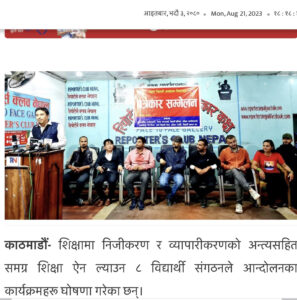
The situation mentioned above must end to improve the quality of education and for further development of education in the country. In this context, I am so glad the eight student organizations unitedly are in the movement for reform in education in the country with three-point demands. One of their demands is to end the appointment of the Chancellor, Vice Chancellor, Rector, Registrar, Deans, Directors, and Campus Chiefs, as well as many other statutory positions of a limited term (i.e., 4/5 years) with the present nomination system of dividing and sharing these positions among the state power holders (prime political parties). Instead, they want all these positions to be filled by merit. I appreciate their demands. I also want to request them to form only one student organization, leaving their political philosophy and ideology out of the educational institutions, and to work to form pure student, professor, and administrative staff associations, which will always work for the upliftment of the institution and professional benefit. The University or other educational institutions – schools or colleges should be for study, not for politics or political training and practice.
Once the root of the political interference in the political appointment mentioned above is uprooted, the atmosphere of political battlegrounds in educational institutions will automatically disappear. It will create a holy academic atmosphere of study, teaching, and research. Now, the institution can retain the autonomy given by the law, and then the appointed authority can work independently for the welfare of all without fear of anybody.
In this way, they can maintain discipline with the administrative staff, students, teachers, or general people.
Once everything comes to order, the institution can thoughtfully formulate academic policies and plans for academic excellence — updating curricula, developing libraries and labs, encouraging community involvement in its development, adding physical facilities, emphasizing merit-based appointments and promotions, controlling corruption, bribery, etc. If we can do this, quality education is bound to come, and we will regain the prestige of this oldest University of Nepal as we had before and, in some ways, much better according to the demands of the time and needs.
The views expressed in this article are the author’s own and do not necessarily reflect People’s Review’s editorial stance.

Login to add a comment