







By Kamal Neeupane
Buildings are responsible for 39 percent of CO2 emissions. Some of these emissions are embodied in the buildings from the mining, processing, manufacture, transportation, and installation of the materials they are made of. Other emissions are generated by buildings through the operation of their heat, electric, and cooling systems, cooking, and appliances. The whole building sector needs to be modernized, and a good way of doing that is through a higher degree of industrialization.
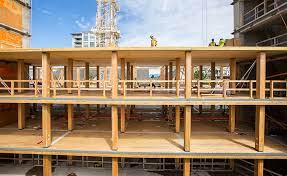
However, concern about climate change has focused significant attention on the building sector, in particular on the extraction and processing of construction materials. Wood is in many ways an excellent material for building in dense cities because we can prefabricate all the elements in factories, instead of on-site. Timber is lighter than concrete, so floors can be added to existing buildings if there is a need for expansion. A timber building weighs 20% more than a concrete building; the gravitational load is vastly reduced. Timber structures would allow us to draw carbon from the air and store it in our homes and offices – leading some to believe that wooden buildings are the future of architecture.
Tree forks are naturally engineered structural connections that work as cantilevers in trees, which means that they have the potential to transfer force very efficiently thanks to their internal fiber structure. Until recently, wood was primarily used in the construction of single-family or small multi-unit wood-framed buildings, limiting its potential in urban areas. However, the development of mass timber technology in recent decades has paved the way for constructing mid- and high-rise buildings with wood to meet the built environment demands of a rapidly growing global urban population. Over the next decade, the greatest increases in housing and infrastructure to accommodate growing urban populations are expected in India, China, North America, and Europe (UNEP, 2017). The urge to become carbon-neutral has made many countries advocate for all buildings to be net-zero carbon.
The model of vernacular housing in Nepal has attracted many researchers, leading them to get to know about the architecture of Nepal and present it to the globe.
The views expressed in this article are the author’s own and do not necessarily reflect People’s Review’s editorial stance.

Login to add a comment