








By Narayan Prasad Mishra
In our culture, Guru (teacher) and Shishya (student) used to have unparalleled love and relationship. Guru would love the students like his own sons and daughters and impart knowledge. Shishya would consider the Guru couple like his own parents and the Guru’s family like his own family and keeps his Guru’s knowledge and teachings alive. Guru played multiple roles – teacher, mentor, parent, guardian, and friend. With his knowledge and wisdom, a guru taught and guided his students and made them stand and work with full knowledge and efficiency in his new educated life. That is why gurus were considered, worshipped, and loved equals to parents giving new life. Besides that, gurus are regarded as Brahma, like the creator, Vishnu as the preserver, and Shiva as the destroyer. According to our old tradition, gurus are not supposed to expect fees for giving education; instead, they expect love, devotion, honesty, and integrity from their students. I remember I went to my Guru’s residence to pay respect and worship him with Tika (red vermillion) and some sweets and fruits and to have blessings from him on Guru Purnima Day (the day of the full moon in the Nepali month of Asar (July) around the year 1950. The day is also called Guru Worship Day (Guru Puja). The following Sanskrit sloka may be the finest example of the importance of gurus in our culture.
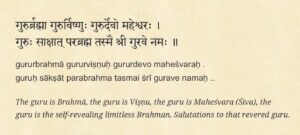 Though that tradition has almost disappeared and the tradition of love, devotion, and respect for gurus has been almost nonexistent, here are two short letters written in Nepali showing how the gurus were loved and respected by students until the 1950s.
In these letters, he said to his Guru that his student (chelo) was about to be complete. You invested so much effort in educating me, and it took so much patience. Your student was about to complete the study. There was not much time left to pass the darkest night of the waning phase of the moon, and the time was about to rise the sun. It gave the beautiful meaning that he was like a plant planted by him and growing and would be ready to give fruits soon. He had high regard, respect, and devotion for him, and his duty would be to keep his Guru happy and prosperous. In each letter, he assured his Guru not to see even in a dream he would have any trouble in the future in his presence
Though the Guru’s name is not mentioned in the letters, they were written by Nara Pratap Shumsher Thapa to my father, Pt. Durga Prasad Mishra, his guru. Pt. Mishra was a pure-hearted religious man, a great devotee of Lord Shiva. He did not eat anything before doing Rudri Puja every day, chanting and praying to Lord Shiva by pouring water into Shiva’s head drop by drop using a unique pot above the statue. The ritual takes hours to do, according to the complete ritual. Pt. Mishra was born on October 19, 1892 (B.S. 1949 Kartik 5) and passed away on Dec. 25, 1978 (B.S. 2035 Poush 10). Some people known to him considered him a silent Tantric. Tantrics are known as those who practice spirituality, which liberates the practitioners from the physical level of existence.
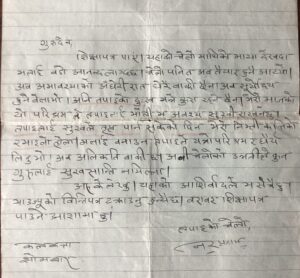
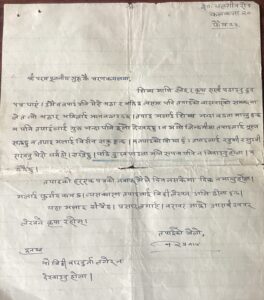
Letters written in Nepali by Nara Pratap Thapa to his Guru
I have treasured some of Nara Pratap’s beautiful handwritten letters to my father, which he wrote while living and studying at Calcutta University. I think the letters were written around the 1950s when I was a small kid. The letters show his reverence towards his Guru and his tremendous love, respect, and good wishes for him. The letters prove he could share his thoughts with his Guru, which he could not share even with his mother and family. Undoubtedly I believe anyone who reads his letters to his Guru experience the delicious taste of the ideal Guru and Shishya relationship, which we seldom see. But it is impossible to put the long or all the letters here.
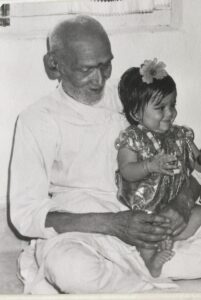
Nara Pratap’s Guru Pt. Durga Prasad Mishra with his baby granddaughter Pragya Mishra in 1971
Even now, I feel sad when I remember how deeply my father’s heart was broken when he lost his most loved, intelligent, diligent, kind-hearted, and shining Shishya Nara Pratap Thapa in 1963. He seemed he might almost die from grief when he heard the sad news of his beloved student’s death. Despite it, he was more broken when Nara Pratap’s family forgot his selfless love, trust, and service toward their three generations as the Guru, priest, administrator, manager, caretaker, advisor, guide, representative, entertainer, friend, helper, companion, etc., after Nara Pratap’s death and instead depended on the wicked workers of the household. Because of that, his most loving family of wealth, fame, knowledge and wisdom, and high reputation crumbled. My father could not do anything to save them from the clutches of the demons. The family and its glorious history almost disappeared. I am also very much sad to see it.
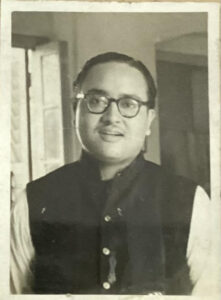 A picture of Nara Pratap Thapa treasured by Pt. Mishra at his residence in Bhaktapur
Nara Pratap Shumsher Thapa, our foreign secretary from 1955 to 1961 and our ambassador to India from May 1, 1961, until he died in 1963, was our fourth foreign secretary and the fifth ambassador to India. He was the son of Shiva Pratap Shumsher Thapa, the first Nepali man with a B. Sc degree and the author of book – 1. Shakuntala (B.S. 1990) 2. Durgeshanandini (B.S. 1990) 3. Shaibhya Harishchandra (B.S. 1992) 4. Shri Krishnacharitamrit (B.S. 1996) (Bhattarai, Ghata Raj. Nepali Lekhak Kosh) and the grandson of Brigadier-Colonel Dilli Shamsher Thapa who was one among the members of a team when Maharaj Chandra Shumsher Junga Bahadur Rana visited England in 1908. He belonged to a wealthy and well-reputed Thapa family, not less wealthy than the then-ruling Rana family. He was a handsome, learned man noted for his knowledge, eloquence, brilliance, and dignified personality. He had an outstanding contribution to our diplomacy and was a charming man who could put a good impression even on Prime Minister Nehru as our ambassador. Prime Minister Nehru was deeply shocked by his untimely death because of the plane accident. In the context of King Mahendra’s visit to Great Britain in 1960, Nara Pratap Thapa, the foreign secretary, was described and recorded in Great Britain as “a man who lived privately having inherited considerable money. He has a good knowledge of Sanskrit, is intelligent, able, and cultured, and has been helpful to Britain.” – “The maharaja and the monarch (Part – 2) (The Record Nepal https://www.recordnepal.com › )
When Mr Thapa was briefly in the US in 1958, he had an important talk with Mr Frederic P. Bartlett, Director, Bureau of South Asian Affairs, USA, for US aid. He urged and sought aid for 1. budgetary support, 2. “discreet” help in training police and possibly even military in US service schools, 3. The provision of helicopters for northern frontier patrol purposes 4. the development of Royal Nepalese Airlines 5. the ropeway extending north from the British-built Gurkha camp 6. 7. the Construction of the east-west road in Terai, etc.
According to the recorded documents of the time, Nara Pratap Thapa even managed personally with Prime Minister Nehru to clarify this purpose with GOI (Government of India) as he understood that the US desire does not undertake any projects which might embarrass US-India relations. It showed his intimacy and good contact even with Prime Minister Nehru, the most potent and influential prime minister of India of the time. (history.state.govhttps://history.state.gov › historicald…
He led the Nepal-India bilateral talks on the trade and transit treaty as a foreign secretary, which was signed in 1960. Himalaya Shumsher Rana, then our governor, was also one of the members of that delegation ( Spotlight. Vol. 13 No. 4 ). He had a big hand in the Joint Communique issued at the end of Prime Minister Bishweshwar Prasad Koirala’s visit to China during Premier Chou En-lai on March 21, 1960. ( indiamadhesi.files.wordpress.comhttps://indiamadhesi.files.wordpress.com ›)
I know Nara Pratap Thapa had a big hand and support for Gopal Pandey Ashim in establishing and running Nepali Shikshya Parishad. He was a great lover of the Nepali language and literature and wished and worked for its development. His handwritten letters given above and many other letters with me show that he not only spoke and wrote excellent English but had a good command of writing beautiful, impressive Nepali language and good handwriting. The letters also prove that he had an excellent knowledge of the Hindu religion and our religious scriptures – Veda, Upanishad, Ramayan, and Gita. He was a pure-hearted, considerate, cooperative, liberal praiseworthy person. That was a big misfortune not only for the family and his Guru but for the country and people to lose him untimely.
I am sad to see that teachers and professors are not respected and loved these days, and students attack them repeatedly. I am sad that teachers also are not devoted to creating knowledgeable, honest, selfless students for the country with love, devotion, and honesty in their teaching. Everybody is self-centred these days. Most are for money. As medical doctors are more attracted and devoted to private hospitals where they get more money, in the same way, teachers and professors are more attracted to private schools and colleges for more money. When working at government-owned organizations, most neglect their professional duties and service. In this connection, once in Tribhuvan University, there was a saying using the words – Ha and Hi for a professor’s job; it meant the professor’s job was not to teach but to make attendance and leave the place. Ha means Hajir (attendance). Hi means Hidnu (To walk away, to leave the place). We should maintain our culture of the appreciable relationship of the bond of love, devotion, and respect between the teachers and students, which is good for the nation and people.

Login to add a comment