








By Narayan Prasad Mishra
We had Tribhuvan University with the Tribhuvan University Act of 1959 ( BS 2016 ). There were some affiliated colleges under it. With the great interest of King Birendra and his dynamic leadership, the New Education System Plan, 1971 (B.S. 2028), was introduced in Nepal in 1971. As a result, the Tribhuvan University Act, 1971 (B.S. 2028) appeared in the country, intending to promote professional and technical education. It brought a drastic change not only in the administrative structure but in establishing and developing technical institutes – medical, engineering, agriculture, forestry, etc. That was like an unforgettable revolution in the education sector of the country. That is known to all. My beloved wife Shanti Mishra and I had an opportunity to contribute our service to it.
After the Tribhuvan University Act of 1971, new rules and regulations were formulated for conducting the university in a changing system. I remember there was a chapter about the appointment of its vice-chancellor in that rule, and it wrote – the vice-chancellor should be an extraordinary intellectual and scholar (Bishista Bidwan). But it was not defined to whom to call extraordinary intellectual. It was not defined what criteria or parameter would be used to judge an extraordinary quality – by degree, experience in teaching and working; writings of articles, books or other research papers, certificates, possession of medals, awards of extraordinary achievements or appreciation or recommendations of power circles, etc. It is a fact that defining an extraordinary intellectual is not an easy job. So at that time, no one could say who was an extraordinary intellectual who would fulfill those criteria among the available human resources and be the vice-chancellor.
Before introducing the new Tribhuvan University Act of 1971. the last vice-chancellor was Dr Trilokya Nath Upreti, who had not completed his previous term. So he continued his term when the new system came. After his term, Prof. Surya Bahadur Shakya was appointed as the T. U. Vice-chancellor. Then many others came from Jagat Mohan Adhikari, Dr Mahendra Prasad to many others, including present Vice-chancellor Dr Dharma Kanta Banskota. We assume that they were people who are extraordinary intellectuals because of their appointment to the position of Vice-chancellor, which demands that quality for its appointment. At the same time, the history of all the previous appointments of the vice-chancellors makes it clear that in this context, the words – extraordinary intellectual, learned, or scholar does not have to possess any extraordinary quality different from other high positions of other offices in the country. He, she, or anyone can be appointed as the vice-chancellor with the blessings and trust of high power holders. So I feel it should be written clearly in the rule that the vice-chancellor can be appointed to anyone on the trust and blessings of the power circle – Prime Minister, Minister, Cabinet, etc. That shows more honesty and makes more sense than writing “extraordinary intellectual, learned or scholar” if those words do not carry any meaning.
It is a known fact that in most developed countries and countries where a genuine democratic system with equal rights and opportunities in practice has existed, people earn their positions and prestige by extraordinary qualification, knowledge, service, experience, contributions, writings, etc., visibly possessed by a person more than others. They are the best among the best. So they are selected, rewarded, or offered the positions. Similarly, people get higher positions after others with experience and knowledge. In general, that system does not exist in our fake democracy.
We seldom see people selected and offered high positions in our country – ambassadors, vice-chancellors, members or chairpersons of constitutional bodies, corporations, etc. based on their extraordinary knowledge, experience, talents, and contributions. We often see the selection and appointment criteria for those positions are blessings because of contact, connections, relations, flattery, or bribery. That is the way people become ambassadors, except for some from diplomatic services. That is the way people become Vice- chancellors of universities here. Ours is a country where people earn prestige and position through sycophancy and blessings, not knowledge and contributions.
I remember with sadness some person who became the vice-chancellor of T.U. before the multiparty democracy without merits. Unlike many other professors, the man was an ordinary professor but had a wooden head. He was appointed to the position of zonal commissioner, then became the vice-chancellor, and was appointed the country’s ambassador sometime after his term as vice-chancellor. He was eligible for any position because of his ruler class blood. Now he was called administrator, educationalist, and diplomat because of his positions. He had these professional adjectives because of his positions which he got with blessings, not because of his knowledge and expertise. That is what we often see in the adjectives decorated in a person’s name in Nepal.
He was a real Babusaheb with blood, nature, and conduct that enjoyed flattery. One could get anything from him through Chakary (Sycophancy) but not with honesty, sincerity, knowledge, intelligence, logic, or arguments. He would consider you his enemy if you put any argument denying his words – right or wrong, good or bad. His face would beam when discussing cows, dogs, guns, or hunting. That was his topic of interest. But he would get bored if you talked about books, libraries, research, or academic excellence. So his sycophants used to please him, talking about his interest topics and getting the work done that they wanted. Then there was a news published about a professor in the newspaper who used to go to his house every day and serve his cow, giving him hay and grass, and admiring the cow like anything. He benefited a lot from him, even with his high position. I remember a professor he blessed with eight grade increments at once because of his Chakary. The professor was so tactful and discreet that later on, he became the ambassador appointed by our communist government, being a notable communist after the multiparty democracy was introduced.
On the one hand, we often see that influential people earn professional adjectives easily with blessings in our country. On the other hand, many knowledgeable, learned, experienced, and genius with visible contributions disappear from the scene without the contact and blessings of influential people. That is very sad to watch.
When the person mentioned above from the Royal caste and connection was in power in the university once, he called me regarding my complaint against the decision of the university, which I had filed before he came to the position. That was just after his appointment. The case of my complaint was pending. That was about the decision of the university to publish a book written by a person who was not qualified to write the book on the subject according to the existing university’s rules. He asked me to take my complaint back and forget about it. At the same time, he said he would arrange to publish my book without any problem if I had any.
I politely told him that my complaint was not for getting a favor for publishing my book. Still, I registered the complaint to maintain the rule and prestige of the university like the universities of developed countries. He got mad at me and said, “Do not worry about the university or the country’s prestige but think for yourself and your advantage. I will not do anything for you if you talk to me like this”. I was so sad to see a person on the chair who was not concerned for the university’s prestige. I said okay if that was so, and I did not want to get a favor by dropping my genuine complaint. With a heavy heart, I returned from his office, turning down his offer because of the lack of blood of Chakary (flattery) in my heart. He treated me like his enemy during his working period just because I argued about maintaining the standard or prestige of our university. I was so distressed and helpless as I could do nothing against his wrong sayings and doings. I knew he was powerful, and his high power was connected to the palace. I wrote the following poem to relieve my sadness and lighten my aching heart. The poem was published in “Naya Nepal Post,” edited by Devendra Gautam on 20 November 1983 (4 Marga 2040) and is included in my poem collection book ‘Umliyeka Pidaharu” in Nepali. I am so sad to hear about the sad demise of Gautam a few months ago, who published many of my poems with pseudonyms evaluating the contents and the value of the poem without any contact. I admire him for this cause and his appreciable ethics of journalism. I pray for the peace of his eternal soul.
The poem in Nepali and its English translation are given below.
Poem in Nepali
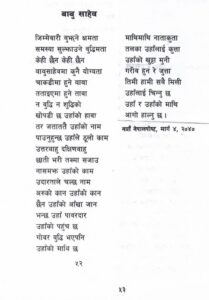 The poem translated into English
Babusaheb (Word for addressing Royal ruler caste men with high respect)
Narayan Prasad Mishra
The capacity to understand the responsibility
The wisdom to solve the problem
Nothing is, nothing is
Any capability in Babusaheb
He becomes intoxicated with sycophancy
He becomes like a hot-pan when instigating
Neither knowledge nor sense
His brain is empty
But his big name is everywhere
He gets big positions
Utarbahu, Dakshin Bahu
He has full of Royal medals on his chest
The work done without sense
Gets appreciation as liberal
Others’ ears are his ears
Know that he has no eyes
It is said he is powerful
He has high contact
He may be brainless
He has connections with high people
He has relations with high
He treats others like shoes
Under his legs
He treats the poor like his shoes
Getting together, you and me
We need to know him
on him and his high circle
We need to put a fire
Just as many Babusahebs during the Panchayat System connected and related with Royalties who were in positions of power and without merit, we now have many more like those Babusahebs, which I call multiparty Babusahebs connected and related to significant parties who were and are in the government and power. Though we have a democratic system in name, the culture is the same. I remember a very close lady and well-wisher of my beloved wife, Shanti Mishra, one of the highly educated women in the country. That lady was appointed as the ambassador. When my wife congratulated her on her appointment, she said to my wife with sincerity and honesty -“Madam! I know, and I think the government should have made the ambassadors the ladies like you who deserve and fit for the position with any standard. I am ashamed to supersede people like you. But I am sorry that we have this kind of system”.
I hope and pray we also will have a system of merits one day in our country. I hope our people someday will get positions and prestige by merits, not by sycophancy, connection, relation, or bribery. I hope people will get adjectives like administrators, educators, diplomats, planners, or any other by knowledge and experience, not by just the positions received with somebody’s blessings, until we establish a merit system. We must accept our misfortune that we are bound to disappear unnoticed by the nation despite our extraordinary merits, like my wife or many notable personalities in our country. I know this is not easy to tolerate, but there is no other way when you are born in Nepal in the present situation with pure independent thoughts with the blood of honesty and integrity. That is our destiny.

Login to add a comment