








By Narayan Prasad Mishra
Besides articles on different topics of my interest, I also write poems and short stories. But I have not published my short stories in book form as I have my book on poems and many articles. My name as an author is listed in the author’s biography book written by Prof. Ghata Raj Bhattarai. But I do not know whether I was listed in some other books. Because in our country, in general, you need to have a connection, links, and friend circle for everything – to be listed somewhere, to get some awards, appreciation, and medals. By merit, you hardly get anything. Just writing good poems, you may not even be called a poet if you do not have a friend circle. You may not be registered or listed anywhere. Sometimes we hear people get awards through private negotiations. It means you recommend your friends for the awards where you have your say, and those friends recommend you for the same where they have their influence. Both get an advantage, and both are awarded.
In this context, I sadly remember my late beloved wife, Shanti Mishra, the well-known translator of the famous Rupamati novel. She missed the Royal Nepal Academy invitation when they organized a big international seminar on the translators of Nepali literature some decades ago. They forgot her for that purpose. Anyway, these days I am glad to see her name everywhere where something is written about the translators of Nepali literature. I have an experience that sometimes people come to approach you and request you to be an advisor, or patron of an association, or organization. Firstly you think you are recognized and respected for the purpose. However, when they mention contributing or donating a significant amount of money, you soon realize people came to you not to recognize your contribution to the field but came for money.
My published short stories are scattered in different Nepali newspapers. I mainly wrote administrative short stories, stories based on administrative problems and solutions. That new concept of short story writing was different from the traditional short stories based on social themes and problems. Primarily they were published in Samaj Dainik, the popular Nepali newspaper of the time now nonexistent, edited by the late Mani Raj Upadhyaya, the well-known journalist of the old generation. I remember I wrote a short story titled “Saha Sachib Sharma” (joint-secretary Sharma), Uslai Office Janna Man Chhaina (he does not like to go to the office) published in that paper. I could not give the published date here as I am currently in the USA, and all my records are in my house at Balkhu. I am incredibly sorry for that.
I vividly remember writing the story about a joint secretary who is talented, intelligent, active, honest, and sincere. He is always on time in the office and highly dedicated to his work. He has a tremendous sense of responsibility and admirable leadership qualities with an unconditional love of the nation and the people. His writing and speaking are appreciable and worthy of following. He is gregarious. Not only that, he is good-looking and has a good personality. Besides all the qualities mentioned above, he is also a man of self-esteem and a person of principle. Because of his love of principle and unchanging nature against the rules and regulations, he is left alone without significant responsibilities. But all other office colleagues who do not possess even one-tenth of his qualities but are sycophants are loved by their bosses. They become close to the boss and become his confidant. The office chief and high officials in our country find it easy to work with sycophants who would do the work – right or wrong, good or bad, based on the interest and likings of the boss. So the sycophants worship power and get an advantage from that.
Another story was about the government employees who come to the office around 11 am instead of 10 am, not worrying about the official starting time of 10 am. Then they go to the restroom lingering slowly. After returning to the table, they start gossiping with other office colleagues for around 45 minutes, after which it will be noon. After that, they slowly open the almirah, take out the files to work, and do some work with little interest for about one and a half hours. The time will be 1:30 pm, which is tea time in Nepal. They all go to someplace to eat and return to work after about one hour though the allotted tea time is only half an hour. This is the way they spend another two and a half hours at work. When the watch is 4:30 pm, they will be ready to close the files, go to the restrooms, and then have a few minutes chatting. Then the time will be 5 pm, the official closing time. Every day that routine is the same. No one is there to supervise. The office chief thinks it will be unwise to question it if he wants to run his office peacefully.
I think that is why we have a Nepali proverb – Sarkari Kaam Kahile Jaala Gham. In Nepali, kaam means work, and Ghaam means sunlight. The work of the government is to pass the time. It means the government employees’ attitude and intention are not to serve the nation and people sincerely. They intend to pass the time with the salary. Their primary attention is looking at the sun going down. In other words, to watch time, hoping to go home early to escape from the office.
At the same time, thinking about the absence of meritorious civil service and also the absence of the culture of supporting the good civil servant with the quality of honesty and dignity to rise in the country, I wrote the poem “Yahaa Yestai Chha” in Nepali which was published in “Naya Current” on September 22, 1982 (B.S. 2039 Ashwin 6). The poem is in Nepali and its English translation is given below.
Poem in Nepali:
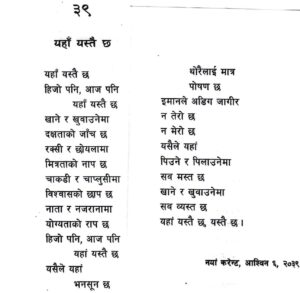
The poem translated into English:
Here it is like this
Here it is like this
Yesterday also, today also
Here it is like this
In taking bribes and sharing it
Your efficiency is evaluated
In alcohol and smoked meat
Friendship is measured
In sycophancy and flattery
Trust is measured
In gift and presentations
your eligibility gets weighed
Yesterday also, today also
Here it is like this
Because of this
Here is a culture of requesting secretly
Here is corruption
Here is procrastination
Here is injustice
Here is exploitation
Only a few
are privileged
The job was secured with honesty
Neither you have
Nor I have
Because of this
In getting profit and sharing it
All are content
In taking a bribe and sharing it
All are engaged
Here is like this, it is like this.
I read the following news published in the People’s Review online edition on September 14, 2022, based on the speech of our honorable Prime Minister Sher Bahadur Deuba when he addressed a program held on the occasion of Civil Service Day, “He (Prime Minister Deuba) also heavily criticized the bureaucracy that the civil servants were equally responsible for the bad governance.
He said there is no progress because the employees do not want to go to remote areas. He complained that the country is lagging behind even when there are local, state, and central governments.
The PM also questioned who is responsible for the country’s downfall. He questioned, “Is it only the political parties or the bureaucracy as well? Why are the works not being done? Let’s have a broad discussion. We are here for five years. But you will be here until you retire. None of the work is accomplished. The country is in turmoil. The employees go to the office, sign attendance and return back. They don’t even stay at the office,” said Deuba.
He said that if government employees do not cooperate, nothing can be achieved through policies and political parties alone.
“Bureaucracy is the first means of serving the people. If it doesn’t work, how will the country be built?” Deuba said.
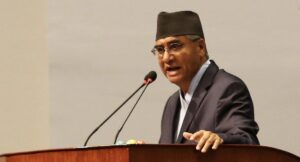 Prime Minister Sher Bahadur Deuba
The Prime Minister’s above speech depicts that the mentality and attitude of the civil servants and government employees have not been changed or improved even after many decades of my writing stories about – Sarkari Kaam Kahile Jaala Ghaam. It seems it is worse than before. Not only are they not working or have slow working and cheating attitudes, but we hear and experience that the government employees also do not work without a bribe. But the concerning question about this problem is — who is responsible and to be blamed for keeping this situation in the country as it is? As I wrote in my above poem — Here, the situation is always like this. Who is responsible for bringing the bureaucrats and government employees to the right path as other countries’ employees with good efficient, dedicated employees and good governance? All should consider these questions, and all responsible people who run the country must bring a revolution to change it. I also hope Prime Minister Deuba will bring this revolution if he becomes the country’s prime minister again, as it seems he is now fully aware of this problem. In this context, I want to draw attention to the following excerpts from the speech of Joe Biden, the President of the United States of America, which he spoke when he addressed the U.S. Department of State Headquarters on February 4, 2021, just after becoming the President. It tells how responsible, rational, and idealistic politicians consider and treat the bureaucracy for the country’s welfare.
Excerpts from the speech
“I want the people who work in this building and our embassies and consulates around the world to know: I value your expertise, and I respect you, and I will have your back. This administration is going to empower you to do your jobs, not target or politicize you. We want a rigorous debate that brings all perspectives and makes room for dissent. That’s how we’ll get the best possible policy outcomes”.
I wrote the following sentences in my article” Party Without Principle,” published in” People’s Review” on August 24, 2022.
“No offices, including the offices of constitutional bodies, can evade the political interference of political leaders and parties in power, which is the leading cause of the mismanagement, malpractices, and corruption in our offices. Those things are indeed necessary to rectify for the good of the country.” I hope our leaders learn about that from President Biden’s speech and do the needful to create strong bureaucracy in the country.”
narayanshanti70@gmail.com

Login to add a comment