







By OUR Reporter
Election fever has gripped the entire nation although the local level election is still about a two-month away.
 The political parties have already intensified election-related activities targeting the local level election scheduled for May 13.
While Nepali Congress has launched a month-long election centric campaign by mobilising its central members in each of 77 districts, the Maoist Centre chairman is touring the country urging party cadres to be prepared for local elections. Similarly, CPN-UML chair KP Sharma Oli is busy welcoming the mayors and other representatives elected from other parties in his party. The Janata Samajwadi Party-Nepal prepared and approved election-related guidelines.
However, the parties have not yet set their agenda for the elections.
While the bigger parties have shown enthusiasm to participate in the local elections and have been formulating and launching poll-centric activities accordingly, the smaller parties which failed to get the status of the national party because of their poor performance in the 2017 elections have been irked by the decision of the Election Commission not to grant them party election symbol. The EC said only six of the 79 parties registered for the local polls will get party symbols.
The smaller parties including Rastriya Prajatantra Party have protested the EC’s decision and warned of launching an agitation against the decision which they termed as discriminatory. Moreover, Rajendra Lingden of the RPP threatened to disrupt the elections if his party was not provided with the party election symbol of the plough. However, the EC is not likely to revoke the decision which it said is according to the law.
The EC has also fixed the ceiling for the expenditure of the candidates of the local elections. While a mayoral candidate of a metropolis could spend Rs. 750,000, ward chairman of the rural municipality could spend Rs. 150,000. However, the ceiling is not likely to be abided by the candidates, especially in Metropolis and municipalities, where candidates had spent around Rs. 40 million in the 2017 polls. Also, the ceiling does not look scientific considering the growing prices of everything.
Parties moving towards election polarization

When the local polls are less than two months, political parties seem to head towards polarization gradually with the ruling alliance on one pole and the CPN-UML and smaller parties on the opposite side.
Although the four parties of the ruling alliance have not formally taken any decision whether they will forge an alliance in the local elections, top leaders of all four parties have been stressing continuity to the present alliance not only in local polls slated for May 13 but also in the parliamentary election in November.
Nepali Congress president and Prime Minister Sher Bahadur Deuba, CPN (Maoist Centre) chair Pushpa Kamal Dahal, CPN (Unified Socialist chair Madhav Kumar Nepal and Janata Samajwadi Party Nepal leaders Upendra Yadav and Dr. Baburam Bhattarai have been stressing the continuity of alliance in elections in each of their speeches. Only NC leaders loyal to Dr. Sekhar Koirala have been opposing the idea of electoral alliance arguing that communist cadres never cast their votes to the tree (election symbol of NC). NC vice president Dhan Raj Gurung and both general secretaries Gagan Thapa and Bishwo Prakash Sharma have been ruling out the possibility of an electoral alliance. However, PM Deuba has been in favour of alliance in election as he fears alliance between the Maoist Centre and UML if he disagrees to forge an electoral alliance. Also, he does not want to deceive Dahal and Nepal without whose support he could not become the PM in July. However, he is finding it difficult to convince the popular NC leaders for such an alliance.
Maoist Centre chair Dahal has also floated a formula of electoral alliance both in local and parliamentary elections. According to the plan, the ruling parties will retain the seats from where their representatives were elected in 2017 polls and divide the seats won by the UML candidates among them. They had applied the same formula during the National Assembly election in January this year. But the proposal is yet to be discussed and accepted.
Again, an electoral alliance is necessary for Madhav Kumar Nepal because without forging an alliance, his party might not win any seats in elections. Thus, it looks likely that the ruling parties will in the end forge an electoral alliance.
When ruling parties forge an alliance, the opposition UML will also go for alliance with Majdoor Kisan Party, both Rastriya Prajatantra Parties, Rastriya Janamorcha and CK Raut’s Janamat Party. The Loktantrik Samajwadi Party may also forge an alliance with UML at some local levels. As UML will find isolated from major national parties, the polarization of political parties in the upcoming elections looks highly possible.
The trend of changing parties rife in Madhes
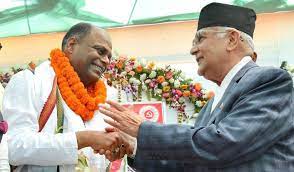
When the local election is approaching closer, the trend of switching parties has increased, especially in the Madhes Province. Several mayors, deputy mayors and ward chairs of the province have already switched their parties with the hope of getting tickets and winning elections again from the new party.
While Birgunj Metropolitan City Mayor Vijay Kumar Sarawagi entered the CPN-UML by quitting Janata Samajwadi Party Nepal in Parsa, Pokhariay Municipality Mayor Deep Narayan Rauniyar joined Nepali Congress. Likewise, the Mayor of Rangeli Municipality in Morang Dilip Kumar Bagadiya joined the CPN-UML quitting the Maoist Centre.
It was said that Sarawagi was preparing to join NC, but when Moti Dugad of UML knew it, he took Sarawagi to CPN-UML chair KP Oli, who convinced him to join the UML.
Not only mayors but also deputy mayors and ward chairs have been switching parties in recent days. On Tuesday, a ward chairman of Province 2, brought five buses of locals including elderly women from Terai to Kathmandu telling them that he would take them to Pashupati. But when they arrived in Kathmandu, the ward chair took them all to CPN UML chair Oli saying that he and his followers were joining the UML. This serves as an example of how the leaders are in the race to switch parties.
While more leaders from Madhes are switching parties, fewer in the hills are also following the suit.
Not only the UML and NC, but every party from bigger to smaller one including CPN (Unified Socialist) are welcoming the new entrants in their party on the eve of elections.
Besides PM Deuba and CPN UML chair Oli, other leaders including Madhav Kumar Nepal, Mahantha Thakur and Pushpa Kamal Dahal are now busy welcoming the leaders from other parties to their parties. This means many local leaders are switching parties with the sole hope of getting a ticket to contest the local poll.
Even in Kathmandu, the UML is said to be preparing to welcome actor Rajesh Hamal and actress Karishma Manandhar to their party. If Hamal joins UML as rumoured, he is likely to get the UML ticket for Mayor in Kathmandu Metropolitan City.
While leaders are opting to welcome new entrants with a promise of granting them a ticket in elections, the genuine party leaders and cadres who have spent years in the party could get irked. Again, there is no guarantee that the popular leaders who join the new party can win elections because most of the trained party cadres hesitate to change parties as they have to spend years in the new party to reach high posts. This means only the leaders and their close aides will be changing the party.
But one thing is sure the growing trend of joining a new party on the eve of the election could make it difficult for the party leadership to maintain discipline within the party organisation. It can breed anarchy in the parties. But the leadership look indifferent to this fact and are promoting the trend of party switching.

Login to add a comment