







Oli further consolidates his strength in UML; prepares Shankar Pokhrel as his successor
By Our Reporter
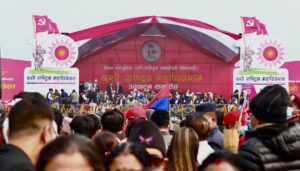
KP Sharma Oli has further consolidated his strength in the CPN-UML. In the 10th National Congress held in Chitwan, Oli has been reelected chairman of the CPN-UML and succeeded to have all his ‘yes men’ in the 301-member central committee.
Oli, by sidelining Bishnu Poudel, has handed over the party’s key post, general secretary, to his confidant Shankar Pokhrel. It is believed that Oli has prepared Pokhrel as his successor from the 11th national convention of the party.
Poudel has been elected as the vice chairman of the party.
Accordingly, by sidelining Subhas Nembang, Oli has selected Ishwor Pokhrel as the senior vice chairman of the party. Pokhrel may look after the party organization in absence of Oli.
Although he tried his best to get elected unanimously and not to hold the elections, Bhim Rawal challenged him compelling him to hold the elections at the eleventh hour. However, as Oli used his all might to prevent any leader from announcing his candidacy, the 10th National Congress could not be held in a free democratic manner. Only negligible leaders dared to fight elections against those picked by Oli himself and those who contested the elections against the will of Oli only suffered defeat. Leader Ghanashaym Bhusal lost in the post of vice-chairman while Bhim Acharya and Tanka Karki lost the election of secretary.
The entire jamboree was in full control of Oli and his men. He did not conduct the closed session as planned. No discussion on policy and other issues was held. No leader from the party was allowed to speak, Bhim Rawal, the candidate of chairman was not allowed to distribute his pamphlets to the participants, slogans were chanted against Rawal and for Oli and the party establishment had openly asked the voters not to vote those who challenged the ‘consensus’ candidates chosen by Oli.
Although the inauguration looked impressive, the closed session and the selection of the office bearers and central members hurt many leaders. They returned home feeling humiliated and injustice was meted against them. When Lal Babu Pandit was found nowhere in the list of the office-bearers, he announced he rejected any executive post and returned to Kathmandu. Binda Pandey, Bishal Bhattarai and many others were not happy with the way the congress was held. But only Bhim Rawal and Ghanashyam Bhusal dared to challenge and speak the truth.
Of course, the 10 National Congress of UML lacked democratic exercises. Oli amended the statute prepared by the statute committee in October without holding a discussion in Congress. The voice of opposition was suppressed. Leadership was not chosen through democratic exercises. Although almost all representatives were pro-Oli, it is not known why Oli did not want an election and tried to pick his men.
Now when the entire committee has his men of choice and when senior leaders like Madhav Kumar Nepal and Jhalanath Khanal who spent their entire life to build UML a democratic force are not in the party, Oli has become the most powerful chairman of the party. Above all, the party lost its internal democracy and now the UML will decide what Oli wants.
NC gears up national convention; tough competition likely between Deuba and Poudel camp
Nepali Congress is now gearing up for its 14th central level convention scheduled to be held from December 10 in Kathmandu.
It has almost completed the district level convention leaving a few districts, including Sarlahi, Banke and Sindhupalchowk. In Sarlahi, the ward level convention in a municipality was difficult due to a clash between the cadres of the rival factions. However, by 10 December, the district convention will be over. Now the party is holding the provincial committee general convention on December 4-5.
The party also rescheduled the inauguration of the Central Working Committee general convention on December 10, candidacy nomination on December 11 and election on December 13. Earlier, the election date was scheduled for December 12.
If we look at the results of the district convention, there will be tough competition between the Ram Chandra Paudel and Sher Bahadur Deuba camps in the central level committee. An almost equal number of central convention representatives have been elected. However, support of Krishna Sitaula camp is likely to be crucial as he also succeeded to have his men in the convention. Like in the 13th convention, the faction that receives the support of Sitaula is likely to win the post of party president. In the 13th convention, Sitaula had played a key role in Deuba’s victory.
Besides, the number of votes that Bimalendra Nidhi, who has announced his candidacy for the post of party president, will also impact the results. If the Paudel camp manages to have a single candidate for the post of party president and Nidhi continues his candidacy, Deuba is likely to suffer defeat. But if the Paudel camp has more than one candidate, and the election is held for the second round, Deuba is almost sure to get reelected. Thus, it is still uncertain as to which camp will win the central level elections.
Cadres from both the Deuba camp and the Poudel camp are putting pressure on the leaders in their camp to give a common candidate to the post of party president ensuring the victory of the camp’s candidate.
RPP’s unity national convention begins, Lingden challenges Kamal Thap’s candidacy
The unity convention of the Rastriya Prajatantra Party (RPP) has begun in Kathmandu.
It is the first convention after the unification of the Kamal Thapa-led RPP and another led by Prakash Chandra Lohani.
However, the unity convention is likely to be interesting as party chairman Kamal Thapa has been challenged by Rajendra Lingden, the only RPP leader elected to the House of Representatives in the 2017 elections.
Moreover, many heavyweights like Dhawal Shumsher Rana and Prakash Chandra Lohani as well as actress Rekha Thapa have backed Lingden. Pashupati Shumsher Rana has not announced whom he will support, however, Rana’s role will be decisive to elect the party leadership and office-bearers.
RPP is a pro-king party, and it has been raising the issue of restoration of the Hindu Kingdom. Also, RPP wants to abandon the present federal structure otherwise, reduce the number of provinces.
Since its establishment, the party is facing the problem of a split. When the party was split into three factions, it was shrunk into one MP from the previous 37 constituent assembly members.
Now, the party leaderships have confessed that without unification, they cannot exist in the present political ground and cannot move forward with their political agendas.

Login to add a comment