








By Our Reporter
The drama being staged at the Supreme Court continues with the Bar representatives continuously protesting against Chief Justice Cholendra Shumsher Rana and a division among the Justices.
The Kathmandu-centre protest of the lawyers have now reached districts, and the justices in SC has not been working.
Although the protest succeeded to strip the power of the Chief Justice over the days, the agitating lawyers have been demanding the CJ’s resignation citing that he sought a share in the government and was involved in corrupt practices.
When the lawyers, civil society, media and a section of the political parties have been voicing against the CJ, Nepali Congress president and Prime Minister Sher Bahadur Deuba as well as CPN-UML chairman KP Sharma Oli are giving protection to Rana. This is why Rana has not budged.
But the dispute that has surfaced in the Supreme Court has badly affected the entire judiciary system. People have stopped getting justice when the judges themselves have joined the protest. It has tarnished the image of the entire country and disturbed the balance between the executive and judiciary. And the political parties should be blamed for the present situation. Of course, the situation arose when the political parties divided justices among them while appointing them.
The present crisis could provide an opportunity to clean the judiciary system by not letting the political activists become justices. However, political leadership should show its guts to free the justice system from political influence.
Again, the present crisis is not likely to end until CJ Rana quits because it is a worldwide practice that a justice quits when he is dragged into a controversy.
Even the issue of SC has been internationalised with the International Commission of Jurists (ICJ), Human Rights Watch (HRW) and Amnesty International (AI) demanding the resignation of CJ Rana.
To uphold human rights and the rule of law, it is essential to resolve the crisis in a way that maintains and enhances the court’s credibility and independence spread a statement issued by ICJ, HRW and AI recently.
Transitional justice in dilemma even 15 years after signing of the CPA
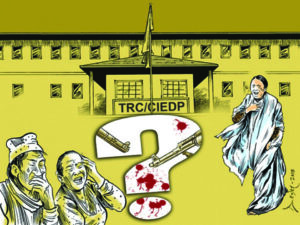
Fifteen years have elapsed since the signing of the Comprehensive Peace Accord (CPA) that has formally ended the Maoist conflict in 2006.
While signing the CPA, both the government and the then rebel (Maoist Centre) had agreed to provide justice to all the victims of the Maoist insurgency in which nearly 17,000 people were killed and hundreds of others disappeared.
Surprisingly, even the Maoists led the government twice after the signing of the CPA, but the victims, especially the families of those who went missing, have not received justice. Many parents are still waiting for the arrival of their sons and daughters who went missing in the conflict.
Although Maoist chairman Pushpa Kamal Dahal in a statement issued on the occasion of the completion of the 15 years of the CPA signing said he was satisfied with the progress made over the years and expressed commitment to concluding the peace process, the victims, as well as the international organisations working in the sector of human rights, criticised the government(s) for failing to conclude the transitional justice.
In a joint statement, Amnesty International (AI) International Commission of Jurists (ICJ), Human Rights Watch (HRW) and TRIAL International said Nepal made no progress on justice for crimes under international law in the 15 years since the signing of the Comprehensive Peace Agreement in 2006 which ended a decade of armed conflict.
They said to enable a credible transitional justice process, the government should put the needs of victims front and centre and set out a clear timeline for holding meaningful consultations and upholding its legal obligations.
The statement read, “Successive Nepali governments have pledged to deliver truth, justice and reparations to victims, including by implementing a 2015 Supreme Court ruling to amend the transitional justice law to disallow amnesties for serious crimes.”
During Nepal’s recent Universal Periodic Review (UPR) of its human rights performance at the Human Rights Council in Geneva, numerous UN member states expressed concern over the delays and weaknesses in the transitional justice process and said that the government should ensure that an independent and rights-respecting process is promptly made operational.
However, Chairman of the ruling CPN Maoist Centre Pushpa Kamal Dahal ‘Prachanda’ has said that he took pride in the political achievements gained after the signing of the Comprehensive Peace Accord (CPA) in 2006 and he was committed to investigating the weaknesses made over the years and making them public.
Issuing a statement on the occasion of the completion of 15 years of the signing of the CPA on Sunday, Prachanda said that it was the duty of the state, not only of the government, to investigate the conflict-era incidents, make them public, compensate the victims, conclude them on the basis of transitional justice and maintain conciliation in the society.
Election Commission to update voters’ list from December
 The Election Commission of Nepal (ECN) is resuming the voters’ name collection programme from all local levels from 3 December 2020. The process was halted due to COVID-19 pandemic last year.
The election body was collecting the names from election offices in 77 districts and 40 area administration offices as per the Voters’ List Act, 2016.
Likewise, it had stopped the name collection programme following a government decision to hold elections for the House of Representatives on 20 December 2020 and 22 May 2021.
“Following the halt of the programme, various stakeholders have been urging the ECN to collect the names from the field,” said ECN.
“The programme will be launched as a special campaign at the headquarters of 637 local bodies, apart from the ones that have district or area offices,” said the ECN in a statement on Monday.
The name collection will run for 10 days in the local bodies of mountain and hilly districts and for 15 days in Terai, Madhes and the Kathmandu Valley.
The EC has decided to resume the collection of the voters as the term of the local levels is expiring in May next year.

Login to add a comment