







Nepali Economics
 By Prajwal Shrestha
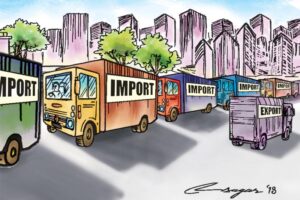
Nepal’s trade deficit has inclined by 24.61 percent in the first eleven months of the current fiscal year on the soaring imports compared to the slow export growth.
According to the Department of Customs (DoC) Nepal witnessed a negative trade balance of above Rs 1.26 trillion during mid-July 2020 and mid-June 2021.
For several decades, Nepal is continuously facing a trade deficit. Imports of petroleum products have significantly contributed to the incline of trade deficit as consumption of petro-products is increasing continuously. Accordingly, imports of vehicles have been increasing every year. If the government plans to assemble e-vehicles within the country and give priority to the consumption of electricity in running industries, vehicles and also cooking food, a significant amount of imports of petroleum products can be substituted by home-produced electricity.
Accordingly, if the government encourage assembling of other luxury products such as branded mobiles, television sets, washing machine, within the country and encourage consumers the habit of using made in Nepal products, a significant size of trade deficit could be reduced.
Of late, in the name of liberalization of the economy, the government launched a privatization campaign of the government undertakings. The leaders in the government, especially those finance ministers from the Nepali Congress since 1990 by taking an attractive amount as commission, sold the industries providing employment to thousands of people at very low prices. Overnight, the ministers and officials became multi-billionaire but the privatized industries were disappeared. The private sector runs behind money and profit only. The Harisiddhi Bricks and Tiles Factory was privatized and then it was collapsed. The land occupied by the Factory was used for the construction of houses. When we travel to Godawari, we can see the NB colony with hundreds of buildings.
Accordingly, the Bhrikuti Paper Mills in Gaidakot has been shut down along with its privatisation. Now, the businessmen are trying to dispose of the land occupied by the factory.
The Bansbari Shoes Factory has been disappeared along with its privatization. Since the Nepal Tea Development Corporation has been given on lease to a private sector, neither the government is receiving royalty nor the labourers are being facilitated with additional benefits. These are the lessons that privatization is not a solution. The demise of such import-substituting industries has contributed to an incline in the volume of trade deficit.
To uplift the economy, the government should facilitate the private sector in creating a market for their products. As farmers are not getting the price of their products due to the exploitation of the middlemen, the government should develop a mechanism to destroy the syndicate of the middlemen.
During the Panchayat days, we had small and domestic industry development departments in all 75 districts. They used to provide training to the locals and used to market the local products nationwide. This mechanism should be expanded to all the local bodies. Similarly, for the development of the agro-products, along with providing fertilizers and modern equipment for cultivation, the government should help the farmers by recommending the plant and seed beneficial for the farmers as per the soil and climate.
If the government will become responsible, it is possible to reduce the existing trade deficit.

Login to add a comment