







By Sharachchandra Bhandary
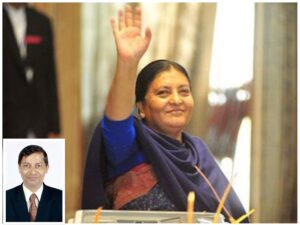
Kathmandu, 21 March: President Bidya Devi Bhandari is paying a state visit to Bangladesh on March 22 and 23. The people of both countries are closely observing with curiosity this visit taking place at the Head-of-State level for the first time after Nepal’s adoption of the federal democratic republican political system. They are confident that the visit will be fruitful in broadening the diplomatic scope of Nepal and further deepening the political, cultural, economic and people-level relations between the two South Asian neighbours.
It is expected that the far-reaching impact of this visit taking place when the world has passed two decades into the 21st century would be centered not only in making the mutual ties more cordial but also would be important from the viewpoint of promoting collaboration, partnership and cooperation towards materializing Nepal’s dream of prosperity.
High level visits are very useful in renewing mutual ties as well as exploring new avenues of collaboration and cooperation. Three separate memorandums of understanding (MoU) on tourism promotion, sanitary and phyto sanitary measures and letter of exchange relating to operationalization of of Rohanpur-Singhbad rail route are to be signed between the two countries duiring the visit. The Government of Bangladesh has provided Nepal transit facility through the Kakadbhitta-Phulbari-Banglabandh roadway as well as at the Chittagong and Mongla sea ports. It has also made available additional ‘rail corridor’ for operation of freight train from Rohanpur-Singhabad to Nepal, and it has opened the way for Nepal to use the Mongla port as an alternative to the Kolkata port. Since Mongla port is nearer than Kolkata port, it will help expand bilateral trade at comparatively lesser cost for Nepal. It is 217 kilometres from Mongla port to the integrated checkpost at Biratnagar and 600 kilometres to the integrated checkpoint at Birgunj of Nepal. ‘Bangladesh accords high importance and respect to Nepal’ Nepal’s ambassador to Bangladesh, Dr Bansidhar Mishra said. Bangladesh has attached high priority and respect to Nepal and it has invited President Bhandari as the state guest in the special ceremony marking the birth centenary of its Father of the Nation Sheikh Mujibur Rahaman as a reflection of this reality. Dr Mishra informed this scribe over the phone that grand preparation has been made for President Bhandari’s state visit in Dhaka and Bangladesh’s President Mohammad Abdul Hamid is scheduled to receive his Nepali counterpart at the Hazrat Shahjalal International Airport on Monday.
Ambassador Mishra shared although preparations have been made for signing the preferential trade agreement (PTA) for developing multiple frameworks of connectivity, for promoting investment for consolidated transit facility and collaboration in tourism expansion, for enhancing partnership in energy sector, for increasing more cooperation in the cultural and educational sectors, and for unrestricted supply of each other’s products in the two countries, the PTA is not being done during the President’s visit due to some technical difficulties. Nepal and Nepalis can reap long-term benefits if Nepal utilized this visit as an opportunity to strongly present its agenda, focusing especially on removing tarrif and non-tarrif barriers that are hindering expansion of bilateral trade, on decreasing the high customs tariff , provision of hassle free access of Nepali products to the Bangladeshi market , on securing extra scholarship quotas for Nepali students who are mostly attracted to medical science faculties and on resolving issues they have been facing including the visa issues. Citizens of both countries expect that President Bhandari’s visit would be helpful not only in further deepening the mutual cordial relation subsisting at the people’s level but also in promoting trade and commerce through the broader connectivity network linking both countries by air, water, rail and road ways, and by facilitating trade, transit and commerce with the provision of providing unhindered accessibility to Nepali vehicles carrying goods and passengers to Chittagong and Mongla ports.
An opportunity for promoting trade and commerce
Former Assistant Minister for Industry, Commerce and Supplies Rajesh Kaji Shrestha has laid emphasis on Nepal holding talks with high officials of Bangladesh by focussing on issues as finalizing the modality of the operation for ferrying of goods by vehicles of Nepal and Bangladesh, fulfilling the modality on implementation of the market accessibility and customs-free/ preferential facility, supporting the tourism promotion by resuming the Dhaka-Kathmandu bus service which is disrupted due to various reasons, and providing market accessibility to Nepali goods of comparative advantage without charging customs duty for reducing Nepal’s growing trade deficit. He also stressed on holding talks with Bangladeshi high officials on ending the procedural and administrative hassles at the customs points, on simplifying the customs procedures and upgrading of the physical infrastructures at the bilaterally-agreed transit points and other routes as well as at customs checkpoints.
Shrestha opined that the visit would be fruitful if provisions could be made for the formation of a joint committee of the customs officials of both countries for smooth procedural works and trade promotion, for putting to an end the technical barriers of trade between the related bodies of the two countries, for issuing on-arrival visa at the point of entry to Nepalis entering Bangladesh via surface and air route and for issuing long-term visa to Nepali students studying in Bangladesh and business visa to the businesspersons and investors of both countries. He opined that both countries would benefit if initiatives were made for exploring areas of deepening cooperation as promotion of mutual assistance and project construction including in hydro electricity generation, installation of transmission lines, for promoting cooperation with public corporations like the Salt Trading Corporation of Nepal in building agriculture infrastructures and construction of fertilizer plants and for signing the bilateral investment promotion and protection agreement (BIPPA).
Shrestha suggested that Bangladesh could provide customs-free market access to Nepali goods of comparative advantage as tea, coffee, cardamom, ginger, medicinal materials, green vegetables, fruits, yarn, lentil, catechu, pashmina, handicraft goods, among others.
Discussions to be held on energy, trade and investment
Joint Secretary of the Ministry of Industry, Commerce and Supplies Prakash Dahal said discussions would be held during President Bhandari’s visit to Bangladesh on possible partnership in power generation, trade and investment between Nepal and Bangladesh, on easy access of productions of pharmaceutical companies of both countries to each others’ market, on promoting mutual tourism, on exploring possibility of establishing air link from Biratnagar and Bhadrapur of Nepal to Saidpur of Bangladesh and on each others’ participation in the international trade fairs to be organized in both countries. Joint Secretary Dahal said Nepal has asked Bangladesh to provide the list of goods it wishes to export to Nepal.
It is still under consideration and PTA would not be reached during the President’s visit this time. He acknowldged the fact that there has been some delay in PTA as the treaty and agreements have to be made keeping Nepal’s national interest supreme. According to the Trade Promotion Centre, Nepal exported goods worth one billion 293 million 475 thousand 310 to Bangladesh in the Fiscal Year 2018/19. The goods exported include lentil, herbal raw materials used for making scent, wheat, cauliflower, tomato, vegetable seeds, juice, furniture, broom, broom grass, felt, wooden furniture, shawl, mufflers, jute sacks and others.
Possibilities for expansion of cooperation
Former permanent representative of Nepal to the United Nations, Prof Dr Jayaraj Acharya’s suggestion is that Nepal, which is moving forward in the direction of fulfilling the national aspiration of ‘Prosperous Nepal, Happy Nepali’, should identify the areas of mutual collaboration and cooperation, and it should work accordingly. He viewed that the objective of the President’s visit should be made public. “Mutual goodwill, cooperation, understanding and collaboration would support in achieving the goal of prosperity. Both countries having immense possibilities for expanding cooperation should work together at the bilateral, regional and international level for the sake of their national interest and the broader benefit of the people,” Dr Acharya reiterated. President Bhandari’s state visit taking place when Bangladesh has graduated itself from the list of least developed countries would be helpful in acquiring Bangladesh’s experience and learning towards fulfilling Nepal’s own dream of climbing up in the graduation ladder. Moreover, it could play a constructive role towards providing new impetus, as the Chair country of the South Asian Association for Regional Cooperation (SAARC), to the stalled SAARC process. It is also expected that this visit would provide a good opportunity to Nepal to chalk out the future strategy in the context of both countries’ collaboration in multilateral organizations including Bay of Bengal Initiatives for Multi-Sectoral and Technical Cooperation (BIMSTEC) and the Bangladesh, Bhutan, India, Nepal (BBIN) initiative.
It is expected that President Bhandari’s state visit will further the multi-dimensional Nepal-Bangladesh relations that has been enriched at the political level as well by Nepal’s then political leadership providing arms to the Mukti Bahini army (also known as freedom fighters or liberation army : the Bangladesh Forces, was the guerrilla resistance movement consisting of the Bangladeshi military, paramilitary and civilians during the War of Liberation that transformed East Pakistan into Bangladesh in 1971)led by Bangabandhu.
People’s News Monitoring Service

Login to add a comment