







- Supreme Court’s controversial verdict sets apart NCP into their previous status
- Prime Minister Oli to face no-confidence motion
- EC upholds SC decision against UML-Maoist merger giving them their previous names
- UML leaders backing Dahal-Nepal faction in NCP face a legal problem, return home
By Our Reporter
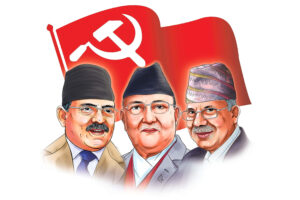
In an unprecedented political development, the Supreme Court on Sunday gave an odd verdict throwing national politics into turmoil. The SC not only unnecessarily squashed the merger between the then CPN-UML and the Maoist Centre but also tried to show that the Court could do also politics. No one, probably except for Prime Minister and his men, had expected such a verdict from the Apex Court.
Although it was the Election Commission that had done wrong in naming the unified party created by merging the CPN-UML and the Maoist Centre, the EC punished the opponents of Prime Minister KP Sharma Oli as if the Oli himself had written the verdict of the Court. The decision has made Oli who was almost on the verge of losing the leadership of NCP as well as the government stronger and weakened Madhav Kumar Nepal. Now Oli has become powerful in the UML even though he will be seen off from the post of prime minister soon if the current political equation continues.
The Supreme Court (SC) has given recognition to Rishi Ram Kattel’s party as Nepal Communist Party (NCP).
Issuing a writ of certiorari, a joint bench of Justices Bam Kumar Shrestha and Kumar Regmi on Sunday ordered the Election Commission, Nepal to authenticate Kattel’s party as NCP.
“The EC’s decision on October 26, 2018, to register the merged party of erstwhile CPN-UML and NCP (Maoist Centre) as NCP while a party with the same name was already registered inconsistent with Section 6 (1) (e) of the Act relating to Political Parties, 2073,” said the Supreme Court in its verdict.
The SC said that while registering a merged party as per Section 10 of the same Act, the party’s name should not be identical to an already existing party. “The EC cannot violate Section 6 (1) (e) of the Act while deciding as per Section 10,” read the SC verdict.
Citing that the EC’s decision was against Section 6 (1) (e) of the Act relating to Political Parties, 2073 and Rule 9 of the Political Parties Rule, 2074, the Supreme Court quashed the Commission’s decision to recognise the merger of the CPN-UML and NCP (Maoist Centre) to a new party named Nepal Communist Party (NCP).
The Apex Court also issued a writ of mandamus to the EC to register a new party if the CPN-UML and NCP (Maoist Centre) would want to continue their merger.
On August 23, 2013, Rishi Ram Kattel had registered a party under the name ‘Nepal Communist Party’. Five years later on June 6, 2018, the CPN-UML and NCP (Maoist Centre) merged party was registered at the EC under the same name, because the powerful party undermined Kattel’s.
On October 26, 2018, the EC had rejected Kattel’s plea and had given recognition to the NCP chaired by KP Sharma Oli and Pushpa Kamal Dahal ‘Prachanda’.
On December 7, 2018, Rishi Ram Kattel had filed a writ petition in the Supreme Court against the EC, NCP office at Paris Danda, and Chairmen Oli and Prachanda, claiming the name of the party by quashing the EC’s decision. Now the court gave justice to Kattel but punished Madhav Kumar Nepal and Pushpa Kamal Dahal, who were enjoying a majority in the central committee of the quashed NCP.
EC upholds SC decision against UML-Maoist merger giving them their previous names
Following the Supreme Court’s decision, the Election Commission has reinstated the unified CPN-UML and NCP (Maoist Centre) to their individual status although the EC’s decision may also be challenged in court.
Issuing a press statement on Tuesday regarding the decisions taken by the Commission in order to implement the SC’s order of March 7, the EC said, “In line with the Supreme Court’s decision, the Commission has decided to regard the unified Nepal Communist Party as separate parties like they were prior to June 6, 2018.” The EC also decided to publish the same in the Nepal Gazette.
Likewise, the Commission has also decided to dismiss the notice published in the Nepal Gazette on June 6, 2018, regarding the unification of CPN-UML and NCP (Maoist Centre) as a unified party.
As per the SC’s decision to quash the Nepal Communist Party merger, the Commission has further decided to inform the chairman of CPN-UML KP Sharma Oli and chairman of the Maoist Center Pushpa Kamal Dahal ‘Prachanda’ about the dismissal of the NCP registered in the Commission under registration number 145.
Stating that the CPN-UML with registration number 32 and NCP (Maoist Centre) with registration number 37 was now reinstated as separate political parties as they were before the unification, the EC urged Gopal Kiranti, chairman of NCP (Maoist Centre) to change the party name and election symbol, and Sandhya Tiwari, chairperson of CPN-UML to change her party name within 15 days.
Furthermore, the Commission said that if the CPN-UML and the NCP (Maoist Centre) wanted to unite again, both the parties may file an application to the Commission with a new proposed name and symbol along with the copies of the decision of the central committee meeting of their respective parties in line with the Act relating to Political Parties, 2073 and Rules 2074.
However, it is unlikely that the two parties will reunite in near future.
UML leaders backing Dahal-Nepal faction in NCP face a legal problem, return home
Madhav Kumar Nepal and the leaders of the CPN-UML who were united under the Dahal-Nepal faction have been found in a difficult position after the Supreme Court quashed the Nepal Communist Party dividing it into CPN-UML and the Maoist Centre.
However, Nepal and other leaders have already decided to abide by the Court verdict, they may be in an uneasy situation because they need to work under Prime Minister KP Sharma Oli against whom they were launching a struggle for months. The controversial decision of the court has made PM Oli victor and his aides have already started expressing pinching words against leader Nepal and others. Surya Thapa, press advisor of PM Oli, in a tweet told Nepal and other leaders to take retirement from politics. The insulting remarks of Thapa were not unusual considering his rude behaviours against the opponents. Thapa, who might have been sucking mother’s milk when Nepal and Jhalanath Khanal were leading the communist movement, dares to make such comments because he feels he is fully protected by PM Oli.
However, despite facing such despise from a junior leader like Thapa, Madhav Kumar Nepal, who led the CPN-UML for over 16 years have no option but to remain within UML for which he had shed a lot of toils and sweat. Oli has been leading the party only for four years, but his sycophants like Thapa and others take that it was only Oli who led the party to the present position.
Although the leaders of the Dahal-Nepal faction have been claiming that they would challenge the EC verdict to not recognise the merger of the UML and the Maoist Centre, the move may not be fruitful as the court may take time to give its decision. Again, multiple things come together in such appeal because it was EC who had committed the mistake causing the present situation.
Prime Minister Oli to face no-confidence motion
With the unexpected separation of the UML and the Maoist Centre from a unified Nepal Communist Party by a court verdict, the government led by KP Sharma Oli has now lost its majority. He has to receive the vote confidence to remain in power and he has already said that he would seek it within a month.
However, it looks that Prime Minister Oli may face a no-confidence motion within a few days. Nepali Congress, the Maoist Centre and Janata Samajwadi Party have already started holding discussions to overthrow Oli. On Tuesday alone, JSP held its parliamentary party meeting while Pushpa Kamal Dahal of the Maoist Centre held talks with Nepali Congress president Sher Bahadur Deuba and JSP boss Dr Baburam Bhattarai.
Meanwhile, Prime Minister Oli has also reportedly held talks with a faction of JSP by forming a talk team. But the PP of the JSP held Tuesday evening did not recognise the talks. However, Oli is likely to apply every measure to divide the JSP so that it could garner majority votes to stick in power. Still, there is a risk for him, because if a few of the lawmakers close to Madhav Kumar Nepal remain absent during the voting, he could lose the power.
If all goes well with the current development, NC’s Sher Bahadur Deuba is likely to replace Oli by forming a coalition government of NC, Maoist Centre and JSP. And the new government will hold elections by May 2022.

Login to add a comment