







 By Our Reporter
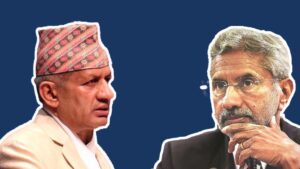
The much-talked-about India visit of Foreign Minister Pradeep Kumar Gayawali, which was widely portrayed by the government and the Nepal Communist Party faction led by Prime Minister KP Sharma Oli as a milestone in improving Nepal-India relations and sorting out the border and other issues, became a complete fiasco.
Neither did India agree to talk about the border issue relating to Kalapani, Lipulek and Limpiyadhur nor to accept the EPG report.
Moreover, Minister Gayawali was denied a meeting with Prime Minister Narendra Modi and Home Minister and powerful leader of the ruling Bharatiya Janata Party Amit Shah.
While Prime Minister KP Oli was easily available for the Indian Army Chief MM Narvane, RAW chief Samant Goel and Indian Foreign Secretary Harsh Vardhan Shringla during their visit to Kathmandu at the end of 2020, Indian Prime Minister Modi gave no importance to Minister Gyawali who had reached New Delhi as a reliable envoy of Prime Minister KP Sharma Oli. This clearly suggested that India has not been happy with PM Oli and does not want to give much importance to Nepal until Oil is in power.
The failure of Foreign Minister Gyawali to meet Modi and Shah in New Delhi may have served a blow to Prime Minister Oli who has been expecting Indian support for his latest suicidal move of House dissolution although India has been in favour of election in Nepal but only to overthrow Oli from power.
To note, India is not egger to discuss on border dispute including encroachment of the Nepali territory in Kalapani area in Daschula district.
Moreover, it has been widely assumed that Prime Minister Oli decided to dissolve the House of Representatives, which the Constitution does not allow, in the Indian design whose ground was said to be prepared during RAW chief Goel’s Kathmandu visit.
Prime Minister Oli also undermined the latest Nepal visit by a Chinese vice minister of the International Department of the Communist Party of China Guo Yezhou because of the same design. The state media, mostly the print, did not cover Guo’s meeting with the President and other leaders, as the men manning the state media did not take the visit friendly for Prime Minister Oli and his coterie. Guo was the first Chinese leader whose visit to Nepal was downplayed or ignored by the Gorkhapatra and The Rising Nepal, the two official dailies. These activities were attributed to the Prime Minister’s tilt towards India. Moreover, in his interview to the two Indian TV channels, Prime Minister Oli indirectly expressed his dislike to Belt and Road Initiative.
Of course, Prime Minister Oli who has now more enemies than friends in home has failed to get Indian backing as well. It is evident from Gyawali’s recent failed India visit.
However, upon his arrival at the Tribhuvn International Airport, Minister Gyawali did not forget to make ritual expressions that his visit to India had further consolidated the intimate and multidimensional relations between two inextricably linked neighbours — Nepal and India.
“While there, both countries held in-depth discussions on the review of 1950 Peace and Friendship Treaty, report of the Eminent Persons Group (EPG) and sorting out the border disputes,” he told journalists at the Tribhuvan International Airport on Saturday.
He said five areas of cooperation were primarily discussed during the meeting of the Nepal-India Joint Commission, held on Friday.
“Meeting of the Nepal-India Joint Commission has reviewed issues like political, security and border; connectivity/infrastructure and economic cooperation; trade and transit; energy and water resources; tourism and education and agreed to promote bilateral cooperation in these areas,” he added.
According to him, India has assured Nepal that it would give Nepal high priority for supplying COVID-19 vaccines.
Of course, except for receiving the assurance of India to provide COVID-19 vaccines, Minister Gyawali’s India visit remained unfruitful.

Login to add a comment