







 By Our Political Analyst
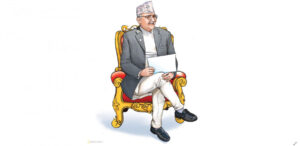
Nepal Communist Party that had swept the 2017 elections by clinching nearly a two-thirds majority in the federal parliament and by forming majority governments in six of the seven states is now on the verge of a split. If any other dramatic development like the six-point suggestions recently thrown by party vice-chairman Bam Dev Gautam does not take place, the party is sure to suffer a split as the enmity between Prime Minister and party chair KP Sharma Oli and another chair Pushpa Kamal Dahal has been deepening every other day.
When Dahal and Madhav Kumar Nepal group of the party has been asking Oli to quit both the posts of PM and party chair, Oli has outright rejected that demand. On Monday this week, he clearly gave a message to Dahal and Nepal camp that he would complete the full term of PM by stating that he would return to his private residence of Balkot only after two and a half years.
Oli reached Balkot in Bhaktapur on Monday after a failed meeting with Dahal in Baluwatar and met leaders close to him. When asked when he would return to Balkot, he replied that he would do that in the next two and half years, which means after completing the full term in office.
Although Dahal and Nepal have argued that Oli failed in both fronts—party and government, in reality, the greed of Dahal to become the PM and Nepal’s envy for Oli have been the main reasons for the disputes in the party. Of course, it is a leader-centric and ego-centric dispute
At the beginning of the dispute, the Dahal camp had asked Oli to quit either the post of PM or party chair but when Oli denied that, they started asking him to quit both the posts as a bargaining chip. Hence, the present dispute in the ruling NCP deepened with the usual demand of ‘one post one man’, which has weakened or even eaten up Nepal’s political parties.
The disease of ‘one-post-one-man’ has been wreaking havoc in Nepal’s political parties right from the 1951 political change and the Nepali Congress became its first victim when the party got divided over the same demand. Matrika Prasad Koirala formed another party after the dispute between BP Koirala and Matrika. The same demand had played a key role behind the fall of BP Koirlaa-led government in 1960. When BP became the first elected PM after 1959 general elections, a section of the leaders in the party started demanding that BP Koirala should quit one of the posts—PM or party chair. But BP Koirala did not do that. As a result, the dispute widened and many influential NC leaders joined the Panchayat system immediately after the fall of the Koirala-led government.
After the fall of Panchayat regime in 1990, the same disease started haunting the party. Nepali Congress suffered a split and the Rastriya Prajatrantra Party faced the same fate. Both Girija Prasad Koirala and Krishna Prasad Bhattarai faced non-cooperation from the party due to the demands of one post one man, but Sher Bahadur Deuba broke NC in 2002 when he was Prime Minister and failed to get support from party president Girija Prasad Koirala.
However, the practice in Nepal has been that it is the party chief who becomes the parliamentary party leader and the PM if the party is in a position of forming the government. But in India, Prime Minister Narendra Modi is not the party chief of his party BJP, and he has been leading the government with a firm fist for over six years. Even Manamohan Singh was not party chief but became PM. But in Nepal, the party chiefs are not that liberal to allow others to become PM until the circumstances go against them. And the demand for ‘one-post-one-man’ does not look suitable in Nepal considering the practice of the party president becoming the PM with a few exceptions.
And now the NCP leaders are raising the same demand. But their demand is not for a system but only a ladder to climb the power. Even Dahal will not quit the post of party chair even if he is offered the post of PM. It is noteworthy to mention here that both the Madhav Kumar Nepal-led and Jhalanath Khanal-led government collapsed because of non-cooperation from within the then CPN-UML. And now the former UML leaders have used the shoulder of Dahal to fire guns at Oli.
People’s Review Print Edition

Login to add a comment