







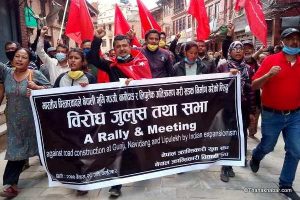
Youths organising demonstration in Kathmandu against India
By Our Reporter
India has never been a good friend to Nepal. Several evidences since India’s independency in1947 prove this. India is solely responsible for political instability in Nepal as it has been using one force against another. Everyone knows that since political coup of 1959, all the unwanted political incidences in Nepal like the Maoist insurgency, abolition of monarchy and the violent Madhes movement were orchestrated in the guidance of the Indian establishment. Initially, India gave shelter to the Maoists who waged a senseless killing spree in Nepal for a decade since 1996 killing 17,000 Nepali, disturbing social and communal harmony and causing physical destruction worth billions of rupees. It imposed inhuman three blockade against Nepal with the latest being in 2015, just a few months after Nepal was hit by a massive earthquake. Obviously, the blockade was imposed in the support of the Madhes movement.
Besides fuelling the forces which want destabilisation in Nepal, India has been making a direct attack on the territorial integrity of Nepal by breaching treaties and international practices. Interestingly, such incidences have multiplied after Narendra Modi became Prime Minister of India in 2014. His government imposed blockade in 2015 and now it has built a road through Nepali territory in Kalapani.
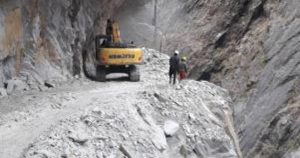
Indians constructing road in Lipulekh, Nepali territory
After Indian Defence Minister Rajnath Singh inaugurated the 80-km road built by Border Road Organistaion of India to connect the strategic pass in the name of facilitating the pilgrims to reach Mount Kailash, a holy mountain in Tibet Autonomous Region of Chinaon Friday, Nepal has strongly objected the move.
The government, the foreign ministry and political parties and leaders strongly objected to the act.
On Monday, the Ministry of Foreign Affairs (MoFA) has handed over a ‘diplomatic note’ to Indian Ambassador to Nepal Vinay Mohan Kwatra expressing Nepal’s position on boundary issues especially in the Kalapani area.
Minister for Foreign Affairs Pradeep Kumar Gyawali summoned Ambassador Kwatra at his office at the Singha Durbar and conveyed Nepal’s position on boundary issues, according to a tweet of the MoFA.
The ‘diplomatic note’ follows the objection of the government on Indian road project from Pithoragarh of Uttara Khand to Chinese border Lipulek.
Earlier, on Saturday the MoFA had reiterated that the Kalapani region (about 400 square km), including Limpiyadhura and Lipulek east of the Kali River, are Nepal’s territory as per the Sugauli Treaty of 1816.
It also regretted the unilateral act of the southern neighbour saying that it was against the understanding reached between the two countries including at the level of prime ministers that a solution to boundary issues would be sought through negotiation.
Nepal had also reminded the fact to India in 20 November 2019 as the latter kept Nepal’s Kalapani area in its territory in a map published then.
FM Gyawali at the Federal Parliament’s International Relations Committee also on Monday said that Nepal wanted an immediate dialogue with India on the border issues although the southern neighbour was evading the proposal saying that it could be held after the coronavirus pandemic is brought under control.
“But we cannot wait for any longer, we want to resolve the issues at the earliest,” he said.
Indian Ministry of External Affairs had claimed that the road was built in its own territory and proposed a dialogue with Nepal after the pandemic is over.
India and China in 2015 had agreed to develop Lipulek – a Nepal-China border point – as a bilateral trade route, which was strongly opposed by the Shusil Koirala-led government. It was also said that late Koirala was denied a scheduled state visit to India for opposing the move.
Nepal shares 1690 km long border with India and 1414 km with China.
Chairmen of the ruling parties KP Sharma Oli and Pushpa Kamal Dahal, Nepali Congress President had criticised the act of road building in Nepali territory while former king Gyanendra, who was dethroned in 2008 in an Indian design, had suggested for an amicable solution to the border dispute.
Nepali Congress on Monday separately demanded that the territory of Nepal of should be safeguarded through high-level diplomatic initiatives with both the neighbouring countries, India and China.
NC spokesperson Bishwa Prakash Sharma issuing a statement urged the government to forward serious steps to resolve the border issue through high level diplomatic process as the NC since long has been clearly stating that Kalapani, Limpiyadhura and Lipulek are Nepali territory.
While leaders have objected to the encroachment of Nepali territory by India, people have taken to street across the country protesting against India. An angry demonstrators even burnt an effigy of Indian PM Modi in Kathmandu. The angry people also burn effigy of Prime Minister KP Sharma Oli for failing to safeguard Nepali territory. It is noteworthy to recall here that Oli’s party had swept the 2017 polls because of his nationalistic stance during 2015 blockade.
Interestingly, China is also seen tilted towards India in the Kalapani case because China had inked the agreement with India ignoring that Kalpani was Nepali territory. The Kalapani case suggests that good relations between the two giant neighbours could pose a big threat to Nepal’s sovereignty if the government and leaders here do not act diplomatically.

Login to add a comment