







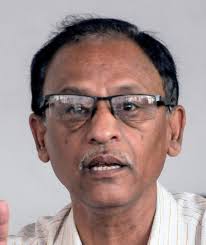
By P Kharel
A court in Seoul last fortnight gave Unification Church’s 83-year-old leader Han Hak-ja two-year jail sentence for bribing South Korea’s former first lady Kim Keon Hee. She had given Kim, the wife of ousted President Yoon Suk Yeol, two expensive bags and a diamond necklace, estimated to worth $57,900. The “gifts” were in exchange for business favours. Convicted of procuring political influence for personal gains, Han’s age might save her from completing the term, if at all.
Earlier this year, Kim was given a 20-month jail sentence for taking the bribes from the widow of the Unification Church’s founding father Sun Myung Moon, a self-proclaimed messiah, who his followers claim became one with God, spoke God’s words and did God’s work.
Former Prime Minister Madhav Kumar Nepal is reported to have attended many of the Mother Moon’s programmes in various cities. In 2017, a “Holy wine incident” in Kathmandu occurred, when Prime Minister KP Oli stayed put at a five-star hotel, the venue for the Asia-Pacific Conference, which is about six km from his official residence at Baluwatar. Oli’s couple of overnight stay at the hotel did not go well with the press. Kathmandu’s elite considered the incident politically and diplomatically inappropriate.
Many complaints in Korea and other countries were reported about the Church cult coercing the “Moonies” to part with big sums of money. The complaints went largely unattended until the assassination of Japan’s former Prime Minister Shinzo Abe in 2022 during an election campaign speech he was giving in Nara city. The convicted assassin, who was given a life term in jail, blamed the Church for bankrupting his family and held a grudge against the ex-premier for actively supporting it.
EXPANDED LINKS: Flaunting its links with people in high places not only in South Korea but other countries as well, the Church’s contacts had multiplier effects. When it released the list of the organisation’s new think tank in 2021, former US Vice-President Mike Pence and Shinzo Abe were among a host of prominent names. While Singapore banned the group, Japan directed it to dissolve.
Japan’s current Prime Minister Sanae Takaichi proudly and openly an ardent admirer of the late Abe who holds the record of nine years in the premier’s chair, spread over two innings until he stepped down in 2020 on grounds of health.
But the Unification Church and the “Mother Moon” continued to have their sway in many countries, including Nepal, where communist leaders lined up to meet and greet her in Kathmandu in what later came to be termed the 2017 “holy wine incident”.
The KP Oli government was the target of public criticism for co-hosting the Universal Peace Federation, the umbrella under which the Unification Church functioned. At a time when demands for restoring Nepal as a Hindu State was gathering momentum, the country’s prime minister had agreed to co-organise the Unification Church conference in the capital. He and many other ruling party leaders received “Holy Wine” blessings from the Reverend Mother.
The Nepalese prime minister apparently felt honoured to hobnob with foreign leaders like Cambodia’s long-time Prime Minister Hun Sen and Myanmar’s State Counsellor and Nobel Peace Laureate Aung San Suu Kyi. He seemed to have been carried away by the international trappings that the Church created. Moreover, the event was recommended by his party’s senior members.
TOEHOLD IN CABINET: Eknath Dhakal, then chairman of Parivar Dal [translated, Family Party], has been the key person associated with the Unification Church and activities in Nepal. Although his party had only one seat obtained through proportional representation mechanism, he became a coalition government minister at least twice. Eventually, Parivar Dal merged in KP Oli’s Communist Party of Nepal (Unified Marxist-Leninist).
Oli was honoured with a Good Governance Award. Whether on second thoughts after the controversy over the organisation in the press or as per pre-planned, the Peace Foundation handed over a purse of $100,000 to the Nepal government.
Known to have their presence in Nepal since 1975, the Unificationists came to limelight after the political change in 2006 here, after which their fraternity is believed to have expanded locally. The late Moon himself had visited Nepal to give a boost to his campaign.
The Church denies charges of exercising political influence methodically. Whether the accusations have any substance might be debatable but the fact remains: No state should be unduly influenced by such groups.
Let us leave the Unification Church at that for now.
But that does offer an opportunity to dwell upon activities of “help” organisastions and I/NGOs of varied hues and banners, which go to great lengths in undertaking their missions far and wide.
MANIPULATIVE: Even honours and awards are given for influence—false pride for the recipient and political capital and perhaps economic benefits for the “benefactor”. There is no denying that such schemes are laid out by governments and other organisations, directly or indirectly. The issue is one of identifying accurately the culprits in their dubious game.
Every effort must be made to trace and track the activities of groups that might disguise as innocuous men and women engaged in public welfare, awareness and cooperation. Vigilance need to be maintained as what really goes behind the façade of their public pronouncements should. At the same time, care should be vigorously made to ensure that the innocent are not victimised on the basis of mere rumours and unsubstantiated accusations.

Login to add a comment