







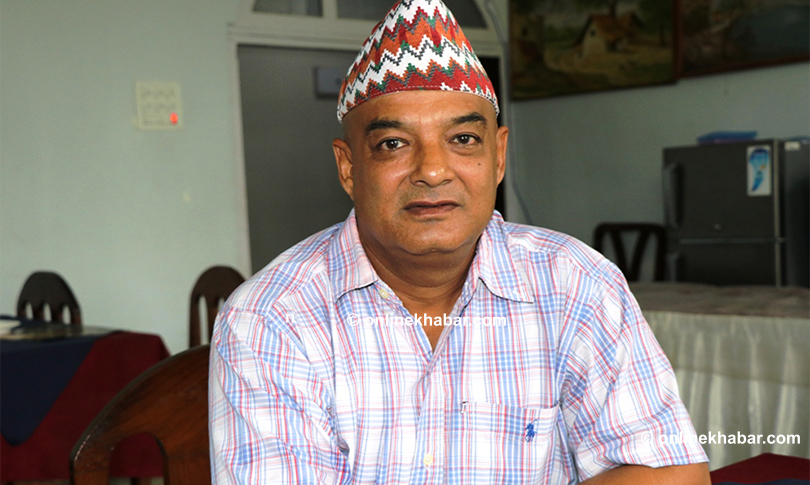
Kathmandu, September 19: Jai Nepal Party Chairman Dr. Dhawal Shumsher Rana has claimed that Nepal’s current constitution has failed to serve the interests of the country and its people. Arguing that the country’s economic, social and educational conditions, as well as employment opportunities, have failed to improve even as the constitution approaches its 10th anniversary, he said the constitution should not merely be amended but replaced.
In an exclusive interview with Nepal News Bank, Rana questioned the republican and federal systems enshrined in the current constitution and said his party favoured a new constitution. He made it clear that his party’s position was that the new constitution should provide for a constitutional monarchy and a Hindu state.
Asked about the government’s ongoing process to amend the constitution, Rana said that although the constitution was approaching a decade in existence, it had failed to deliver the expected results in terms of the country’s development and progress.
According to him, although the Rastriya Swatantra Party (RSP) has raised the issue of constitutional amendment, the necessary parliamentary arithmetic does not currently exist to move the process forward. Under the constitutional provision concerning amendments, a two-thirds majority of the total number of members currently in office in both houses of Parliament is required.
Rana said that instead of merely amending the current constitution, there was a need to draft a new one. “The constitution needs to be dissolved and a new constitution suited to the Nepali people and the soil of Nepal needs to be drafted,” he said.
He said his party favoured establishing, through a new constitution, a Hindu state based on Sanatan Dharma and a democracy with a constitutional king.
Chairman Rana claimed that the current constitution was making Nepali people poorer. He said Nepal had considerable potential in terms of natural resources but had been unable to utilise them, while expected improvements had not been seen in employment, economic activity and the living standards of the people.
Reforms Possible Through Amendments, but the System Itself Must Change
Rana did not rule out the possibility of improving certain provisions of the current constitution through amendments. Saying that extensive reforms were necessary in areas such as the judiciary, education and health, he said some issues could be changed within the framework of the Constitution.
“This constitution can also be amended by giving space to the king and the Hindu state, and many rules and laws need to be formulated,” he said.
However, questioning the republican system adopted by the constitution, he reiterated that fundamental changes to the system were necessary.
Development Cannot Be Measured by Roads Alone
Rana argued that roads, bridges and physical infrastructure alone should not be used as the basis for determining whether the current Constitution has been successful or unsuccessful. He said the country’s economic condition, employment, education, health and the living standards of citizens should be regarded as the principal indicators of development.
He said the condition of healthcare, education, old age, unemployment and inflation should also be considered when measuring the success or failure of the constitution.
Although there are claims that the constitution has provided citizens with freedom and rights, Rana said the growing use of information technology has made it increasingly difficult to distinguish truth from falsehood. He said content appearing on social media, abusive language and AI-generated material had made it difficult to distinguish reality.
Rana said that although changing the constitution did not appear immediately possible, political circumstances were fluid and sudden changes could occur. He cited the recent Gen-Z movement as an example.
“Politics is fluid. Did anyone think there would be a Gen-Z movement?” he asked. “The Gen-Z movement proved that anything can happen in politics if the people want it.”
He said that because political circumstances could change rapidly, he believed changes to the current system were also possible.
Not an Active Monarchy, but a Constitutional Monarchy
Rana made it clear that his party was not in favour of an active monarchy. He said they supported a monarchy that remained within the Constitution and played a guardian-like role.
“Jai Nepal Party is not in favour of an active monarchy,” he said. “We believe the country needs a monarchy that remains within the Constitution, plays a guardian role and acts as the head of the family.”
Referring to the 1990 People’s Movement, Rana claimed that although the main demand of the movement at the time was to end active monarchy, it was not a demand to abolish the monarchy itself.
He said the monarchy was subsequently abolished through political developments and that, in his view, Nepali people were now regretting the decision.
“The Nepali people never said that the king or monarchy should be abolished,” he said. “The Maoists’ objective was to remove the king. But other parties followed the Maoists and removed the monarchy. And now the entire country is regretting it.”
In Favour of Restoring a Hindu State
Rana said his party favoured restoring Nepal as a Hindu state. He argued that a Hindu state could be established while safeguarding the rights of different religious communities in Nepal.
“The Hindu state would include Kirat, Buddhist and all other religions. This country belongs to everyone, but if we could make it the world’s only Hindu state, Nepalis would also be happy and their religion and culture would be preserved,” he said.
He claimed that restoring a Hindu state could also have a positive impact on Nepal’s economy through religious tourism.
“If 1.5 billion Hindus regarded Nepal as their religious destination and came here on pilgrimage, it would greatly contribute to the country’s economic progress as well as religious tourism,” he said.
Proposal to Reform the Inclusive Proportional Representation System
Rana said the objective of the inclusive and proportional representation system incorporated into the current Constitution was good, but problems had emerged in its implementation.
He said the Constitution had introduced the inclusive process with good intentions, but alleged that the proportional representation system had become a means for political leaders to send their relatives and close associates to Parliament.
Rana also proposed reducing the size of the House of Representatives and concentrating proportional representation seats in the National Assembly.
Federal Structure Needs to Be Reconsidered
Rana said the structure of federalism also needed to be reconsidered. He said there should be extensive discussions with experts about the need, role and administrative structure of the provinces.
He proposed strengthening the local level. According to him, the number of local governments should be reduced while increasing their geographical size, and local bodies should be strengthened in terms of authority and resources.
Opposition to a Direct Executive System
Rana said he was not in favour of proposals for a directly elected executive prime minister or president. He said a direct executive system could weaken the balance of power and stressed the need for checks and balances.
According to him, adopting a direct executive system in Nepal, which lies between powerful countries, could raise questions about controls over decisions made by the executive.
Rana said that if the government sought suggestions for constitutional amendments, his party had clearly defined its major issues. He also said his party did not believe that anyone should be deprived of rights on the basis of religion. According to him, the rights of all religions and communities must be protected.
“This Constitution Has Not Been Beneficial to Our Country”
In a message to well-wishers and the general public on the occasion of Constitution Day, Rana reiterated his conclusion that the current Constitution was not in Nepal’s interest.
“This Constitution is not in the interest of the nation of Nepal; it needs to undergo fundamental change,” he said.
He said the Constitution should be changed in a way that incorporates Nepal’s values, norms and traditions.
Rana also urged the general public to reconsider their views on the current Constitution.
(Nepal News Bank)

Login to add a comment