







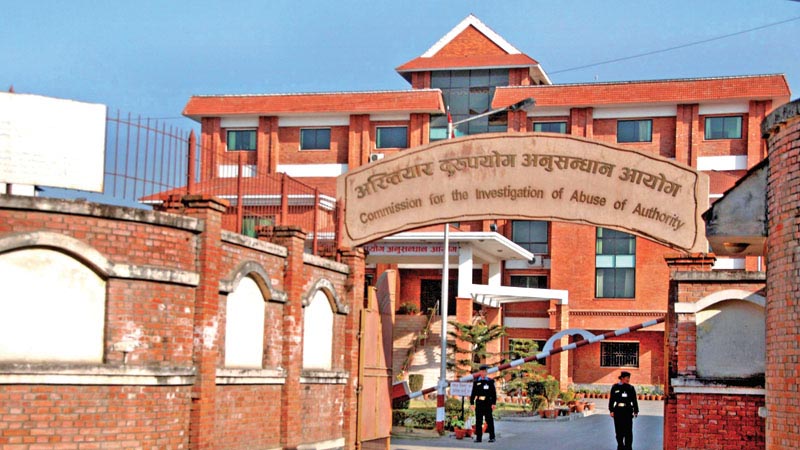
Kathmandu, Sept 18: More than half the complaints of corruption and irregularities handled by the Commission for the Investigation of Abuse of Authority (CIAA) in fiscal year 2025/26 concerned local and provincial governments.
According to the commission’s 36th annual report submitted to the president, provincial and local governments have faced a heavier volume of complaints than federal ministries in recent years.
CIAA spokesperson Suresh Neupane said both corruption risks and complaints had risen sharply at the local and provincial levels following the transfer of financial powers.
“An analysis of the nature and number of complaints received by the commission shows that irregularities at the local level are the most concerning,” Neupane said. “Of the 40,842 complaints on record last fiscal year, 49 per cent, or 20,025, concerned local governments alone.”
Federal bodies accounted for 37.98 per cent of complaints, or 15,512, while provincial bodies accounted for 12.99 per cent, or 5,305.
An analysis of complaints at the provincial and local levels shows that Madhesh Province and Kathmandu Metropolitan City (KMC) topped their respective categories.
Among complaints concerning provincial governments, Madhesh accounted for the largest share, at 27.8 per cent, or 1,475 complaints. Gandaki had the smallest share, at 7.67 per cent.
Municipalities and rural municipalities in Madhesh also accounted for 36.8 per cent of all complaints concerning local governments, with 7,370 complaints.
“Among individual local governments nationwide, Kathmandu Metropolitan City received the highest number of complaints, at 721,” Neupane said. “It was followed by Pokhara Metropolitan City, Videha Municipality in Dhanusha and Chhipaharmai Rural Municipality in Parsa.”
Among federal ministries, complaints concerning land management, cooperatives, federal affairs and general administration accounted for the largest share, at 19.57 per cent. The Ministry of Education and Sports and the Home Ministry followed.
By subject, more than a third of all complaints, or 35.35 per cent, concerned federal affairs and local administration. Education, illicit wealth accumulation and land administration were the other sectors with high numbers of complaints.
Following inquiries and investigations, the commission filed 175 cases at the Special Court during the last fiscal year.
It sought recovery of Rs 35,236,597,989 from 990 defendants, comprising 145 women, 801 men and 44 organisations.
The largest number of cases, 56, concerned damage to public property, followed by 41 involving bribery and 27 involving unlawful gains or losses.
Of the 156 cases decided by the Special Court during the year, 81, or 51.92 per cent, resulted in convictions, according to the commission.
Despite the sharp rise in complaint numbers, the commission said it still lacked sufficiently detailed complaints supported by facts.
“The nature and methods of corruption are becoming more complex as technology advances. To address this effectively, the commission needs staff with specialised expertise, modern technology and a proactive investigation system,” Neupane said.
“The public perception that controlling corruption is solely the commission’s responsibility also needs to change.”
Of the 40,842 complaints on record, the commission disposed of 32,823, or 80.37 per cent, through preliminary inquiries and screening. The remaining 8,019 were carried forward to the new fiscal year.
People’s News Monitoring Service

Login to add a comment