







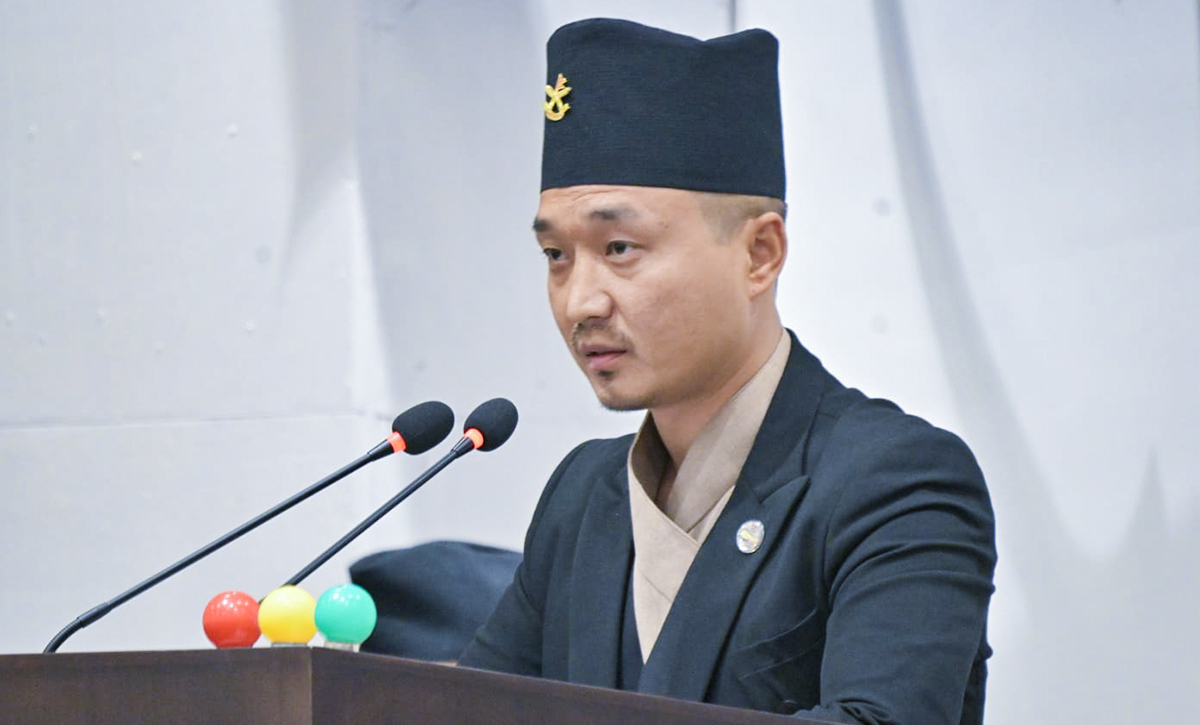
By Our Reporter
The demand by human rights activists, senior lawyers and civil society figures for Home Minister Sudhan Gurung to withdraw his remarks against journalists and apologise is not simply another dispute between a politician and the media. It raises a larger question about how a senior state official should speak to institutions whose job is to question those in power.
Gurung’s latest remarks have drawn particular concern because they fit a broader pattern of controversial public statements that have often created unnecessary disputes. His comments have not gone down well with people from different fields, including journalists and political actors. A minister may disagree with criticism, challenge a report or defend his record. What he cannot reasonably do is treat every critic as an enemy and respond to uncomfortable questions with language that can be interpreted as a threat.
That distinction matters even more for a home minister. The ministry oversees internal security, policing and disaster management. The person occupying that office exercises considerable authority over the state machinery. When such a minister uses threatening language against journalists, the concern is not limited to hurt feelings. It can create fear about whether the state may use its power against those who question it.
The activists have also raised concerns about Gurung’s past controversies and the questions surrounding his appointment and allegations against him. Those issues make restraint even more important. A minister facing public scrutiny should respond with evidence and explanation, not hostility.
There is also a basic misunderstanding that politicians sometimes have about journalism. Journalists are not required to praise ministers, accept official claims without question or protect public figures from criticism. Their job is to ask difficult questions, examine decisions and report matters of public interest.
Nepal’s press has done that through difficult periods, from the Panchayat era and the armed conflict to the Narayanhiti palace massacre, King Gyanendra’s direct rule and the political transition that produced the present constitutional order. Journalists have faced threats before and continued reporting.
That does not mean journalists are above criticism. They must follow professional ethics, verify information and give people a fair opportunity to respond. If a report is inaccurate, the proper response is evidence, correction and, where necessary, legal action. Threats are not a substitute for any of these.
Gurung should therefore change his approach to criticism. He does not need to agree with journalists or political opponents. He needs to learn to distinguish criticism from hostility and scrutiny from conspiracy.
The home minister should establish a simple rule for himself: respond to allegations with facts, to criticism with arguments and to mistakes with corrections. If a journalist crosses an ethical or legal line, use the established mechanisms instead of personal attacks.
The activists are right to ask for an apology. An apology would not weaken the minister. It would show that he understands the limits of his office.
Gurung still has an opportunity to turn the controversy into a lesson in public leadership. The home minister has considerable power. The strongest way to use it is not to silence people he dislikes, but to demonstrate that even uncomfortable questions can be answered without intimidation.
A minister should be judged not by how effectively he silences critics, but by how calmly he responds when they refuse to remain silent.

Login to add a comment