







By P.R. Pradhan
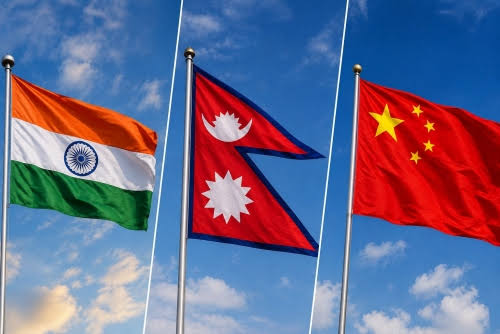
Both China and India are in the process of normalising their bilateral relations. After the military standoff along their disputed Himalayan border, Indian Prime Minister Narendra Modi and Chinese President Xi Jinping have taken several steps towards improving relations. Modi and Xi met in New Delhi on September 12 on the sidelines of the 18th BRICS Summit, Xi’s first visit to India in seven years. Both sides stressed the importance of maintaining peace along the border and resolving their differences through dialogue.
During their bilateral meeting, Xi said that China and India should view each other as partners rather than rivals and work together for development. Modi also stressed mutual respect, sensitivity and interest. The two leaders agreed to expand economic, trade and people-to-people ties while continuing efforts to resolve the long-standing boundary question.
India’s relations with the United States have also entered a more complicated phase, particularly because of disagreements over trade and the policies of the Donald Trump administration. This changing relationship could encourage New Delhi to maintain greater strategic engagement with Beijing, even though the two countries continue to face a long-standing border dispute and significant strategic differences.
Xi has repeatedly advocated a more multipolar international order and greater cooperation among countries of the Global South. China sees BRICS as an important platform for strengthening the voice of developing countries and promoting a more balanced international system. At the same time, India has sought to maintain strategic autonomy rather than align itself completely with either China or the United States.
Impact on Nepal
Nepal’s position between the world’s two most populous countries requires particularly careful diplomacy.
Nepal was not among the countries participating as members of the expanded BRICS grouping at the New Delhi summit. This should not, however, automatically be interpreted as evidence that India has deliberately excluded or undermined Nepal’s present Rastriya Swatantra Party government. Nepal is not a BRICS member, and the absence of an invitation by itself does not establish such an intention.
Nevertheless, the rapidly improving China-India relationship has important implications for Nepal. Kathmandu must closely monitor how Beijing and New Delhi manage their bilateral relations, particularly on border issues, trade, connectivity and regional security.
At the same time, there have been reports and allegations regarding growing American influence among Nepal’s younger political leaders and civil-society groups. Documents relating to a US-funded youth programme implemented through the International Republican Institute have received considerable attention. A report published by People’s Review, citing internal documents, said that a $350,000 programme supported youth mobilisation and political training in Nepal and was designed partly to counter Indian and Chinese influence.
However, allegations that individual Nepali leaders such as Balen Shah, Rabi Lamichhane or Sudan Gurung are American agents, or that the September 2025 Gen-Z uprising was directly organised or sponsored by the US government, cannot be denied when some American media have made public the report.
There have also been reports and social-media claims concerning the possible exploration or exploitation of uranium or other critical minerals in Mustang and alleged involvement of foreign companies or security forces. These claims deserve scrutiny because Mustang is strategically sensitive, being close to the Nepal-China border and the Korala trade point.
Such allegations should be investigated transparently. Any agreement concerning strategic minerals, foreign security personnel or military involvement in a sensitive border area would naturally have serious implications for Nepal’s relations with China and India.
Lipulekh: A Serious Concern for Nepal
More immediately, Nepal faces a concrete geopolitical problem over the Lipulekh Pass.
India and China agreed in 2025 to resume border trade through Lipulekh, and trade through the pass resumed in August 2026 despite Nepal’s objections. Nepal maintains that the area, including Kalapani, Lipulekh and Limpiyadhura, lies within Nepali territory. It is reported that Lipulekh is located about 56 kilometres inside Nepal’s western frontier according to Nepal’s official position.
The resumption of India-China trade through Lipulekh is therefore a serious diplomatic challenge for Kathmandu. It demonstrates that improving India-China relations can sometimes produce developments that are contrary to Nepal’s territorial interests.
Nepal cannot afford to remain a passive observer while its two giant neighbours improve their relations. Nor should Kathmandu allow itself to become a strategic battleground between China, India and the United States.
There have also been claims about large stocks of arms being kept in some Tibetan monasteries. Such allegations require credible evidence and should not be treated as facts without independent verification. If foreign military activities, arms storage or strategic deployments were ever established in areas close to Nepal’s northern border, they would obviously raise serious security concerns.
Nepal Must Avoid Becoming a Geopolitical Launchpad
The greatest danger for Nepal is not simply choosing between China, India and the United States. The real danger is allowing Nepal to become a geopolitical launchpad for any external power against another.
Nepal shares a long and sensitive border with China and an open border with India. Its economic, social and security interests are deeply connected with both neighbours. India remains Nepal’s overwhelmingly dominant trading partner, accounting for about 62.3 percent of Nepal’s merchandise trade, while China is also an increasingly important economic and strategic partner.
Nepal therefore needs a balanced and independent foreign policy based on national interest, sovereign equality, non-alignment and the principles of Panchsheel.
The government must be particularly careful about foreign-funded political activities, military cooperation, strategic mineral agreements and security arrangements in sensitive border areas. Transparency is essential. If foreign assistance or cooperation is legitimate, there should be no reason to conceal it. If any arrangement has security implications, Parliament and the Nepali people have a right to know.
Nepal must also understand that improved China-India relations do not necessarily mean that Nepal’s interests will automatically be protected. The Lipulekh issue is a clear reminder of this reality.
The government in Kathmandu must therefore maintain equally cordial relations with both neighbours while firmly defending Nepal’s territorial integrity and sovereign interests.
Nepal should neither become an anti-China platform nor an anti-India platform. Equally, it should not become a platform for any outside power seeking to expand its strategic influence in South Asia.
Nepal’s location between China and India is a geopolitical reality. It can either become a source of opportunity through balanced diplomacy, connectivity and economic cooperation, or a source of instability if the country becomes entangled in great-power rivalry.
The choice ultimately rests with Nepal’s political leadership.

Login to add a comment