







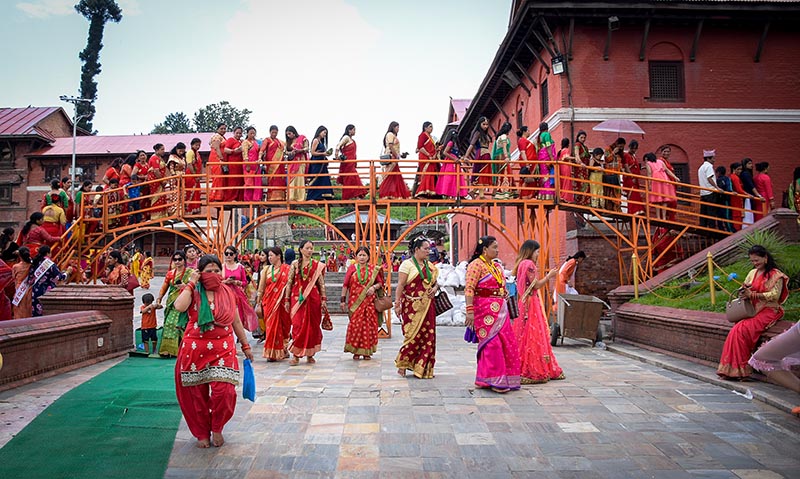
Kathmandu, Sept 14: The Haritalika Teej festival, observed on the third day of the bright fortnight of Bhadra, is being celebrated today with prayers and worship dedicated to Lord Shiva. Hindu tradition holds that fasting and worshipping Shiva and Parvati on this day brings happiness, peace and well-being to the family.
According to Hindu mythology, the tradition of Teej began in the Satya Yuga, when Parbati, the daughter of Himalaya, performed penance at Gaurighat and received a blessing that she would marry Lord Shiva.
When her father, Himalaya, later tried to arrange her marriage to Lord Bishnu against her wishes, Parbati shared her distress with her friends. After learning of her plight, her friends took her away and hid her in a secluded place where no one could find her. Parbati then undertook a fast without food and eventually won Lord Shiva as her husband.
According to religious texts, the practice of observing the Haritalika Teej fast began from the same day, the third day of the bright fortnight of Bhadra, when Parbati was taken away by her friends.
The word Haritalika is derived from two Sanskrit words, “harit” and “alika”. “Harit” means “taken away”, while “alika” means friend.
It is believed that Parbati obtained Lord Shiva as her husband after observing a complete fast on this day in the Satya Yuga. Hence, devotees believe that fasting on Teej can help fulfil their wishes. Religious scholars, however, say this does not mean that all women must observe a fast without food or water.
There are three forms of fasting: fasting without food or water, fasting with water, and fasting with fruits. Those who are physically able may observe a complete fast, while those who cannot may fast with water or fruits.
As women traditionally observe the fast as representatives of the family, men also observe it when women are unable to do so or are menstruating.
Religious scholars say the overall purpose of the fast is to fulfil wishes and seek the well-being of the entire family. Both spiritual and theistic followers observe the fast. Overall, Teej is regarded as significant for happiness and peace in family life and for spiritual well-being after death.
Religious texts classify fasting into five categories: obligatory, voluntary, regular, occasional and wish-fulfilling. The Teej fast is traditionally regarded as both an obligatory and wish-fulfilling fast.
Religious texts also state that the Teej fast is not limited to Hindus but is intended for humanity as a whole.
People’s News Monitoring Service

Login to add a comment