







By Our Reporter
The disastrous flood on August 26 revealed a disturbing divide between how the government seems to be reacting to disaster and how people on the ground perceive that reaction.
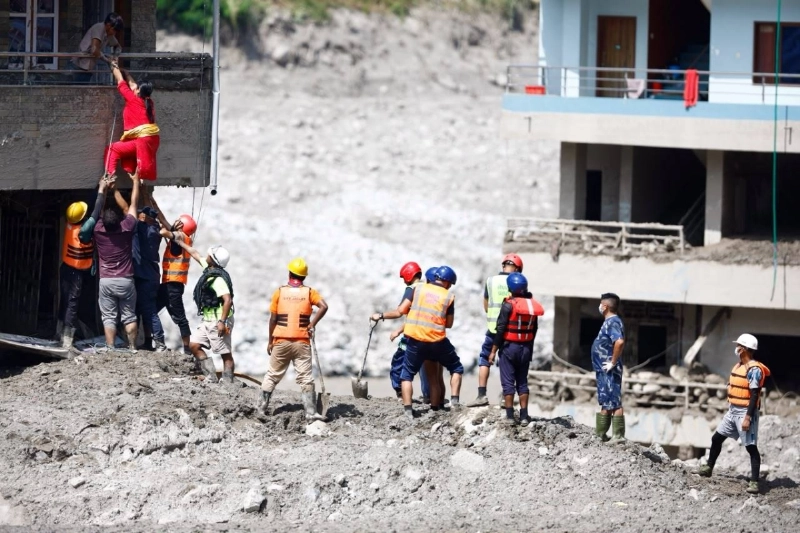
The flood devastated areas from Rasuwagadhi’s border crossing to Nuwakot’s Dhunge Bazaar and Devighat. Upstream communities like as Betrabati, Syafrubesi, and Timure were devastated, with houses destroyed, livelihoods lost, and dead purportedly spread around the impacted districts.
However, while the government has been visible in more accessible places ranging from Battar to Trishuli, it has been significantly less successful in Rasuwa’s hardest-hit upper belt. That distinction is significant since the final success of a crisis response is determined not by the number of announcements made, but by whether assistance reaches those in most need.
Two days after the flood, on August 28, a reporting team from Betrabati came upon an Armed Police Force unit with a sniffer dog coming toward the location. Many inhabitants above Betrabati, however, experienced no real feeling of state presence over the first two days. Even when the APF team came, people said that its intervention was mostly restricted to public statements until it returned.
“The APF crew arrived on the third day with a dog. They looked about Betrabati before returning. “The bodies here have yet to be recovered,” claimed local resident Narayan Lal Dangol.
For survivors, the lack of government aid was like a second calamity. Homes and food supplies had vanished, family members had been injured, and access to medical care was limited. “So far, we have not gotten any assistance. “No one from the administration has come to check on us,” resident Indramaya Dangol explained.
The alleged failure to recover bodies adds to the agony. When survivors are waiting for food, medication, and shelter while the dead go uncollected, the problem is more than just logistical. It is now an issue of whether the state has developed an effective command structure capable of reaching remote populations.
Young volunteer Prakash Paudel, who travelled to Rasuwa with relief supplies, reported a reaction that was mostly limited by road access. Beyond Betrabati, especially in Timure, roads and communications had been cut off, essentially isolating villages.
This isolation results in a dangerous information vacuum. Without power, cell networks, or working roads, individuals cannot quickly report their needs, and authorities cannot properly assess them. As a result, the most vulnerable groups may become less visible.
Paudel noted three interwoven issues: uncertainty about personnel stranded at hydropower plants, extreme trauma among communities who had lost everything, and the impossibility to bring help due to road and communications failures.
“Timure has no access at all,” he stated. “People there have yet to feel any respite or support. The scenario is horrifying.” This is where the government’s over use of social media becomes troublesome. Prime Minister Balen Shah said on Facebook shortly after the flood that the government was fully operational. However, the experience recounted from remote settlements indicates that government visibility online and government capacity in the field are significantly different.
The similar conflict arose surrounding hydroelectric projects. While isolated populations struggled to access food and medical aid, the government focused its attention on labourers stuck in tunnels. Families of Upper Trishuli 1 workers ultimately protested outside the project business in Kathmandu, claiming that their relatives had not been rescued after five days.
Meanwhile, Home Minister Sudan Gurung openly acknowledged his role in rescue attempts at Upper Trishuli 3A, declaring on Facebook that rescuers had reached the upper section of the tunnel and were providing air via a small gap. However, the rescue apparently required the assistance of Chinese and Indian expertise.
This begs an unpleasant question: did the government waste crucial time demonstrating that it could conduct technically complicated rescue operations on its own rather than quickly calling in outside expertise?
Reports that around 600 workers and personnel were confined across hydropower tunnels exacerbate the problem. In disasters involving collapsed tunnels, unstable slopes, and quickly shifting river systems, every hour counts. Rescue efforts should be guided by skill and urgency, rather than political ownership.
As a result, the government’s communication strategy has become a source of concern. When ministers’ field trips and social media posts garner more attention than real rescue operation progress, public relations might begin to take the place of performance. The alleged distribution of a Ministry of Energy tweet saying that victims’ relatives had congratulated the Energy Minister while the situation within the tunnels remained unknown demonstrates how fast disaster response can become political propaganda.
A government cannot rescue individuals via Facebook. Social media can indicate that a reaction exists, but only troops on the ground, helicopters in the air, tunnel engineers, and relief reaching isolated villages can demonstrate that it works.
In the end, disaster response is not a race for visibility. It is a test of the state’s capabilities. And the folks who are unable to post on Facebook are exactly the people the state needs to locate first.

Login to add a comment