







By Our Reporter
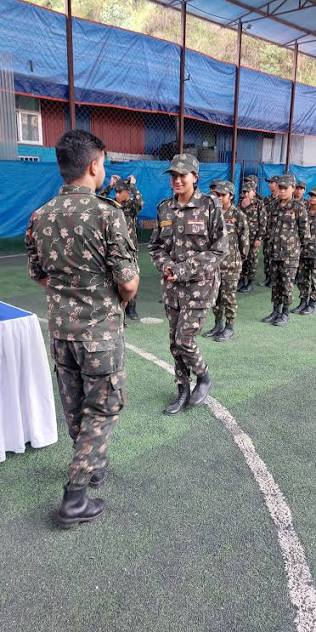
People who come to help victims during a crisis are often greeted with little reluctance. What happens, then, when those rescuers show up wearing military-style uniforms, refer to themselves as the “Green Army,” and even seem to have rank insignias, all the while senior security authorities claim to know nothing about them?
After the disastrous Bhote Koshi tragedy, a group going by the name Green Army Nepal emerged in flood-affected villages of Rasuwa and Nuwakot, raising this topic.
Members of the gang may be seen taking part in rescue and relief operations in videos that are making the rounds on social media. A local speaker can be heard stating, “We knew about the Nepal Army, but there’s also a Green Army here,” in a video that was uploaded on X. One teenage member of the gang allegedly responded that they were the Green Army and had arrived from Kathmandu when locals asked them about their identification.
On the surface, young volunteers going from Kathmandu to assist victims of disasters could seem normal. Nepal has a long history of individuals, student organisations, non-governmental organisations, and community groups coming up in times of need. In fact, when government resources are limited, this kind of volunteerism is frequently invaluable.
However, the fact that these individuals are assisting is not always a cause for alarm. It is their identity, the authority they are working under, and the reason they are dressed in military attire.
Senior members of the Nepali Army and Nepal Police claim that the organization failed to coordinate its search and rescue efforts with the government. Deepak Regmi, the deputy inspector general for Bagmati Province, stated that he was not aware of the group’s existence or actions in the impacted districts. Brigadier General Rajaram Basnet, a spokesman for the Nepali Army, added that the Army was looking into the situation but that he was not aware of it.
This brings up a fundamental question: is it possible for any commercial entity to independently carry out actions that resemble coordinated military action in a disaster area?
Because catastrophe reaction involves more than just goodwill, the response is important. Rescue activities need to be coordinated. Authorities must be aware of who is going into hazardous regions, what equipment they are carrying, where they are working, and if they are qualified to do high-risk rescues. Uncoordinated organisations may inadvertently put victims, rescuers, and security officers at greater risk.
A Facebook site called Green Army Nepal Kathmandu seems to advertize the group’s operations, making the subject even more politically delicate. The organization participates in search-and-rescue missions and involves students from schools and universities, according to material posted on the page. There have allegedly been failed attempts to reach the phone numbers on the page.
All of this does not prove that the group is unlawful, a private militia, or a private military organization. It’s a crucial distinction. It is possible for a group to use a moniker like “Green Army” without really having military power. It may just be a volunteer group that uses a unique uniform to identify its members.
But rather than letting conjecture fill the void, the government must give clarification for this very reason.
Arjun Narsingh KC, a prominent member of the Nepali Congress, requested answers from the administration, bringing the topic to Parliament. He questioned whether the group was a private military organization and questioned its military-style look. He also made comparisons between the issue and foreign private military companies like Russia’s Wagner Group and the former American firm Blackwater.
Though politically dramatic, the similarities shouldn’t be taken as gospel. Currently, there is a crucial distinction between demonstrating that a volunteer group is a private military force and challenging its image and validity. Before anyone takes such a risk, the government must establish the facts.
However, it is not enough to ignore the issues brought forward by legislators and individuals. Nepal is an independent nation with well-established security agencies. During national crises, the roles of the Nepal Army, Nepal Police, and other approved agencies are well-defined. Any civilian organization that operates in a disaster area should be open and honest about its financing, training, leadership, legal status, and interactions with government officials.
Thus, a number of simple questions should be addressed by the government. Is there official registration for Green Army Nepal? If yes, under what legislation and as what kind of organization? In Rasuwa and Nuwakot, who gave the go-ahead for its deployment? Did it work with the Army, police, district administration, or those in charge of disaster relief? What training is available to its members? Why are military-style clothing and insignias used? And does it have more power than regular volunteers?
There is a more general lesson here as well. When calamities strike, Nepal needs volunteers, but it also requires clear guidelines for organising volunteers. Volunteer organisations could be registered, their training verified, their identity provided, and they could be included into official emergency response systems through a national system. This would avoid misunderstandings about who is in charge in a crisis area and permit legitimate volunteers to help.
Therefore, the Green Army debate shouldn’t turn into a political conflict between the group’s proponents and detractors. Furthermore, the authorities shouldn’t presume that all citizen-led rescue operations are dubious. Transparency ought to be the first concern.
If Green Army Nepal is just a collection of volunteers and students working to save lives, it ought to be able to prove that. The government ought to deal with any issues pertaining to its registration, uniforms, operations, or jurisdiction. Additionally, it should be made explicit if there is no legal justification for portraying a civilian group in a way that may be mistaken for a military unit.
Nepal needs more individuals who are willing to assist during a tragedy, not more uncertainty about authority. It is now the government’s duty to establish the facts, set the guidelines, and guarantee that any rescue operations—whether they are conducted by the Army, police, government agencies, or volunteers—run smoothly and securely.

Login to add a comment