







By Nirmal P. Acharya
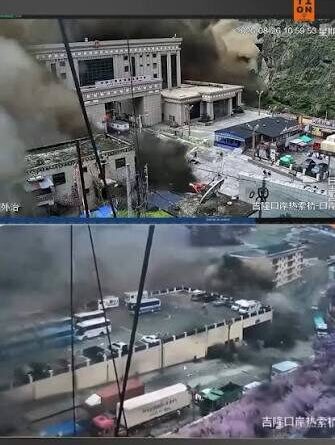
At around 9 a.m. on August 26, an ice glacier on the southern slope of Mount Lantangliang in Nepal broke off at an altitude of about 5,200 meters, triggering an ice and rock avalanche. The massive ice-rock mass rapidly descended from high elevation to around 4,000 meters, eroding the mountainside and generating a colossal debris flow that surged forward at roughly 50 meters per second for about 22 kilometers. Within just six to seven minutes, it reached the Chinese border checkpoint at Gyirong at an altitude of approximately 1,800 meters. An area of about 0.7 square kilometers was completely flattened, destroying 27 buildings and their supporting facilities.
By September 1356 people had died and 4,994 were missing on the Nepali side, while 16 people had died and 546 were unaccounted for on the Chinese side.
Disasters know no borders. During the 2024 flood season and again in July 2025, the same region experienced glacial lake outburst floods that left 17 Chinese personnel missing. Now, with this cross-border ice and rock avalanche—three consecutive years, the same area, disasters recurring—it is clear that China and Nepal are objectively a shared community of destiny when it comes to disaster prevention and mitigation in the Himalayas.
Common Wounds, Common Warnings
The reason why this disaster was so devastating lies in its “cross-border” nature – the source of the disaster was on the Nepalese side, but the impact force crossed the border and destroyed the Chinese border crossing. Ironically and painfully, on the day of the disaster, the International Centre for Integrated Mountain Development (ICIMOD) was hosting the Disaster Reduction and Cryosphere Annual Conference at the Chengdu Institute of Mountain Science of the Chinese Academy of Sciences, which happened to gather experts from multiple countries. After the disaster, everyone completed the information summary in the shortest time and determined the cause of the ice and rock collapse – but this timely information exchange and interaction was not normal.
Climate warming: The “culprit” hidden behind the glaciers
The direct cause of the disaster is the collapse of ice and rock, but the underlying driving force is global climate warming. Studies show that in recent decades, the glaciers in the Himalayas have generally melted and retreated, and the rock walls that were previously covered by ice have gradually become exposed. The movement state of the glaciers has been constantly changing. From 1990 to 2020, the area of glaciers in the Hindu Kush-Himalaya region decreased by 12%. The former general secretary of the Nepali Communist Party, Dev Gurung, also publicly stated that the root cause of this mudslide disaster lies in the instability of the glaciers caused by climate change.
The glaciers in the Himalayan mountains are like a Damocles’ sword hanging over the heads of China and Nepal. When and where this sword will fall, and in which direction it will fall, cannot be accurately predicted by any single country alone.
From emergency cooperation to long-term mechanisms
Fortunately, after the disaster occurred, China and Nepal demonstrated the responsibility of a community with a shared future. The Chinese government provided emergency assistance to the Nepalese side and offered them daily briefings on hydrology, meteorology, glacial lakes, etc. The China Meteorological Administration activated the emergency guarantee mechanism for Fengyun meteorological satellites and relied on the “Mazu” intelligent early warning system to provide data support to the Nepalese side.
However, these remain emergency and fragmented collaborations, and have not yet formed a systematic and regular cross-border disaster prevention system. The Nepalese side has explicitly stated that they hope to establish a mechanism that receives real-time data every 10 minutes.
Establishing a permanent scientific research team: Time is of the essence
This reality has given us the following warning: China and Nepal should cooperate to form a permanent scientific research team and establish a corresponding regular mechanism to conduct systematic daily monitoring and continuous research of the Himalayan Mountains.
This proposal is fully feasible. In May 2026, the “Core of the Summit” joint scientific expedition between China and Nepal successfully completed the first human ice core drilling at the summit of Mount Everest; in June of the same year, the joint exploration team of China and Nepal has already conducted joint scientific research on ice lake collapse disasters in the border river basin. In May this year, the two countries also discussed strengthening cooperation in monitoring glacier risks. These practices have proved that both sides have the ability and willingness to carry out in-depth cooperation.
The core tasks of the permanent scientific research team should include: First, establish a three-dimensional monitoring network covering the entire river basin. Deploy multi-dimensional monitoring equipment such as glacier movement, lake water level, and mountain stability in key areas on both sides of China-Nepal, enabling real-time collection and sharing of cross-border data.
Second, build a cross-border disaster early warning information platform. Integrate monitoring data from both sides, satellite remote sensing and weather forecasts to form a closed-loop management system of “monitoring – assessment – warning – response”.
Third, conduct systematic research on the cryosphere. Conduct long-term tracking of glacier changes and ice lake evolution, and establish disaster prediction models; at the same time, assess the impact of climate change on cross-border water resources and explore the potential benefits of the Himalayas for the people of both countries.
Fourth, establish a joint emergency drill and talent training mechanism. Regularly conduct cross-border disaster joint drills and provide technical training to the Nepalese side.
Disasters are the best teachers and the most brutal alarm bells. For three consecutive years, in the same area, cross-border disasters have repeatedly occurred – glaciers do not recognize national boundaries, and mudslides do not recognize national boundaries, but warnings can cross borders, and cooperation can also cross borders.
Establishing a permanent scientific research team is not only to prevent the next disaster, but also to make the Himalayas truly become a bond connecting China and Nepal, rather than a barrier. This is both the need of science and the most concrete and urgent practice of the concept of a community with a shared future. Time waits for no one.

Login to add a comment