







By Our Reporter
Nepal’s political parties rarely agree on much. They fight over government decisions, parliamentary conduct, appointments, investigations and even issues that, from the outside, can look remarkably small. Their rivalry often spills beyond Parliament and into the streets, where party cadres trade accusations and supporters turn political disagreement into personal hostility.
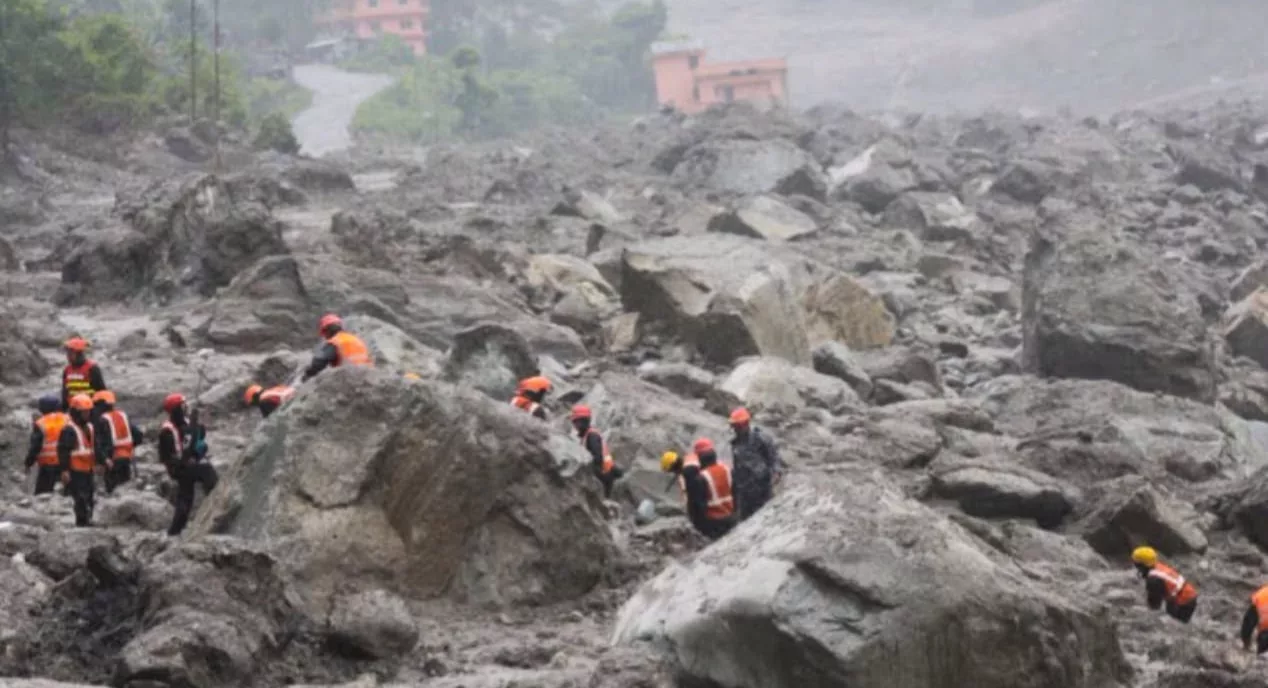
Against that background, the response to the Rasuwa floods offers a welcome change. The ruling Rastriya Swatantra Party, Nepali Congress, CPN UML and other parties have mobilised their organisations for search, rescue, relief and coordination. At a time when thousands of people need help, this willingness to put political differences aside is not merely useful. It is a good sign.
The RSP deployed its Rapid Action Team in coordination with security agencies. The party says its members rescued around 600 people, including about 250 from Sete Odar in Mailung, Rasuwa, on Thursday alone. It has also arranged shelters in Nuwakot, supplied food and accommodation, and helped organise transport for rescued people heading towards Kathmandu. RSP lawmakers have reached affected areas with medicines and protective equipment.
The Nepali Congress has formed a disaster management coordination committee involving leaders, lawmakers and local representatives from several affected districts. It has also established an information and coordination desk at its central office. Its affiliated Nepal Tarun Dal is collecting food and clothes for victims.
The UML, meanwhile, has mobilised its local structures and affiliated organisations, including the youth and student wings, while a senior party team led by General Secretary Shankar Pokhrel has inspected affected areas. CPN coordinator Pushpa Kamal Dahal has also instructed party members to engage in rescue, relief and humanitarian assistance in coordination with local authorities.
None of this means Nepal’s political parties have suddenly stopped disagreeing. Nor should they. Political parties exist to represent different ideas and interests, and disagreement is part of democracy. The problem begins when disagreement becomes hostility, and when political competition becomes more important than the public interest.
That has happened too often. Parties that cooperate during elections can become bitter opponents once in government. The ruling party often treats criticism from the opposition as an attempt to destabilise it, while opposition parties sometimes oppose government decisions simply because they come from the government.
The government and opposition can spend hours arguing over procedure, appointments or political statements while pressing public problems remain unresolved. Party to party animosity has also become deeply embedded in political culture. Leaders exchange sharp accusations, cadres defend their sides regardless of the issue, and cooperation is often viewed as weakness. Such behaviour may serve short term political interests, but it does little for citizens who expect political parties to work when the country faces a crisis.
A disaster changes that equation. When homes have been swept away, families separated and communities cut off, nobody asks which party controls the government. A person trapped by floodwater does not need a party speech. They need a boat, a helicopter, a road cleared, medicine, food and a safe place to sleep.
That reality appears to have pushed political differences into the background. It is precisely the kind of political maturity Nepal needs more often. But political unity during a disaster should not end when the water recedes. In fact, the real test begins after the rescue operation. Relief distribution, compensation, reconstruction and rehabilitation will require coordination for months and possibly years. Roads and bridges will have to be rebuilt. Damaged hydropower projects will need assessment. Displaced families will need support. Questions about safer settlements and infrastructure will have to be answered.
This is where the parties can demonstrate whether their current cooperation is genuine or merely temporary. The government should welcome constructive assistance from opposition parties rather than treating every initiative as political competition. Opposition parties, in turn, should support effective government action while pointing out weaknesses where necessary. Criticism and cooperation are not contradictory. A responsible opposition can cooperate during an emergency and still hold the government accountable.
Political parties also need to understand that their organisational networks can become valuable disaster response structures. Their local branches reach communities that government agencies may not reach quickly. But those networks must operate with discipline, transparency and coordination with professional responders. Relief should never become an opportunity for partisan publicity or competition over who did more.
Nepal has been tested by earthquakes, floods, landslides and other disasters before. Each crisis reveals the same need: institutions must work together when ordinary systems are overwhelmed. Political parties are part of that institutional landscape.
The Rasuwa floods have produced enormous suffering. If one positive development can emerge from such devastation, it is this temporary closing of political ranks. The parties have shown that they can put aside quarrels when lives are at stake. They now need to show that they can do the same when rebuilding the country, making disaster policy and solving problems that do not carry an immediate political advantage.
For once, politics has taken a step back and people have come first. Nepal needs its parties to remember that lesson long after the floodwaters disappear.

Login to add a comment