







By Our Reporter
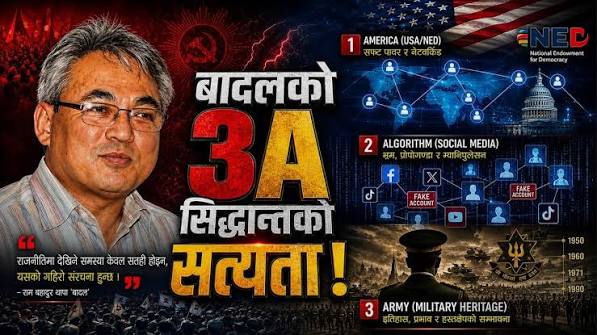
The opposition has every right to attack the government. A strong opposition is essential to parliamentary democracy. It should question ministers, expose failures, challenge policies and force the government to explain its decisions. The latest example came from UML parliamentary party leader Ram Bahadur Thapa Badal, who described the present government as the product of three “As”: the Army, algorithms and America. His remarks went beyond criticism of Prime Minister Balendra Shah’s performance. They questioned the circumstances that brought the government to power after the Gen Z movement in September last year.
Thapa’s references to “Balenism,” national sovereignty, the Nepal Army, the United States, Tibet and the Dalai Lama pushed the debate into sensitive territory. He even warned of a “people’s tsunami” greater than the political upheavals of 1951, 1990 and 2006 if the government failed to change course.
The Nepali Congress, UML, who were thrown out of power through Gen Z movement, and other opposition parties have some reasons to criticise the Shah government that has made mistakes, some avoidable. Cabinet coordination remains a concern, ministers have not always communicated clearly or spoken with one voice, and questions persist over administrative performance, economic management and the pace of delivery.
The government has also made itself an easy target. PM Shah’s direct and unconventional style creates political openings for opponents. A government that came to power promising to break with the old political order cannot afford to appear disorganised or defensive.
Its parliamentary conduct presents another challenge. The ruling side has generally responded to provocative remarks through points of order and procedural measures rather than prolonged verbal clashes. That may be sensible, but restraint alone cannot compensate for weak performance. Ultimately, the government will be judged by jobs, prices, public services, investment, infrastructure and governance.
The opposition, meanwhile, seems to have adopted a simpler strategy: question the government’s legitimacy, attack its motives and predict its collapse. The intensity of that response is partly rooted in how Shah came to power. The Gen Z movement abruptly disrupted Nepal’s established political order and brought the RSP to the centre of government. Traditional parties are still adjusting to that shock. For leaders who spent decades operating within the old system, the rise of Shah and the RSP represents more than a change of government. It challenges their political assumptions and influence.
That helps explain the anger. But questioning how a government emerged is not the same as proving that it is illegitimate. The government was formed under the Constitution and has parliamentary legitimacy. If opposition parties believe foreign powers, technology platforms or security institutions played a decisive role in its formation, they need evidence. Political insinuation cannot replace proof. Dragging the Nepal Army into partisan politics is particularly troubling. The Army is a politically sensitive and constitutionally important institution that should remain outside party competition. Political parties can demand accountability from state institutions, but suggesting that the Army helped create a civilian government is a serious claim that requires evidence.
Thapa’s “Army, algorithms and America” formulation also raises questions. These are very different forces. Algorithms can influence information flows and public opinion. Foreign governments can pursue geopolitical interests. Security institutions can have political significance. But connecting all three to the formation of the present government requires more than suspicion.
Without evidence, parliamentary scrutiny risks becoming conspiracy politics. Foreign policy deserves a more serious debate. Nepal must balance its relations with India, China, the United States and other partners. Issues involving Tibet, the Dalai Lama and Nepal’s diplomatic commitments are legitimate matters for Parliament. But if the opposition believes Shah is moving too close to Washington or mishandling relations with Beijing, it should explain what it would do instead.
The same standard should apply to economic issues. If the government is failing on employment, inflation, investment or public services, opposition parties should offer alternative policies and explain how they would work. Parliament should test competing solutions, not simply provide a stage for competing accusations.
This is where the established parties face a larger political challenge. They cannot attack the RSP for being unconventional while returning to the same confrontational style that has frustrated voters for years. The Gen Z movement did not emerge from nowhere. It reflected deep dissatisfaction with the established political order. The opposition should ask why that anger produced a new political force instead of simply attacking the force that benefited from it.
The government, however, should not hide behind its mandate. Winning power does not provide immunity from criticism. RSP lawmakers are right to defend the voters’ choice, but they should not treat every criticism as an attack on democracy. The strongest response to opposition pressure is performance.
The opposition should attack harder, but with better arguments. Demand documents, challenge budgets, propose amendments, question ministers, offer alternative policies and use parliamentary committees to investigate failures. Most importantly, keep the Army and other politically neutral institutions out of partisan battles.

Login to add a comment