








By Narayan Prasad Mishra
On the Special Occasion of Nepal Library Day, August 31, 2026 (2083 Bhadra 15)
Education
We acquire knowledge of various subjects primarily through formal education in schools, colleges, and universities. Education not only imparts knowledge that we previously lacked but also develops and enlightens the limited knowledge with which we are naturally endowed. It enables us to perform our work successfully by improving our understanding, communication, writing, behavior, judgment, and decision-making abilities.
Education and Library
In developed countries, education and libraries are regarded as inseparable—like the sun and its light, or the moon and its moonlight. In other words, they are considered as closely connected as the body and the soul. One cannot exist meaningfully without the other. The reason is simple: the accumulated wisdom, experience, and knowledge of the world’s scholars and thinkers are preserved in various forms of recorded knowledge. Libraries carefully select, acquire, preserve, organize, and scientifically manage these knowledge resources, making them readily available to educational institutions, teachers, students, researchers, and the general public without delay.
For this reason, the library is regarded as the principal source of knowledge and the heart of education. It is not merely an institution for students, teachers, and researchers; it is also an indispensable educational institution for the entire community. Without strong libraries, quality education cannot be expected.
Libraries in Developed Countries
In prosperous and developed nations, well-organized libraries are found not only in schools, colleges, universities, and research centers but also in major government offices, industries, factories, business organizations, and other institutions. These libraries provide carefully selected, high-quality knowledge resources to their users. Moreover, cities and villages alike are served by well-established public libraries operated by governments or municipalities, ensuring easy and equitable access to knowledge for all citizens.
Examples include the Delhi Public Library in India, the Takeo City Library in Japan, Dokk1 in Aarhus, Denmark, and above all, the New York Public Library in the United States. These public libraries serve as common learning centers for everyone—regardless of age, profession, or social background—from children to senior citizens. Developed countries regard public libraries as indispensable educational institutions that enable lifelong learning for all.
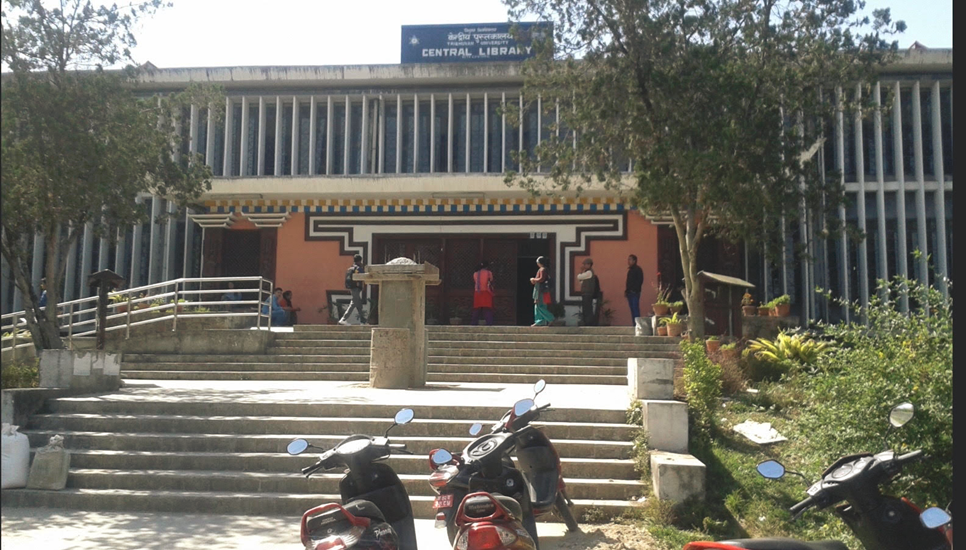
Tribhuvan University Central Library, Kirtipur
Public Libraries
A public library is considered one of the most important educational institutions in a civilized and democratic society because it guarantees free and open access to knowledge and equal opportunities for every citizen. It plays a vital role in cultivating reading habits, educating the public, and providing reliable information and knowledge necessary for work, study, teaching, research, writing, public speaking, intellectual development, planning, and policymaking. It is, therefore, recognized as an essential center for the dissemination of knowledge.
Public libraries also organize exhibitions, book displays, lectures, discussions, and various educational programs to keep their readers informed about current events, national and international developments, matters of public interest, contemporary debates, important issues, and newly acquired publications. They provide knowledge based on facts and truth concerning every aspect of national development and public welfare. Remaining free from cultural and political bias, they strengthen education, learning, and research.
In this context, the well-known observation of the American Library Association is particularly memorable:
“The library profession is the profession upon which all other professions depend.”
The great American industrialist and philanthropist Andrew Carnegie, who donated millions of dollars to establish more than 1,600 libraries throughout the United States, aptly remarked:
“Of all the things which a community can do to benefit its people, the establishment of a library is the greatest. It is a never-failing fountain of knowledge in the desert.”
Libraries in Developing and Underdeveloped Countries
The situation in developing and underdeveloped countries, however, is quite different. There, the importance of libraries in public education has not yet been adequately understood. As a result, even educational institutions often lack quality libraries. Public libraries, where they exist, are frequently little more than libraries in name. Institutions capable of providing the knowledge and information required by people from every walk of life are seldom found.
The Condition of Libraries in Our Country: The Difference Between a Book Collection and a Library
Our country’s situation is not very different from that of other underdeveloped nations. It is well known that, throughout Nepal, there are hundreds, indeed thousands, of collections of books established through the enthusiasm and dedicated efforts of lovers of books and knowledge. Every Nepali should be grateful to those pioneers who cherished books and preserved these valuable intellectual resources for future generations.
Strictly speaking, however, a collection of books is not necessarily a library. Just as milk is not yogurt, although yogurt is made from milk; and flour is not bread, although bread is made from flour; similarly, a mere collection of books or other knowledge resources does not constitute a library. Nevertheless, no library can exist without such collections.
A true library is a professionally organized center of knowledge. It is created by scientifically selecting, acquiring, organizing, preserving, and systematically arranging knowledge resources and by making the information they contain readily available to readers according to their needs and interests without unnecessary delay. Such an institution alone deserves to be called a modern library in the true sense of the term.
Therefore, one of the important tasks before our nation is to transform the hundreds and thousands of existing book collections into genuine modern libraries capable of effectively serving the educational and intellectual needs of society.
The Need for Modern Public Libraries in Nepal
Although Nepal possesses hundreds of public libraries established through the dedication, voluntary service, generosity, donations, and tireless efforts of book lovers and library enthusiasts across the country, we still do not have a single international-standard public library established and operated by the Government, a local government, or any municipality—not even in Kathmandu, the nation’s capital.
Our country lacks a professionally planned public library established based on careful studies of community needs, geographical coverage, population, reading requirements, location, and library services.
In this regard, Janajyoti Library of Bhaktapur, established by the Bhaktapur Municipality in the 1950s, deserves special recognition as a historic municipal library. I recall with pride that King Tribhuvan inaugurated it. At that time, Mr.Ratna Sundar Saiju was the Mayor of Bhaktapur. At the same time, my elder brother, Bhawani Prasad Mishra—the distinguished first English teacher of Shree Padma Higher Secondary School, later Principal of Vidyarthi Niketan High School, and subsequently Professor of English at Tribhuvan University—presided over the inauguration ceremony. Although the library has remained under the patronage of the municipality, it has unfortunately not developed to meet the needs and expectations of the present day.
Our Role in Providing Public Library Services
Recognizing the absence of a public library in Kathmandu and the need to provide library services to its citizens, my beloved late wife, Shanti Mishra—Nepal’s first professionally qualified woman librarian to earn a master’s degree in Library Science, the founding Chief Librarian of the Tribhuvan University Central Library, and the architect of the country’s first modern library—and I, the first Nepali to earn a master’s degree in Library Science from India, opened the Tribhuvan University Central Library at Lal Durbar not only to members of the university community but also to the general public of Kathmandu.
Until the library was transferred from Lal Durbar (now the premises of the Yak & Yeti Hotel) to Kirtipur, we provided services not only to students and teachers but to all citizens. However, after its relocation, limited space and insufficient reading materials made it impossible to continue providing public library services on the scale we had envisioned.
At one point, we even proposed to high government authorities that, if the
former Military Hospital building near the New Road Gate could be obtained, a branch of the Tribhuvan University Central Library could be established there. Our objective was to provide both academic library services to university teachers and students and public library services to the wider community in the heart of Kathmandu. Unfortunately, this proposal was not accepted.
Later, on 16 Shrawan 2028 B.S. (1971 A.D.), we submitted a petition to His Majesty King Birendra requesting that the Keshar Library be placed under the administration of the Tribhuvan University Central Library, as the library was lying unused. To us, a library is not merely a storehouse of books and other knowledge materials but an intellectual workshop. Our vision was to provide academic library services to students, teachers, and researchers while simultaneously offering public library services to the general public. Regrettably, this effort also failed because the country’s highest authorities did not fully appreciate either our vision or the broader significance of this noble objective. A copy of the petition submitted to His Majesty is reproduced on page 234 of our Nepali book, The Glorious History of the Tribhuvan University Central Library and Our Service.
With the hope that Kathmandu Metropolitan City would one day establish an exemplary public library, my wife Shanti Mishra and I wrote an article in Nepali entitled Books, Book Collections, and Libraries, which was published in the weekly Janasatta on Magh 27, 2061 B.S. Her lifelong dream of establishing a model public library remains alive in my heart even today.
The Need for Patronage, Parent Institutions, and Sponsoring Authorities for Libraries
No modern library, whether small or large, can be established or sustained without the support and protection of a strong parent institution. A library must, first and foremost, have a permanent building or designated premises. It also requires qualified professional librarians, library assistants, and other staff trained in library science. In addition, it needs bookshelves, tables, chairs, equipment, and numerous other materials essential for library operations.
Most importantly, a library must have a sponsoring authority that provides regular financial support for its continued operation and development. For example, a school library is supported by the school, a university library by the university, a government library by the government, an industrial library by the respective industry, and a public library, in most cases, by a municipality or another local government. It should not be difficult for anyone—educated or uneducated—to understand that no library can function effectively merely through the enthusiasm or goodwill of individuals, without institutional support or the support of philanthropists and wealthy donors.
Unfortunately, very little attention has been given to this fundamental principle by many lovers of books and libraries in our country. Some libraries have been established out of genuine love for books, others for political purposes, and still others merely to gain recognition or prestige, often without due consideration of the essential requirements needed for their long-term success.
Whatever the motivation may be, libraries should be established only after professional studies conducted by qualified library experts. Such studies should examine the geographical area to be served, the size of the population, the potential readership, the nature of the reading materials required, the location and design of the library building, staffing requirements, furniture, equipment, and budgetary needs. Based on these studies, clear policies and development plans should be formulated, and every library should be placed under the protection of a responsible sponsoring authority. Only then can libraries be properly organized, efficiently managed, and sustainably developed.
In this context, the recent dispute concerning the Kathmandu Valley Public Library has become a matter of considerable public discussion. According to an article by Lokendra Bishwakarma, published in Shilapatra on 21 Shrawan 2083 B.S., the library was established through the efforts and participation of many distinguished scholars and respected public figures, including former members of our country’s Planning Commission. Nevertheless, the historical account presented in that article suggests that insufficient attention had been paid from the very beginning to establishing an appropriate parent institution responsible for its long-term protection and management. The present conflict appears to have arisen largely from this very weakness and lack of planning.
Whatever the circumstances, locking the doors of a public library instead of ensuring its proper administration is deeply unfortunate. Rather than allowing political disagreements to determine whether a library should remain open or closed, we should learn from this experience and establish a responsible sponsoring authority capable of managing the institution efficiently and sustainably.
According to the article, the Social Welfare Council has expressed its willingness to assume responsibility for the library. It is certainly encouraging when an institution comes forward to protect and preserve a library that needs institutional support. Personally, however, I believe that the Kathmandu Municipality would be the most appropriate authority to undertake this responsibility. Indeed, I feel that the municipality itself should willingly come forward to assume this important public duty.
Libraries, Municipalities, and Local Government Units
If the people of Nepal are to enjoy the same opportunities for acquiring knowledge as citizens of developed countries, our municipalities and other local governments must establish and operate modern public libraries based on clear policies, scientific planning, and sustainable management. Such libraries should provide effective services in the true sense of the term.
No library—whether public, academic, governmental, or otherwise—can function effectively without a responsible parent institution. Therefore, our local governments should formulate clear policies, laws, and regulations, assume responsibility for the existing public libraries within their respective jurisdictions, and ensure their modernization and continued development in accordance with changing times.
In this regard, I earnestly appeal to the heads of all municipalities and local governments throughout Nepal to give serious thought to establishing and effectively operating public libraries. When Balen Shah served as Mayor of Kathmandu Metropolitan City, he emerged as a dynamic and development-oriented municipal leader who also demonstrated commendable leadership in keeping educational institutions within his jurisdiction free from partisan politics.
I had hoped that he would also devote attention to library development. I believed that, under his leadership, Kathmandu could establish and operate an international-standard public library comparable to the Delhi Public Library. At the same time, the municipality could also assume responsibility for modernizing the city’s existing public libraries.
Therefore, I wrote an article entitled ‘A Necessity of Kathmandu Municipality Public Library and Balen Shah’ to draw his attention to this matter and, if he became interested in it, to gladly offer my expert services as a volunteer without any remuneration for this work. The article was published in People’s Review on June 7, 2023. Whether the article escaped his attention or whether the subject did not interest him, I do not know.
Today, he serves as the Right Honorable Prime Minister of Nepal. I sincerely hope that his government will also prioritize establishing and developing modern public libraries throughout the country. I further hope that, under his leadership, the knowledge-seeking citizens of Nepal will soon enjoy access to excellent places for study and invaluable opportunities for lifelong learning.
Nepal Library Day
For the past several years, Bhadra 15 has been observed annually in Nepal as Library Day. Unfortunately, many such commemorative occasions in our country are often limited to ceremonial activities—garlanding a few close associates, offering speeches of praise, and holding formal gatherings. Such observances, by themselves, accomplish very little.
I therefore hope that the organizers of Library Day will devote greater attention to the concrete measures that are necessary for the development of libraries in Nepal. The occasion should serve not merely as a celebration but as an opportunity to formulate practical policies, review progress, and launch meaningful initiatives for strengthening library services throughout the nation.
Some Matters Requiring Attention in Library Development
Libraries are not luxuries; they are indispensable institutions for education, intellectual growth, informed citizenship, and national development. A nation that neglects its libraries inevitably weakens the very foundation of its educational and cultural life. Conversely, a nation that invests in libraries invests in the enlightenment of its people and in its own future.
It is therefore the responsibility of the Government of Nepal, provincial governments, municipalities, and other local bodies to formulate clear policies, enact appropriate legislation, and establish sustainable systems for the development and effective management of modern libraries. Existing public libraries should receive institutional protection, adequate financial support, professional management, and continuous modernization so that they may serve future generations more effectively.
The establishment of international-standard public libraries in our major cities, especially in Kathmandu, should no longer remain an unfulfilled dream. Such libraries would not only provide access to knowledge for students, teachers, researchers, writers, and professionals but would also become centers of lifelong learning, cultural exchange, intellectual discussion, and democratic participation for every citizen.
I sincerely hope that Nepal’s political leaders, policymakers, local governments, educational institutions, and the public at large will recognize the true importance of libraries and work together to transform this vision into reality.
Only then can we truly build a knowledgeable, enlightened, and progressive Nepal.
About the author: A non-partisan writer of several books and numerous articles in Nepali and English; former Chief of the Office of the Tribhuvan University Service Commission and former Chief Librarian of the Tribhuvan University Central Library; and a senior citizen in his mid-eighties.

Login to add a comment