







By Nirmal P. Acharya
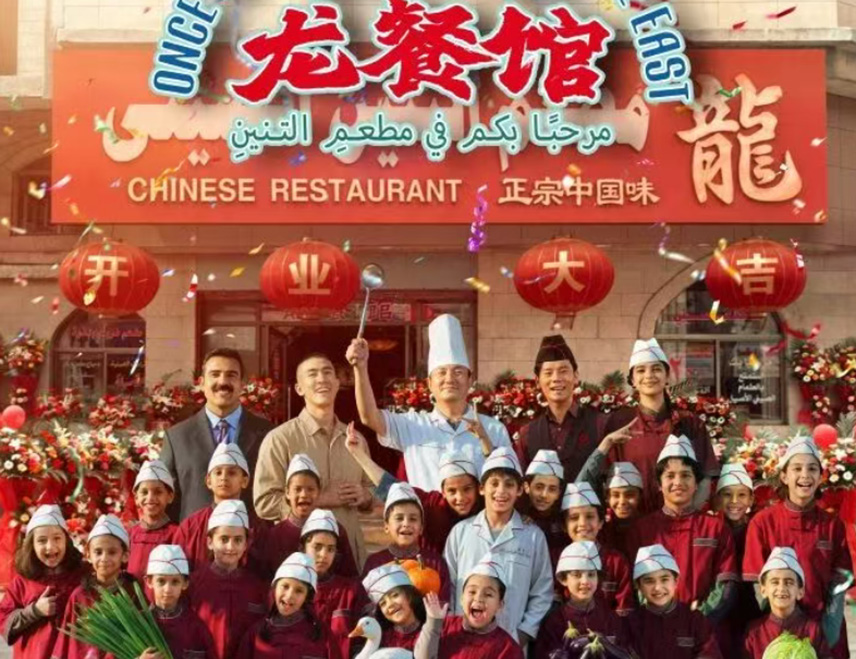
Recently, China released a war-themed film titled “Welcome to Dragon Restaurant.” The film reflects on current global hot-button issues and presents its insights. It can be said that this is a work with a distinct sense of contemporary relevance.
This film is set in Iraq and covers a period of time that begins several months before the United States launched the Iraq War and continues until around 2004 and 2005.
The core story of the film: A common Chinese chef named Xu Fu was stranded in a war-torn area. Using a restaurant and a hot meal as the medium, he adhered to simplicity and kindness, rescued children from the society, maintained a neutral perspective as a third party, did not side with any of the warring parties, did not resolve conflicts through force, and prioritized meeting the most basic survival needs of ordinary people (such as having enough food, surviving, and the survival rights of children).
The narrative perspective and value concepts adopted in the film “Welcome to Dragon Restaurant” present a sharp contrast to the traditional Western narrative. The core argument can be summarized as follows: Through the contrast of the imagery of “cooking fire” and “guns and cannons”, the film showcases a “Chinese-style peace narrative” that is different from the Western hegemonic narrative. It emphasizes reconciliation, inclusiveness, and symbiosis, presenting a “peace narrative” that is more humane than the Western narrative.
This is specifically manifested in the following aspects:
1. Subverting Western narrative and providing a new perspective: The film unfolds from the perspective of Chinese chef Xu Fu, breaking the Western film’s habit of simplifying Middle Eastern characters as “terrorists” or “helpless refugees”. It questions “where do terrorists come from” and shows how war destroys the lives of ordinary people. This exploration of the root causes of conflicts is considered more humanistic.
2. Presenting “Eastern wisdom”: “Using the warmth of the cooking fire to counter the smoke of war” becomes the core metaphor of the film. The cooking fire symbolizes nourishment and order, conveying the simple survival philosophy of “eat well”; while the guns symbolize destruction and chaos. The film promotes “harmony and difference”, not relying on conquest to prove strength, but creating beauty by nourishing life.
3. Transcending zero-sum game: The film conveys the idea of “reconciliation, inclusiveness, and symbiosis”, believing that true peace is not the “winner-takes-all” outcome of a zero-sum game, but the “coexistence of each being beautiful and sharing beauty”.
In conclusion, “Welcome to Dragon Restaurant” offers a new possibility for thinking about international relations. It transforms diplomatic concepts into stories that ordinary people can understand, using the soft power of culture to carry out a “Chinese narrative”, filling the international void left by Hollywood’s monopoly on the Middle East war narrative.
In my opinion, the release of this film represents China’s first attempt to present its logical and moral judgments on global conflicts through the medium of cinema, and to propose a solution from the perspective of Chinese civilians. This indicates that China is ready to exert its global influence.

Login to add a comment