







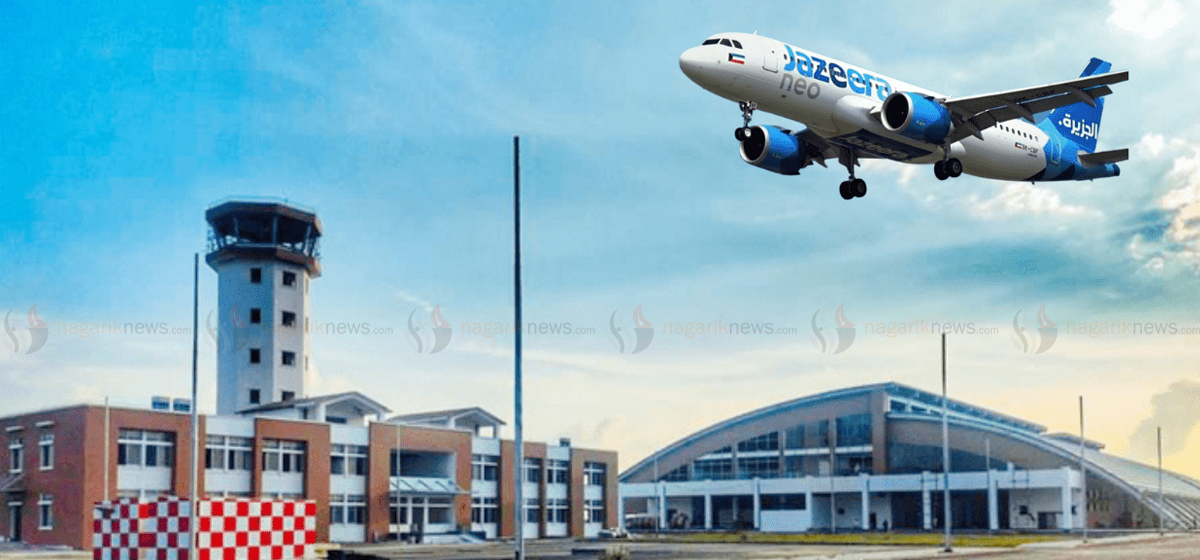
Kathmandu, August 12: Four years after coming into operation as Nepal’s second international airport, Gautam Buddha International Airport in Bhairahawa is still waiting for regular international flights. Despite having modern infrastructure and completing all necessary preparations, the airport remains largely deserted, prompting serious public debate over whether the problem lies with a lack of passengers or with government policy.
Viewed from outside, the airport appears fully prepared, with a modern terminal, a 3-kilometer runway meeting international standards, and immigration and security facilities in place. However, regular international airlines have not returned. Apart from occasional charter flights, the Bangkok–Bhairahawa service operated by Thai AirAsia, which was the most recent regular service, was also suspended after March, and there are no scheduled regular flights until October.
According to the airport administration, the problem is not a lack of passengers but a weak system for bringing them to the aircraft. The administration complains that travel agencies and General Sales Agents (GSAs), which are concentrated in Kathmandu, have not played the expected role in promoting flights from Bhairahawa, with business activities ranging from ticket sales to passenger management remaining centered in the capital. The administration also believes that if national flag carriers such as Nepal Airlines and Himalaya Airlines begin regular services, it would send a positive message to foreign airlines as well.
Representatives of the private sector, however, say the problem is deeper. According to Chandra Bahadur Thapa, president of NATTA Lumbini Province, the government has failed to formulate a clear policy for operating the country’s second international airport. He has suggested that flights targeting the Buddhist Circuit should be concentrated in Bhairahawa to reduce excessive air traffic in Kathmandu, and that Nepal’s air services agreement with India should be reviewed for this purpose.
In addition, the provision preventing foreign tourists holding Indian e-visas from entering India through Belahiya has also weakened the region’s potential. According to Thakur Kumar Shrestha, president of the Federation of Nepalese Chambers of Commerce and Industry Lumbini Province, the airport is not merely an international gateway for Rupandehi but a common international gateway for millions of people living west of the Narayani River. He says that even if Nepal Airlines starts one regular flight a day, or operates only cargo services if passenger flights are not immediately feasible, it would send a positive message to the market.
Although the airport has been equipped with a modern Instrument Landing System (ILS), which allows aircraft to land even in low visibility, the necessary agreement has yet to be secured because some of its protection areas extend into Indian territory. Although the government has offered various fee discounts to attract airlines, the necessary policy decisions for regular flights, effective diplomatic initiatives with India, strengthening of the local travel market, and active involvement of the national flag carrier have yet to materialize.
The site began as a grass airfield in 2021 BS and was upgraded to operate as a domestic airport in 2023 BS. On Magh 1, 2071 BS, then Prime Minister Sushil Koirala laid the foundation stone for its development as an international airport. Built at a cost of around Rs. 35 billion and spread over approximately 800 bighas, the airport was inaugurated on Jestha 2, 2079 BS, by then Prime Minister Sher Bahadur Deuba. Classified as a Category 4E airport, it has the capacity to park up to five international aircraft at a time—four narrow-body and one wide-body—similar to Tribhuvan International Airport. However, due to the lack of concrete policy and initiative, it is still waiting for regular flights.
People’s News Monitoring Service.

Login to add a comment