








By Narayan Prasad Mishra
Everyone knows that throughout our country there are hundreds of thousands of collections of books called libraries, established by the interest and efforts of book lovers and people who appreciate the importance of knowledge resources. We, the people of this country, must be grateful to them for it. However, strictly speaking, a collection of books alone is not a library. Just as milk itself is not yogurt, although yogurt is made from milk; just as flour itself is not bread, although bread is made from flour; likewise, a collection of knowledge materials alone is not a library. Yet no library can indeed exist without knowledge materials.
A scientifically selected, systematically organized, and properly managed collection of knowledge resources, together with the ability to provide readers promptly with the information they need according to their interests and requirements, constitutes what we properly call a library—or, more precisely, a modern library.
Until around 1959 (2016 B.S.), Nepal had neither the concept nor the reality of such a modern library. In 1959, Tribhuvan University, the nation’s first university, was established. Along with its establishment, a traditional collection of a few books was designated as the University Library. However, the task of transforming that collection into a scientifically organized modern university library—equipped with appropriate knowledge resources to support higher education, teaching, and research—still remained.
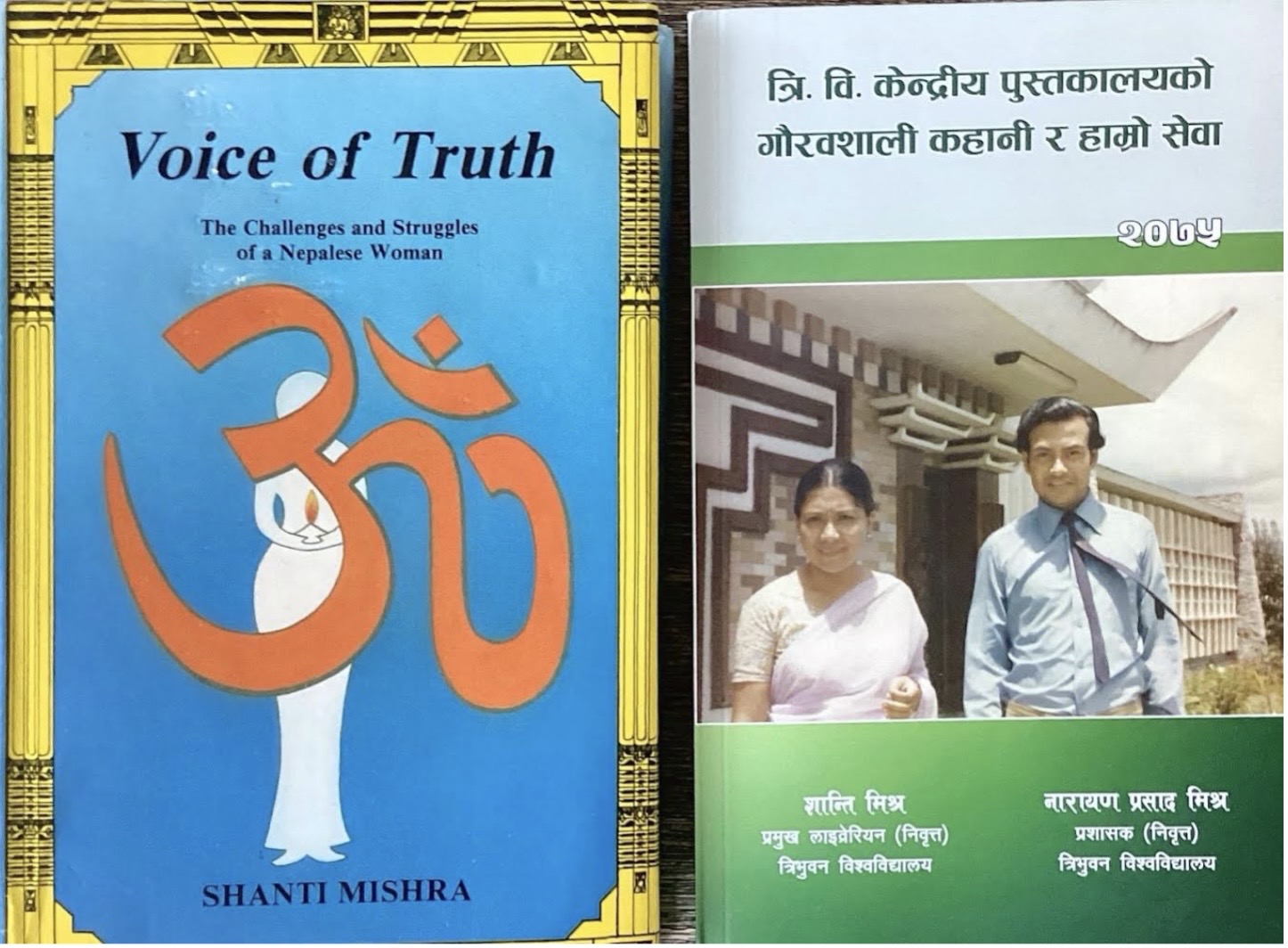
My beloved wife, Shanti Mishra, as Chief of the Tribhuvan University Central Library, established, built, and developed it into a modern library of national and international repute after earning a Master’s degree in Library Science in the United States of America. She demonstrated to Nepali society that a library is not merely a warehouse of books but an important center that provides readers with prompt access to the knowledge contained in its collections. She also awakened public awareness of the importance and necessity of modern libraries and became the pioneer of Nepal’s modern library movement. Then, as a fellow traveler in the library profession, I, too, supported this great mission with my whole heart and soul.
Generally speaking, no achievement in this world — small or big — comes without challenges and struggles. Likewise, no matter how good a person may be, they may still have enemies without any valid reason. Some people imagine others to be their enemies and attempt to obstruct even their noble work. Sometimes, without intending it, we may unknowingly harm someone, just as we may accidentally step on an ant or an insect while walking. We may not even realize it, but the injured creature regards us as an enemy. While governing a nation or administering an institution, it is sometimes necessary to take disciplinary action against those whose activities are contrary to the interests of the country or the institution. Those who are punished may become hostile and bear lasting resentment toward the authorities. Others become enemies simply out of jealousy and resentment. Such is the nature of the world.
The establishment and development of the Tribhuvan University Central Library also came about only after overcoming countless challenges and struggles. This is clearly documented in Shanti’s English book “Voice of Truth: The Challenges and Struggles of a Nepalese Woman” and in our jointly authored Nepali book “The Glorious History of the Tribhuvan University Central Library and Our Service”.
We struggled not only to fulfill our official responsibilities but also to defend the dignity and prestige of the library profession voluntarily. For this cause, we confronted not only our immediate superiors but also those above them. We risked our positions and promotions.
At one point, the university’s Rector, who was the highest authority overseeing the library, arranged—contrary to university laws and regulations—for the Curriculum Development Center to commission a library science book from an individual who possessed neither the qualifications nor the knowledge required in Library Science. We filed a formal complaint against the Rector in his own office. In fact, I was the petitioner. Our struggle was against violations of university rules and regulations. It was for the rights, dignity, and professional recognition of qualified Library Science professionals. It was not directed against the individual who wrote the book but against those who improperly commissioned them. It was a struggle for the library profession itself.
At that time, the National Library and Kaiser Library existed largely in name and without proper organization. We proposed bringing them under the university administration and developing them along the Israeli model so that their knowledge resources could effectively support study and research nationwide. Had this proposal been implemented, the name of the donor, Kaiser Shumsher, would have remained fully preserved, and the donor’s wishes would not have been violated. Institutions such as Thakur Ram Multiple Campus and Amrit Campus, which were once outside the university system but later became part of it, clearly demonstrate that integration into the university does not erase donors’ identities. Our proposal was intended to make valuable national knowledge resources more accessible to all citizens. We did not make this proposal out of ignorance. Unfortunately, it was never implemented.
Likewise, certain university authorities who did not value the dignity of libraries and the library profession created the post of Documentation Officer for the Institute of Nepal and Asian Studies without requiring qualifications in Library Science, and advertised the position through the Tribhuvan University Service Commission. Had this precedent continued, even the positions of Librarian at the Tribhuvan University Central Library and other library posts could eventually have been filled without Library Science qualifications, thereby endangering the entire profession. We therefore protested this decision as being contrary to both the law and the dignity of the library profession. We filed complaints, including against the Service Commission itself. Our protest was not against the individual who might obtain the position but against the university offices responsible for the irregularity. We even confronted the Chairman of the Service Commission. This too was a determined struggle to protect the prestige of the library profession.
Around 1970 (2027 B.S.), with the interest, support, and sponsorship of the American Library in Kathmandu, a library association was established comprising people working in libraries who held the title “librarian.” At that time, Shanti Mishra was at home on maternity leave. Under the chairmanship of a former minister, the association was formed, and despite her absence, she was respectfully elected Vice-President.
At that time, there were only about five or seven professionally qualified librarians in the entire country. The need of the time was to distinguish clearly between a mere book collection and a modern library, and between professional librarians and support staff, to promote the development of modern libraries and elevate the status of the profession. Although she had been honored by being elected Vice-President in her absence, Shanti Mishra believed that joining such a non-professional library association would ultimately lower rather than enhance the dignity of libraries and the profession. Therefore, after expressing her gratitude for the honor, she withdrew from the association. This decision, too, was made solely to protect the dignity of the library profession.
All these matters are explained in much greater detail in the books mentioned above. There are countless other issues, greater than these, that are not discussed here. The story of our struggle against the entire Tribhuvan University administration—including the vice-chancellor and all other high-ranking university authorities of the time—in pursuit of a sound library policy and an effective library system is described in our book. It tells how we fought, prevailed, and established a proper system for the university library. None of these actions was undertaken without a great measure of courage or selflessness. Raising a strong voice against powerful authorities who held the power to shape one’s own fortune or misfortune, solely for the benefit of the institution entrusted to one’s care and in accordance with the dictates of one’s conscience, was no ordinary expression of love and loyalty to that institution. Consequently, we both suffered greatly during our years of service, even losing promotions and jobs. These were not struggles for our personal benefit or advantage; they were struggles to uphold the dignity, integrity, and professional standards of librarianship and to advance the development of modern library services in Nepal. Any fair-minded reader will have little difficulty understanding this.
Throughout our careers, Shanti Mishra and I worked together without concern for our personal gain or loss. We spared no effort in advancing modern library development and strengthening the library profession. Even so, there have been—and there always will be—people who find fault even with our undisputed achievements and selfless service. Some may have considered our efforts and struggles for library development and the dignity of the library profession as obstacles to their own interests. Others may have felt offended by something we unknowingly did, or acted out of jealousy, resentment, or ill will.
Some people become enemies without any reason. Our sacred texts refer to such people as “enemies without cause”—individuals who become hostile even though one has neither harmed them nor caused them any loss or injury. Just as tigers are natural enemies of sheep and cattle, they attack them. Similarly, the goats and cattle consume grass by their very nature; some people are driven by their own nature to harbor hostility toward others without any cause.
In this connection, someone even fabricated a series of misleading stories and went so far as to write, “Only much later was Shanti Mishra exonerated by the court.” In reality, there has never been any court case filed against Shanti Mishra in her entire life. No wonder mosquitoes always seem to find a way to bother you, even when you’re inside a mosquito net. In a world where even Mahatma Gandhi and Martin Luther King, Jr, the great apostle of nonviolence, were assassinated by gunfire, such incidents are not particularly surprising. Nevertheless, I believe that anyone who sincerely wishes to know the truth about such matters will gain a clear understanding by reading the books mentioned above, even after we are no longer in this world.
About the author: A non-partisan writer of several books and numerous articles in Nepali and English; former Chief of the Office of the Tribhuvan University Service Commission, Nepal; and a senior citizen in his mid-eighties.

Login to add a comment