








By Narayan Prasad Mishra
Our history shows we had the Rana regime (1846-1951), ruled by the Rana family according to their wishes until 1951 (B.S.2007). That was the autocratic rule under the Rana Prime Minister, the hereditary ruler of Shree Teen Janga Bahadur Rana (1817-1877). The ruler was also called Shree Teen Maharaj, and the King was Shree Panch Maharaj. Shree is a word used before a person’s name to honor the person. The word Shree is always put before the person’s name when writing names in Nepali, as it is customary to write Mr. or Mrs. in English. In general, only one Shree is written before a person’s name. According to the then custom, the King deserved five Shree in front of his name. So, he was called Shree Panch (five) Maharaja Dhiraj. The Ranas made the rule to put three Shree before the Rana Prime Minister’s name and got the Shree Teen (three) Maharaj (the honorific word for the word King). They became a king within the King. Taking military power in hand, the Rana Prime Minister made the King only the ceremonial head without power, and they ruled the country with full autocratic power, which ended in 1951. We call the Nepali day Fagoon 7, the seventh day of the Nepali month Fagoon, Democracy Day. We still celebrate that day as Democracy Day. That was the day we became independent from the Rana regime. If we count from that day, our democracy is 73 years old.
During the Rana regime, our lives and property were in their hands. We had to obey what they asked and wished. They were our masters, and all others were their servants. All the powers of the state–the executive, legislative, and judicial–were vested in them. The words from their mouth would be the law. If we compare the changed political system from that point on, there is undoubtedly a lot of difference, and it is incomparable.
We enjoyed democracy starting 73 years ago. However, that democracy could not bring any tangible change to the nation’s development and welfare of the people. After that, we have adopted many political systems. After the first general election in 1959 and multiparty democracy, King Mahendra introduced a new political system called the Democratic Panchayat System. This system existed for about 30 years. However, people became irritated with it. The system was thrown out in 1990 and replaced with a multiparty parliamentary democracy under the Constitution of 1990. This system got the new Nepali name Loktantra instead of Prajatantra, though there was no difference in meaning–democracy. Blaming that system for not developing the country and not working for the people’s welfare, we adopted another new system–a republic without the King with the Constitution of 2015, which replaced the Interim Constitution of 2007. Under this system, too, most independent people think we do not see any notable development, and in most cases, the country is going downhill in all sectors. The change always came only for the few in power, not for the people as a whole. I also feel the same way.
I vividly remember that just after the election of 1959, Dr. K. I. Singh, the leader of the United Democratic Party, filed a case against the Nepali Congress for rigging the election. At that time, the Supreme Court was in the present Ratna Park area near Rani Pokhari. While speaking in court, he talked about the democracy under the Nepali Congress Party and said the party propagated democracy but worked only for themselves. Just the same way the present republican leaders, especially the communists, talk about the people’s supremacy, they work for their own supremacy. They are doing anything to achieve their supremacy—right or wrong, righteous or unrighteous. We have clearly seen them in their bribery scandals. The communists or Democrats are all the same–as the Nepali proverb “Uhi Dyangko Moola” — a radish from the same field. I have not seen more than that in my eight decades of life experience. Based on my experience, I wrote the following poem titled People’s Supremacy (Janatako Sarbochata) in Nepali, which was published in Janasatta Saptahik (Janasatta Weekly) under the chief editorship of Ram Chandra Neupane, the former chief editor of the Gorkhapatra Dainik on June 6, 2009 ( 2066/2/23 ).
Poem in Nepali
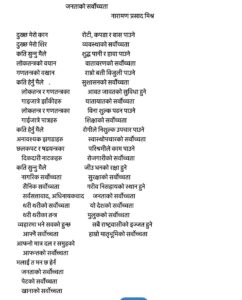
Poem translated into English
People’s Supremacy
My ear aches
My headaches
How much to hear
The appreciation of democracy
The admiration of the republic
How much to see
Democracy and republic’s
Faked models
Democracy and republic’s
Faked heroes
How much to see
Unwanted confrontations
Deceits and conspiracies
Frustrating dramas
How much to hear about
Civil supremacy
Military supremacy
Authoritarianism
Various supremacy
Various systems
In practice, all have
Their own supremacy
Their own party, group, and
Relative’s supremacy
I would like to see
People’s supremacy
Hunger’s supremacy
Food’s supremacy
The supremacy of the system
That provides the bread, clothes, and shelter
The supremacy of the environment
That provides pure drinking water and pollution-free fresh air
The supremacy of good governance
Which provides electricity to all
The supremacy of transportation
Which provides easy transportation
The supremacy of education
Which provides free education
The supremacy of health service
Which provides free health services to the patient
The supremacy of employment
Which provides a job to hard workers
The supremacy of security
Which protects the life and property
The People’s supremacy
Which centers on the poor and helpless
The supremacy of this country
The supremacy of this nation
Where all nationalists are respected
The supremacy of the Motherland
The above poem was published 14 years ago. Instead of working for the development of the country and the welfare of the people by improving their lives and living with good services of food, drinking water, electricity, shelter, health services, educational services, etc., the leaders have not stopped talking about the supremacy of democracy and republic. For them, democracy and republics mean only the slogan, not the service. How can we change their minds and educate them if that is their meaning? If people also accept their meaning of democracy and republic and enjoy the slogan but do not expect more than that, what can we do? The religious scriptures say you carry the results of your good and bad works for your reward and punishment when you die. So we all should do good to all that we can from our conscience for the welfare of all. According to the following proverb, we should do our best to travel to heaven in business class. To do or not to do is our choice.

The views expressed in this article are the author’s own and do not necessarily reflect People’s Review’s editorial stance.

Login to add a comment