







 By Our Reporter
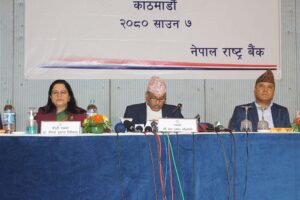
The private sector has strongly opposed the Monetary Policy 2023/24 unveiled by Nepal Rastra Bank (NRB) on Sunday, stating that the policy would not help revitalise the ailing economy.
In a joint press statement issued on Monday, the Federation of Nepalese Chambers of Commerce and Industry (FNCCI) and the Confederation of Nepalese Industries (CNI) and the Nepal Chambers of Commerce (NCC) said that the new monetary policy would not be able to address the existing economic challenges.
They said that the Monetary Policy was not as was expected them.
“At a time when the economy is already suffering from low private sector lending by banks, further capping in lending will make it difficult for the government to achieve the targeted economic growth of six per cent,” read the press statement.
Banks provided a mere 6 per cent of loans to the private sector, far below the NRB’s guideline of 12.6 per cent loans in the last fiscal year, and the central bank has now capped it at 11.5 per cent for the next fiscal year.
The private sector has been demanding the central bank bring the lending rate down to single digits, as it was over 17 per cent in the last fiscal year. However, the central bank has only reduced the policy rate by a mere 0.5 per cent, they argued.
They said although the NRB claimed that the new monetary policy was liberal, the provisions in the policy were otherwise.
The monetary policy also talks about enforcing a separate guideline to monitor large debtors. The FNCCI has expressed scepticism about this measure, as it may discourage the private sector from taking loans from banks.
They blamed that the monetary policy does not seem to provide a clear roadmap on how to improve domestic production capacity.
Despite criticizing most of the provisions, the private sector has praised the NRB’s policy to increase the limit on home loans from Rs 15 million to Rs 20 million, allow visitors to carry foreign exchange of US $2,500 instead of US $1,500, and revise the risk weightage for loans against shares, automobiles, and real estate from 150 per cent to 100 per cent.

Login to add a comment