







 By Our Reporter
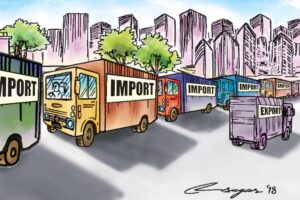
The country’s trade deficit has decreased in the last fiscal year thanks mainly to a decline in imports 2022/23.
According to annual trade statistics of the last fiscal year 2022/23, published by the Department of Customs on Monday, the trade deficit has declined by 15.45 per cent and is limited at Rs. 1,454.59 billion during the last fiscal year as compared to the previous fiscal year.
The trade deficit was Rs. 1,720.41 billion in the fiscal year 2021/22. The decline in both exports and imports has contributed to a fall in the trade deficit during the review period. The imports declined by 16.08 per cent while the exports fell by 21.44 per cent in the last fiscal year. With the decline in both imports and exports, foreign trade has declined by 16.58 per cent to Rs. 1,768.87 billion during the last fiscal year.
Foreign trade was recorded at Rs. 2,120.47 billion in the fiscal year 2021/22.
The ratio of import and export in the fiscal year 2021/22 was 1:9.60 while this ratio is 1:10.26 during the last fiscal year 2022/23. The contribution of export and import to the total trade is 8.88 and 91.12 per cent respectively.
Due to the restriction measures taken by the government in the import of luxurious items to keep the foreign currency reserves in a sound position, the import has been reduced which contributed to an improved trade deficit and reduced overall foreign trade.
The government banned the import of all kinds of ready-made liquors except raw materials, vehicles jeeps, cars and vans (except ambulances and hearses) and motorcycles with a capacity of more than 150cc.
According to trade statistics, the total import decreased by 16.08 per cent in the last fiscal year as compared to the previous fiscal year. Goods worth Rs. 1,611.73 billion were imported in the review period. The country imported goods worth Rs. 1,920.44 billion in the previous fiscal year.
After a significant decline in foreign currency reserves, the government banned the import of luxurious items in April 2022. However, with the improvement in forex reserves, the government lifted the ban on December 16, 2022.
Over Rs. 300 billion was spent on petroleum products
During the review period, the country imported petroleum products worth Rs. 300 billion
Diesel is worth Rs. 153.76 billion, aviation fuel worth Rs. 20 billion, and kerosene worth Rs. 1.4 billion, petrol worth Rs. 66.84 billion and liquefied petroleum gas (LPG) worth Rs. 58.15 billion had been imported in the last fiscal year.
Similarly, the country spent around Rs. 56 billion on the import of cereals during the review period. Paddy and rice worth Rs. 36 billion, and maize worth Rs. 17 billion were imported. Likewise, around Rs. 100 billion has been spent on the import of various machines and their parts while Rs. 31 billion have been spent on the import of vegetables. Similarly, the country has imported iron and steel worth Rs. 140 billion during the review period.
Drastic fall in soybean, palm oil hits overall export:
Not only imports but also exports have decreased. Goods worth Rs. 157.14 billion had been exported in the last fiscal year. This is 21.44 per cent lower than the previous fiscal year. Goods worth Rs. 200 billion were exported in the previous fiscal year 2021/22. That amount of export was historic for Nepal.
Similarly, the exports of soybean oil and palm oil have decreased drastically due to a decrease in imports which resulted in a decline in overall export during the last fiscal year.

Login to add a comment