








* Persistent Sino-American Tensions
* Pakistan: Imran Khan’s Failed Revolution
* United States: Trump Confounds

By Shashi P.B.B. Malla
Attempts to Reduce Persistent Sino-American Tensions
Blinken Visits China Finally
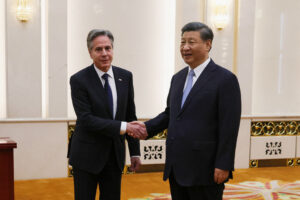
US Secretary of State (SoS/pun intended!) Antony Blinken finally embarked on a high-stakes diplomatic trip to China to try to cool down escalating tensions between the two super powers that have set many around the world on edge (AP/Associated Press, June 17).
After all, it takes two to tango.
Blinken was the highest-level US official to visit China since President Joe Biden took office nearly two-and-a-half years ago, and the first secretary of state (SoS) to make the visit in five years.
That’s a long time between visits for two competing world powers.
Biden and Chinese President Xi Jinping had agreed to Blinken’s trip early at the G-20 summit last year in Bali.
It came within a day of happening in February this year but was delayed by the diplomatic and political tumult brought on by the discovery of what the US says was a Chinese spy balloon flying across US territory that was finally shot down off the eastern coast in the Atlantic.
Opportunities Galore
Since the abrupt cancellation of Blinken’s visit in February, there have nonetheless been some high-level engagements.
CIA chief William Burns travelled to China in May.
China’s commerce minister travelled to the US.
Biden’s national security adviser Jake Sullivan met with Wang Yi, China’s topmost diplomat in Vienna.
But these meetings have been punctuated by bursts of amgry rhetoric from both sides over the Taiwan Strait, their broader intentions in the Indo-Pacific, China’s refusal to condemn Russia for its war against Ukraine, and US allegations that Beijing is attempting to boost its worldwide surveillance capabilities, including in Cuba.
And earlier this month, China’s defence minister peremtorily rebuffed a request from US Defence Secretary Lloyd Austin for a meeting on the sidelines of the Shangri-La Dialogue, the annual security symposium in Singapore, a sign of continuing discontent.
Prospects Dim
Yet prospects for any significant breakthrough on the most vexing issues facing the planet’s two largest economies are slim, as relations have grown increasingly agitated in recent years starting in the Trump years, but continued under Biden.
Animosity and recriminations have steadily escalated over a series of disagreements that have implications for global security and stability.
Blinken arrived in Beijing on Sunday for two days of talks.
He met with Foreign Minister Qin Gang on Sunday.
He also met Wang Yi (the former foreign minister), state counsellor, and the Communist Party’s top functionary on foreign affairs.
There was also a short but calculated and politic meeting with President Xi Jinping. A non-meeting would have indicated that Sino-American relations were really in hot water.
Points of Disagreement & Dispute
The list of disagreements and potential conflict points is quite long:
- Trade
- Mutual relations with Taiwan
- Human Rights conditions in China (Uighurs, Hong Kong)
- China’s military assertiveness in the South China & East China Seas
- Russia’s war in Ukraine.
Friday that he would raise each of the points of disagreement, though neither side has shown any inclination to back down on their positions.
Establishing & Maintaining ‘Lines of Communication’
Shortly before leaving, Blinken emphasized the importance of the US and China establishing and maintaining better lines of communication.
The US wants to make sure “that the competition we have with China doesn’t veer into conflict” due to avoidable misunderstandings, he told reporters.
Biden and Xi had made commitments to improve communications “precisely so that we can make sure we are communicating as clearly as possible to avoid possible misunderstanding and miscommunications,” Blinken said on Friday.
Possibilities & Probabilities
Xi offered a hint of a possible willingness to reduce tensions, saying in a meeting with Microsoft Corporation co-founder Bill Gates on Friday that the United States and China can cooperate to “benefit our two countries”.
“I believe that the foundation of Sino-US relations lies in the people,” Xi said to Gates.
“Under the current world situation, we can carry out various activities that benefit our two countries, and the entire human race.”
Biden, on his part, told White House reporters on Saturday he was “hoping that over the next several months, I’ll be meeting with Xi again and talking about legitimate differences we have, but also how…to get along.”
Chances could come at a Group of 20 leaders’ gathering in September in New Delhi and at the Asia-Pacific Economic Cooperation summit in November in San Francisco that the United States is hosting.
Pakistan in Crisis
Political tensions between Imran Khan, former ace international cricketer and British high-society lion, and the Pakistani government have flared up in recent weeks and led to violent nationwide protests.
Khan’s bail on corruption charges was again extended on Monday, after he urged supporters to take to the streets peacefully if he is again re-arrested (AFP/Agence France Presse, June 19).
He remains far and away the most popular politician in Pakistan.
In this context, “Pakistan’s military has responded with a chilling campaign against Mr. Khan’s supporters that aims to hollow out his political party before general elections in autumn” (NYT/New York Times, International Edition, June 17-18).
Throngs of his supporters have been arrested.
Media columnists considered sympathetic to him have been intimidated.
Key allies have been made to resign from his party, saying they had been threatened with criminal charges and arrests.
Army’s ‘Grand Design’
The military’s pressure campaign has begun to gnaw at Khan’s previous momentum.
It is the military’s most forceful effort yet to disempower the former leader who was ousted from office last year.
It’s the latest move in the Pakistani military’s standard playbook for weakening or incapacitating politicians who no longer enjoy their support and preserving its iron hold on the country’s politics.
After all, the military has been ‘a state within the state’ for more than half the period of its independence from British rule.
It also underlines how Khan has become the target of the very tactics that helped him to power in 2018, when the army cleared the political field of his antagonists and paved the way for his election.
Since his toppling and fall from grace last year, Khan has constantly denounced the generals – a confrontation that has erupted in the most severe political crisis in Pakistan in over a decade.
Recently, over 100 senior and midlevel party officials, including two former chief ministers, a former governor and several former cabinet ministers, have left his party, known as Pakistan Tehreek-e-Insaf, or PTI.
PTI-members are announcing their resignations from the party on a daily basis, declaring their backing for Pakistan’s military and rejecting Khan’s conflict with the top brass.
“The primary aim here is to remove Khan from the political process, as he’s no longer reliably obedient and has amassed popular support that gives him political capital independent of the military,” said Arif Rafiq, a political analyst.
Khan’s Prospects
Many experts are already writing off Khan’s electoral prospects.
Although he has retained popular support among the masses, political parties in Pakistan need strong individual candidates to win seats in Parliament [a phenomenon that can also be observed in Nepal].
The series of defections mean Khan has lost his party’s key electable candidates, which will make it difficult for him to translate his street power into victories in the general elections scheduled for October, according to experts.
Many PTI defectors, including several high-profile former allies of Khan, have joined a new party political party – the Istehkam-e-Pakistan Party – led by Jahangir Tareen, a wealthy businessman and politician known for his alliance-making skills, and once Khan’s close confidant.
Raza Rumi, a political commentator maintains: “It is not even clear if Imran Khan would be qualified to contest the elections.”
Adding: “His return to power now seems almost impossible.”
Trump Confounds & Torments America
Come what may, Trump intends to again aim for the highest office of the land. Given the vagaries of the American political system, he does have a good shot.
Many Americans are confounded and tormented by Trump’s myriad antics to manipulate American society to further his selfish ends.
One such is the longstanding and perspicacious New York Times columnist David Brooks.
Brooks confesses that he tries to be a reasonable person. He looks out on the world with trusting eyes. Over the decades, he’s built up certain expectations about how the world works and how people behave. He relies on these expectations in analyzing events and anticipating what could happen next.
However, Donald J. Trump has confounded him at every turn, and, unfortunately, he is not cynical enough to anticipate what he is capable of (NYT International Edition, June 17-18).
Brooks concedes that he consistently underestimated Trump’s depravity.
He was shocked at how thuggishly Trump behaved in that first election debate with Joe Biden in 2020 [but this was to be expected after his behavior at other such debates, including his wantonly intimidating one with Hillary Clinton in 2016].
He was also stunned to find out just how aggressively Trump worked to overthrow the free and fair elections of 2020.
Then, just last week, was the final straw.
Brooks was once again taken aback to learn how flagrantly Trump had breached national security.
Like most Americans, Brooks cannot quite feel ashamed of his perpetual naivete toward Trump. He doesn’t exactly know what to make of the amoral narcissist.
Like others, he is bracing for the 17 months of election campaigning that apparently lie ahead, with “Trump probably once again the central focus of the nation’s consciousness” (NYT).
He is thinking about how Americans will once again be forced to defend their inner sanctums as Trump seeks, on a minute-by-minute basis, to take up residence in their brains. It will be a difficult exercise for mental independence from Trump.
Trump, by his mere presence, is an assault on the worldview that respects persons and institutions, while flawed are basically legitimate.
Trump is a tyrant, and as Aristotle observed, tyranny is all about arbitrariness.
Under a tyrant, there is no rule of law, there is no governing order. There is only his whim.
Under Trump, “High-minded values begin to seem credulous and absurd, irrelevant to the situation at hand.”
Trump has already corroded the Republican Party in just this way. Many Republicans have switched off the moral faculty.
Unfortunately, Trump’s corrosive influence has spread far beyond his party. It has corrupted parts of American society.
According to Brooks, in the coming months, America faces not merely a political contest, but a battle between those Americans who believe in ideals, and those who argue that life is a remorseless struggle for selfish gain.
The latter’s victory would be a step toward “cultural barbarism”.
The writer can be reached at: shashipbmalla@hotmail.com

Login to add a comment