







Nepali Affairs
India’s Latest Cartographical Aggression & Repercussions
By Shashi P.B.B. Malla
We are all aware how India has forcefully incorporated sovereign Nepalese territory in its official maps.
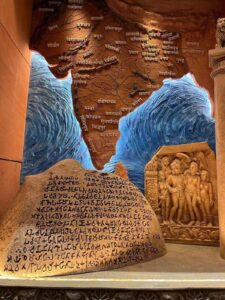
The recent controversy over a mural in India’s new parliament building is worthy of debate.
Highly important cultural sites in neighbouring countries – Pakistan, India, Bangladesh, Sri Lanka and the Maldives – have been depicted as parts of a historical Greater Bharat.
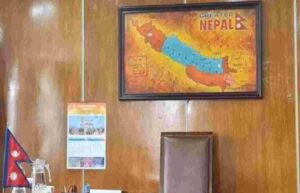
‘Greater Nepal’ Map in KTM Mayor’s Office
Balendra Shah – also known popularly as Balen – the mayor of Kathmandu Metropolitan City, has supposedly placed a map of ‘Greater Nepal’ in his official chamber as a symbolic counter to India’s placing of the ‘Akhand Bharat’ mural in its parliament building in New Delhi.
This step may have pampered to the Nepali sense of extreme nationalism, but it has done a disservice to genuine Nepali patriotism.
After all, the so-called ‘Greater Nepal’ map only depicts the size and extent of a geographical entity that existed only for a very short while, and is, in fact, now history.
After remarkable military campaigns, Nepal did conquer vast territories in the East, South and West; so that it extended from the River Teesta in Sikkim in the east to the River Sutlej in Punjab in the west.
However, Nepali rulers were careful not to encroach on territories to the north.
In any case, as an expanding power to the north of India it soon clashed with another expanding South Asian power – the British East India Company.
After losing the Anglo-Nepalese War, Nepal was forced to sign the Treaty of Sugauli, 1816, by which it ceded all conquered territory east of the Mechi River and all those west of the Mahakali River.
It also lost territory in Madhes-Tarai.
Considering that this happened more than two hundred years ago, and that Nepal’s loss of territory is sanctioned by international law, it is indeed foolish to even dream of a ‘Greater Nepal’.
Dogma of ‘Akhanda Bharat’
India’s ruling Bharatiya Janata Party’s dogma of ‘Akhanda Bharat’ (Greater India) is also completely misplaced.
India’s External Affairs Minister S. Jaishankar tried to brush off the raging controversy by dismissing it as a minor cultural matter: “It depicts the extent of the Ashokan Empire. Friendly countries will understand. You can forget about Pakistan, they don’t have the capacity to understand.”
Jaishankar elaborated further: “It is not a political issue…friendly nations like Nepal have understood India’s explanation, however, a nation like Pakistan does not have the capability to understand it…This is a cultural map, not a political one. I hope our friendly neighbours understand it” (TKP/The Kathmandu Post, June 9).
Jaishankar wants to ram his spin of the matter down our throats – whether we like it or not. This is India’s arrogance of power in action.
The overwhelming majority of Nepalese have not understood or accepted India’s explanation.
Pushpa Kamal Dahal-Prachanda may have kowtowed to Narendra Modi and sold Nepal’s vital national interests down the drain, but the majority of Nepalese know on which side their bread is buttered.
Jaishankar’s argument is dull-witted, fundamentally contradictory and does not confirm with historical facts.
How can Lumbini, Kapilavastu be depicted as within the extent of the Ashokan Empire and the map be still considered ‘cultural’.
Moreover, a nation’s culture is part of its national heritage and its national identity. All Nepalese – whatever their religion or ethnic background – are proud that Gautama Siddhartha, later the Buddha, the Enlightened One was born in Nepal.
India wants to take this away from us.
By the way, Emperor Ashoka visited Lumbini as a simple pilgrim, and he was fully cognizant of the fact that he was on hallowed ground.
Nepal’s sovereignty over Lumbini is longstanding and India should not attempt to overturn it by foul means.
Too Much Talk, Too Little Action
It has been very frustrating for the Nepali people that there is a lot of chattering in the internet and the social media about the dismal state of the nation in general, and the latest Indian cartographical aggression in particular – but no resolute, effective and sustainable action.
As the great German political philosopher Karl Marx wrote:
“The philosophers have only interpreted the world in various ways; the point is to change it.”
The idle talk of the chatterati will not help to drain the foul Kathmandu swamp.
Nepali Leaders’ Weakness
The main problem is that Nepal’s leaders are all too feckless, and are not willing or able to protect the country’s sovereignty and territorial integrity.
They are also too willing to bow down to Indian demands and to accept Indian assurances.
Once the old fogeys are removed from office, the new batch of younger leaders may be better motivated and equipped to represent Nepal more resolutely in the geopolitical and geoeconomic competition in three theatres:
- South Asia region
- the Asia-Pacific [ or the Indo-Pacific according to the US and India ] and
- world-wide between the U.S. and China.
Our current leaders’ thinking is just old-fashioned and backward. They believe that India is the dominant power in South Asia and we have to accept India’s bullying.
However, we are no longer a land-locked country. Being sandwiched between two great powers is not a geographical curse or major impediment, but an opportunity – if the leaders know how.
For this, we have to practice the grand strategy of dynamic non-alignment.
This entails:
- the strict policy of diplomatic equidistance between Beijing and New Delhi;
- and that of dynamic non-alignment between Beijing and Washington.
Nepal cannot be in favour of any kind of confrontation or armed conflict between the United States and China.
Nepal cannot hang on to India’s coattails and be part of the Indo-Pacific Startegy comprising the Quad [ US, Japan, India, Australia ] attempting to contain China.
Nepal Must Reject Hindu Nationalism
According to the 2015 Constitution, Nepal is a secular state.
However, it is permeated thoroughly by the Sanatan Dharma, so much so that the President of the Republic apes the former monarchs at religious functions and festivals.
It must distance itself completely from the rabid Hindu nationalism – Hindutva – of Narendra Modi and his ruling Bharatiya Janata Party (BJP). We must have nothing to do with these bigoted people.
Some people and groups pin their hopes on the BJP and Hindu groups for the restoration of the Hindu monarchy in Nepal.
These hopes are completely misplaced. The Indian establishment, whether Hindu or not, will not tolerate a Hindu monarchy in Nepal, because it is, in fact, the depository of the country’s sovereignty and territorial integrity.
These groups will need to explore new avenues.
Secularism Goodbye?
These days even the prime minister – an atheist since his youth — now masquerades as an ardent Hindu.
Some even in the bigger, established parties are for easing secularism, if necessary by amending the Constitution.
This is just a sham – to win the hearts and minds of a deeply religious electorate.
Hindu State Equals Hindu Constitutional Monarchy
There is an ongoing concerted effort by the Indian BJP and their supporters in Nepal – which includes Dahal-Prachanda – to separate a possible de-secularization from a Hindu constitutional monarchy.
There is method in their madness, because such a de-coupling would remove what has been the very symbol and protector of Nepal’s sovereignty and territorial integrity since the Great King re-established a new version of an ancient kingdom.
We have seen time and again that indirectly elected presidents of the republic as heads of state have not lived up to their expectations and have been far from impartial.
Dr. Alok K. Bohara, the prolific and astute professor of Economics at the University of New Mexico has written: “The mere fact that the selection of this highest office is left in the hands of the top leaders of the established political parties, the whole process has turned into a display of political puppetry.”
The hallowed institution of a Hindu constitutional monarchy was hastily abolished in collusion with the Indian establishment without any recourse of asking the sovereign Nepalese people in any form or a referendum.
Now, it is high noon for that vital feedback from the Nepalese people. And it is in the nation’s vital national interest.
The writer can be reached at: shashipbmalla@hotmail.com

Login to add a comment