








By Shanker Man Singh
Prime Minister Pushpa Kamal Dahal ‘Prachanda’ offered prayers at the famous Mahakaleshwar Temple in Ujjain city of Madhya Pradesh during his recent visit to India. PM Dahal was welcomed by Madhya Pradesh Governor Mangubhai Patel, State Minister Mohan Yadav and Jagdish Deoda at Mahakaleshwar Temple, one of the 12 Jyotirlingas in the country. It is to be remembered that during the joint press conference recently, the Indian Prime Minister concluded his speech by seriously stating that Dahal’s religious visit to Ujjain and Indore would give him spiritual awareness by visiting from a country of Pashupati and to Mahakaleshwar Mahadev.
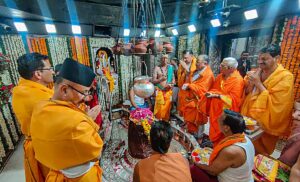 The Mahakaleshwar Temple is one of the twelve Jyotirlingas of India. It is the main temple of Lord Mahakaleshwar located in the city of Ujjain in the state of Madhya Pradesh. The beautiful description of this temple is found in the works of epic poets like Puranas, Mahabharata and Kalidash. Mahakaleshwar Mahadev is self-built, magnificent and south-facing, so it has a lot of virtuous significance.
It is believed that one can get salvation only by seeing it. The great poet Kalidasash praised this temple while discussing Ujjayini in Meghdoota. After the destruction of this ancient temple in 1235, the rulers of this place paid special attention to the restoration and beautification of this temple, so the temple got its present form. This temple is decorated every year before Simhastha.
As a testament to the deep cultural and religious ties, Prime Minister Prachanda also made a special trip to Ujjain in the state of Madhya Pradesh where he visited a temple dedicated to Lord Shiva. The temple holds great significance as one of the twelve Jyotirlingas, or sacred abodes, of Lord Shiva, and although the Prime Minister’s visit to the temple is expected to emphasize the shared spiritual ties between Nepal and India, the news and photos of the PM Dahal visiting Pashupatinath do not seem to be public. In the social network, “People are ashamed to work in the country, leaders are ashamed to worship in the country, the pair have come together. After all, Krishna is there prevalent. After returning to Nepal, don’t say that religion is opium”
Wearing an orange shawl, PM Dahal, a secular by belief, performed religious rituals in the sanctum sanctorum of the temple in the afternoon. The priests were gifted 100 ‘Rudraksha’ and Rs 51,000 to the temple amidst the chanting of ‘Shlok’ (bhajan) Nepali PM.
The purpose of the Nepali PM’s visit along with a high-level delegation was to strengthen the already strong bilateral partnership between the two countries. This trip has wider implications as it seeks to enhance cooperation not only in the political arena but also in areas such as solid waste management, which the Prime Minister should have explored during his visit to Indore. Indore has been adjudged the cleanest city in India for six consecutive years, according to the annual cleanliness survey of the central government of India.
The current visit to temple diplomacy follows the footsteps of the former PM Sher Bahadur Deuba, who during his visit to India paid homage to the famous Kalbhairav and Kashi Vishwanath temples in Varanasi. Such gestures not only deepen the cultural ties between the two nations but also show the rich religious heritage that unites Nepal and India.
Since Dahal was a “revolutionary”, his religiosity in India can be seen as a strategic transformation to address the Modi factor – a factor that could be crucial to his political success and survival. It would not be an exaggeration to say that the visit to India five months after becoming the Prime Minister for the third time was for political management.
The Citizenship Bill rejected by the then President was approved by the current President just hours before PM Dahal’s departure to India. Whether this was accidental or not, time will tell. The visit to Mahakaleshwar Temple, Ujjain was an attempt for the BJP government to show its ‘Hindu’ credentials. Some believe that it was an attempt to convince them that staying in office was in the interest of India as compared to China.
PM Dahal has worn the formal and traditional dress of Nepal for the first time on a foreign visit. Dahal and his party Nepal Communist Party (Maoist Center) are not wearing traditional dress to maintain a radical and revolutionary image.
Religion and communism have no place in the 21st century. Both of those are old concepts. Nepalis have started to understand this. Also, the ‘rule of law’ and ‘human rights’ are all important things, not second to none. Communists of Nepal do not want the nation to be governed by the Gita or any religious text. Many communist leaders present themselves as atheists or agnostics but during festivals, they post festive pictures.
There can be a debate about atheism or agnosticism. Actually, this is not an issue. Not only the communists, no party in Nepal has anything to do with religion. Everyone here respects all religions. It can also be seen that Nepal is a country where there is no violence related to religion. No party or people are against any religion here. It is often and repeatedly said from the Indian side that it depends on Nepal what kind of relationship Nepal wants to develop and maintain with India. Aam Bharti says that India is always open and ready to help in any field of mutual interest. This requires mutual respect, tolerance and perseverance from both countries. Let us quote only what the famous South Asian Mahatma Gandhi said, “Happiness is when there is consistency in what you think, what you say and what you do are in harmony.
Indian Prime Minister Narendra Modi announced that the fertilizer plant in Nepal, the second inland petroleum pipeline, the conclusion of the revised trade and transportation agreement, the new joint hydropower project and the new long-term plan will take the partnership with Nepal to the ‘height of the Himalayas’.
Under the power trade agreement, India will be able to import 10,000 megawatts of electricity from Nepal in the next 10 years. Along with the visiting Prime Minister Dahal, Modi jointly inaugurated many projects and exchanged many other MoUs and agreements. Both sides have also signed an agreement on a cross-border digital payment mechanism between Nepal and India.
Prachanda termed the new initiatives as “path-breaking” that will give new momentum to the relationship. He also welcomed the Indian initiative to enable Nepal to export electricity to Bangladesh. The Indian Prime Minister said that he and Prachanda have taken very important decisions to make the partnership between the two countries a ‘super hit’ in the future.
During his visit to Nepal about nine years ago, he took “heat” in the form of highways, information technology and transmission lines.
It is necessary to strengthen the relationship with Nepal in the context of geo-economics that is changing in the world scenario, which is taking the movement of world neo-globalization and protectionism as the center point. It will be important to develop strong partnerships in the region to counter its impact. Nepal, with its growing economic success, provides an important partnership in this region.
“There has been a protocol that the main guest should wear ochre clothes at the Mahakaleshwar Temple. If I had denied donning the clothes, the people of India would have a deep feelings for the Prime Minister. Why should we not take it as cultural diplomacy?” clarified PM Dahal when questions were raised on his temple visit.
He further said, “I have been pro-secular since childhood. But secularism does not mean going against religion. The state should equally treat all religions. It should not support a particular religion and ignore another. I am not only a communist but also a Prime Minister. All should be brought along. It is the responsibility of all of us to honor all religions and communities.”
The Nepali economy is in dire need of growth and that should have been his focus. Also, the political situation in Nepal is now critical. However, this visit and the program in Ujjain have given a glimpse of transformation. It is a reflection of the changing situation.

Login to add a comment