








* Kissinger: The Great Scholar & Practitioner of
Foreign Affairs
* Sino-American Peaceful Co-Existence Vital
* Putin’s Ukraine War: Denouement?

By Shashi P.B.B. Malla
Henry Kissinger: Scholar, Diplomat, Eminence Grise
One of America’s greatest scholars of International Relations and a practicing diplomat to boot, turned 100 on May 27.
He was without doubt a scintillating practitioner of diplomatic statecraft.
During his colourful life, he wore many hats.
He was born in the German Bavarian city of Nuernburg as Heinrich and remained a lifelong fan of that city’s football club.
He left for the United States in 1938 and became Henry.
He went to high school, entered the US Army during World War II and served with distinction in Germany.
He earned undergraduate and graduate degrees from Harvard, where he later joined the faculty.
Kissinger’s many publications and a stint at the Council on Foreign Relations dramatically increased his profile.
However, it was as a government official that he made his mark on American history and politics.
He spent eight years in the highest level of government in the Richard Nixon and Gerald Ford administrations where he was National Security Advisor and Secretary of State, and for two years the only individual to serve simultaneously as both.
There is ample evidence that the interagency process has never run so smoothly as under his watch (Richard Haass: Home & Away, May 26).
There have been voices critical of Kissinger for policies associated with Vietnam, Cambodia, Chile, and what was then East Pakistan and is now Bangladesh.
Kissinger’s accomplishments were many and large.
His crowning achievement was probably:
- The US ‘opening’ to China;
- Détente and nuclear arms control pacts with the then Soviet Union;
- The negotiations that brought the Vietnam War to a close;
- The diplomacy that helped end the 1973 Middle East conflict and paved the way to the Israel-Egypt peace treaty.
According to Haass, the current President of the Council on Foreign Relations: “It is an extraordinary set of achievements by any measure.”
And in the last nearly 50 years since Kissinger left government, he has managed to stay relevant and influential both through his books, articles, interviews, and private meetings with the most senior leaders and officials in the United States and around the world.
He is “the pre-eminent scholar-practitioner of our age”.
U.S. Peaceful Co-Existence With China
Confrontation between the United States and China is neither necessary nor inevitable.
Armed conflict between them would be catastrophic to the world at large.
The only viable and stable condition in world politics is that of peaceful co-existence between the sole super-power and the rising one.
Peaceful Co-existence between the U.S. and China is essential:
- For a stable and sustainable world economy
- To jointly combat and take leadership of climate change
- To control and check proliferation of weapons of mass destruction (WMD);
The threat and use of nuclear weapons to be severely disciplined
- Generally, that International Law and the Charta of the United Nations are upheld
Particularly, the sovereignty and territorial integrity of all states to be respected and the use of force to instigate territorial changes rigorously reprimanded and punished.
China’s position could be crucial in bringing about an end to the Ukraine war.
It is indeed regrettable that in the United States an extremely hawkish, so-called bipartisanship vis-a-vis relations with China has emerged.
The Republicans are leading unsuspecting Americans down the garden path, and Democrats have fallen into the trap of making common cause with them.
Recurring claims that a new “Cold War” is emerging adds fuel to the fire and obviously evokes the US-Soviet precedent.
However, a new biography of George F. Kenan, the intellectual father of the US policy of containment reveals that this concept was not intended as a military strategy, and was instead meant as a prerequisite for negotiating the terms of peaceful coexistence between the US and the Soviet Union (Frank Costigliola in Paul Heer/The National Interest, May 5).
Kennan actually advocated a combination of “patience, sacrifice and restraint.”
However, US leaders and the foreign policy establishment supported the consensus view that “a more hard-edged containment strategy brought overall stability to US-Soviet relations without requiring substantial US compromises with Moscow” (Heer).
This resonates in contemporary US-China relations.
The Biden administration is embracing an almost exclusively confrontational approach to Beijing that has many of the hallmarks of the earlier militarized, zero-sum containment strategy it pursued against the Soviet Union.
Many China experts have instead advocated “military restraint and serious diplomacy with China, and emphasized the increasingly apparent limits on US power and leverage.”
The prevailing narrative in Washington is that the US is facing a “deadly and irreconcilable conflict” and “the likelihood if not the inevitability” of a US-China war because China seeks “to achieve world domination.”
The US-China contest is portrayed as a winner-take-all struggle between democracy and autocracy [the Chinese people themselves do not see it that way].
Beijing, no doubt, also shares ample responsibility for this poisonous bilateral dynamic, including periodic resistance to engagement with Washington.
Both sides need to recognize the “symmetry of their perspectives”, and the mutual distrust and recrimination that are fueling it.
They need to overcome such an interactive dynamic and reach a diplomatic modus vivendi before the confrontational aspect of their relationship leads inexorably to another unnecessary cold war, or even worse.
Strategic empathy may be achieved through the good offices of European leaders like Emmanuel Macron and Olaf Scholz, who do see China in a different light.
They would be willing to assume the risks of pursuing mutual accommodation, especially – and unlike the Americans –if they have not already concluded that doing so would be futile.
Ukraine’s Upcoming Counter-Offensive
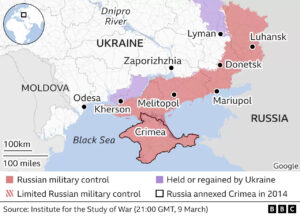
Ukraine is ready to launch its long-expected counteroffensive against Russian occupying forces according to one of Ukraine’s most senior security officials (BBC).
Oleksiy Danilov would not name a date, but said the assault “could take place tomorrow, the day after tomorrow or in a week’s time.”
As secretary of Ukraine’s National Security and Defence Council, Danilov is part of President Volodymyr Zelensky’s de facto war cabinet.
He also confirmed that Wagner mercenary forces were withdrawing from the embattled city of Bakhmut, the site of the bloodiest battle of the war so far.
Danilov also said he was “absolutely calm” about Russia beginning to deploy tactical nuclear weapons to neighbouring Belarus.
Ukraine has been planning a counteroffensive for months. But it has wanted as much time as possible to train troops and to receive advanced military weapons from Western allies.
In the meantime, Russian forces have been preparing their defence.
Much is at stake because the government in Kyiv needs to show the people of Ukraine – and Western allies – that it can break through the Russian lines, end the effective military deadlock and recapture some of its sovereign territory.
Danilov said the armed forces would begin the assault when commanders calculated when they can have the best result at that point of the war.
Good Chances of Success in strategic objectives while preserving much of its armed strength and physical infrastructure as possible.
One way would be to cut off the Crimean Peninsula and starve it from Russian military support – achieving Ukraine’s war aims at a much lower personnel and materiel cost.
This approach would envisage the bulk of Ukraine’s new mobile brigades massing near Dnipro, a major road and rail hub in southeastern Ukraine well outside Russian artillery range before rupturing the front and driving for Zaporizhia.
From there the operational objective would be the capture of Melitopol and the severing of the land bridge from Russia to Crimea.
The seizure of Melitipol would cause a crisis of confidence among Russian political and military leaders as Russian forces in the south and east would be cut off from each other, rendering a coherent defence at the operational level impossible.
This would dramatically undermine Russian morale and encourage even more international support for Ukraine.
Ukraine’s counteroffensive could potentially be concluded by the end of summer, leaving the Crimean Bridge as the only remaining option for ground supply of Russian forces in Crimea.
However, if Ukraine has been successful in its military campaign, the bridge would be within range of long-range missile and drone attacks.
Resupply of Russian forces in Crimea by air and sea would also become precarious, as ports and airfields would now be vulnerable to drone, missile and rocket artillery strikes.
Crimea would effectively be isolated.
Ukraine would have also regained control of the North Crimean Canal, Crimea’s principal water supply – adding to Russia’s
The Russian Black Sea Fleet with its home sea port of Sevastapol would come within range of Ukraine’s rocket artillery and be forced to withdraw to Russian waters.
Nuclear Threats, Ceasefire & Diplomatic Negotiations?
Vladimir Putin is expected to react to such unprecedented setbacks by reviving his amoral threats to respond with tactical nuclear weapons.
However, his nuclear saber-rattling has lost much of its impact through overuse.
Moreover, China has made it clear that such weapons of mass destruction are a no-go.
Putin may use the impasse to demand international intervention to pressurize Kyiv for a ceasefire and a negotiated settlement that allows Russia to at least retain some occupied territory.
The point is, however, whether Ukraine and its people will be in a mood to accept such a settlement.
The writer can be reached at: shashipbmalla@hotmail.com

Login to add a comment