








By Narayan Prasad Mishra
We see various government systems in different countries – Monarchical, Democratic, Communism, etc. A democratic is a system where the government is formed based on the opinions and views of the majority. So the election is the soul of the democratic system because the correct opinions can be collected only by-election. The country’s constitution guarantees free and fair scheduled elections in a democratic country with an independent powerful election commission. That office is supposed to conduct the election impartially, being the chief executive and Chief Justice for this purpose. So the chief of that office is expected to be like Yudhisthir, dharmaraj, the king of righteousness, pure and holy, untouched by any kinds of impurities – political, economic, social, etc. The person should be a man of courage, honesty, and integrity and should not go against the rules and regulations under pressure. The person should not be greedy for money or wealth or attracted to any other positions of power.
Infographic designed by Ms. Asha Adhikari
In the present-day world, democracy and election are exhibited as mandatory even in a country where both are not liked and welcomed. This fact has almost been established that speaking against democracy is shameful. Because of that, even the dictators do not want to speak against it; instead, they want to show democracy and election. So Marxist, Leninist, Maoist regimes, and single-party governments also exhibit election though, in action, everything is controlled, and the dictator is always chosen and elected. One can see it in some communist countries where the same leaders are elected from time to time for many decades, even in some countries for life. They talk of election and democracy. That is interesting to see and watch.
Naturally, the actual democratic election in a democratic country is much different from an undemocratic one. The democratic election is always periodic, competitive, inclusive, and definitive but not just symbolic. The candidate must come to the competition with his or his party’s plan and programs to speak in front of the people, not only in a closed room or chamber. The freedom of speech and writing and the rallies are not controlled, and the rules and regulations of an election are applied to all equally. The party which holds the majority seats in the election forms the government. People do not expect the same leader to be elected lifelong.
As mentioned above, we also have the election commissioner’s office in our country with full power and authority, fully independent from the government. We have periodic elections. We have all the necessary rules and regulations that one democratic country needs for this purpose. We have been experiencing democratically elected governments for many decades. But almost all the time, we know our elected government of any party did not work to the people’s satisfaction. Instead, people always felt the government worked for the party people and the near and dear. It showed that corruption was their main agenda. So the country and the general people are becoming poorer and poorer.
On the other hand, hundreds of leaders and followers of the party who were in the government are becoming wealthy and more prosperous. To know it, you do not need to study or do research. You can see and experience it by seeing the people who were in power and comparing their life and standard of living then and now. The leaders who could not rent a good-sized room in Kathmandu Valley now own big bungalows and mansions with expensive cars and millions of rupees bank balance. The topic has become a talk of the villages and towns. Everybody knows it. Everybody feels and talks about it. It is seen crystal clear. There is not even a ray of secret. Corruption has become almost a part of our culture as if there is no need to be shameful of being corrupt in Nepali society. The people in power do not work and act according to their promises and political manifesto made during the election. Their promises and manifesto are seen just to be exhibited to cheat the people but not to work. All the parties seem to be of the same conduct and nature.
When we see the democratic exercises of many other democratic countries, even the uneducated people are conscious of using their voting rights. They compare the government’s performance with their pre-election promises and political manifesto. They also keep their eyes on the honesty and morality of the leaders. They do not vote for the party and the candidate who did not perform well to the people’s satisfaction. They do not vote again for the same party and leaders who did not deliver good governance, better qualities of life, and the rule of law. They do not vote again for the same party and candidates whom they think indulged in corruption and worked only for self-interest. They select the new party or candidate, searching for a new possible good performance. According to the reports, we have 79 political parties participating in the coming local election. But the most mysterious in our country so far is that our voters vote for the same political parties and candidates who had been in power for many decades and about whom they saw only negatives and saw only their corruption, nepotism, and favoritism.
We are heading to the polls soon to elect the members of our municipalities. We will also have a new general election soon, in the future. There are many burning domestic issues of corruption, nepotism, favoritism, price hike in foods and daily used goods, unemployment, expensive, unbearable health care, and education, mismanagement and corruption in the government offices everywhere, the problem of drinking water, pollution, exploitation of the weak by the strong, gender inequality, etc. Besides, there are some constitutional issues raised by the people – constitutional monarchy instead of the party president, local self-government instead of a federal structure, Hindu kingdom instead of a secular state, citizenship problems, etc. There is also an issue of international relations and foreign aid like the MCC controversy even after the ratification by the parliament as wanted by the donor country and the BRI project of China. People are aware of them.
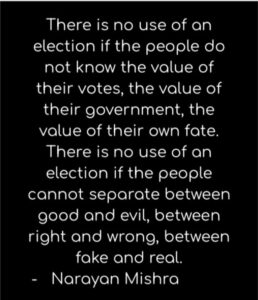
I hope, this time, people will vote for the party and candidate using their wisdom and conscience, not thinking of relation, near or far, not by pressure or some monetary gain. If they do again what they did before making the same parties and candidates win without correct evaluation of their past performance, we must be sure that our country and the people are not fit for democracy. If they vote again for the criminals, killers, exploiters, destructors, kidnappers, bomb blasters, extortionists, corruptors, gangsters, cheaters, we better establish another system as there is no use in spending a vast amount of treasury in the name of democracy and election, just in the name. There is no use of an election if the people do not know the value of their votes, the value of their government, or the value of their own fate. There is no use of an election if the people can not separate between good and evil, between right and wrong, and between fake and real. There is no use of an election if the people do not know that their votes decide their fate; their votes decide their country’s fate.
narayanshanti70@gmail.com

Login to add a comment