








By Narayan Prasad Mishra
We often hear people saying that experience makes a man wise, and practice makes a man perfect. We hardly understand it when we are kids. We hardly give importance to it even when we are young. We think we are wise enough and know everything about life and living as we see them. That is the way we grow and live. We do not learn everything by birth. As you grow physically in size and height, in the same way, our wisdom and understanding power grows and increases.
That we realize only after time passes when we look back at our life and seriously think about it. Besides, we know about it correctly when we feel with a free conscience, not being the servant of any faith and doctrine. In this context, I always try to remember my negative thoughts on King Mahendra’s royal step of 1960.
In 1959 when we had the country’s first general election, I was a student at Trichandra College, Kathmandu. I saw Bisheshwor Prasad Koirala, the supreme leader of the Nepali Congress Party when he came to speak for his election campaign in Bhaktapur. The program was held on the premises of Shree Padma High School, where I studied. He was a dignified leader with a good appearance and personality. He communicated well about the importance of democracy and his party for the people’s welfare. I was impressed. He became the prime minister of the country on 27 May 1959, winning 74 seats out of 109 seats of the house of representatives, the lower house of the parliament, in the election held from February to April 1959. I was glad that he formed the government and hoped for the country’s development in the way he presented.
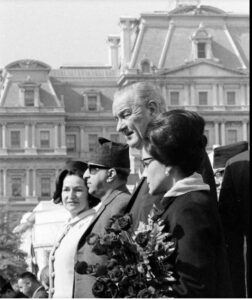 King Mahendra and Queen Ratna with President Lyndon B. Johnson and Lady Bird Johnson.
Though prime minister Koirala was good by all standards, his government was not delivering the result as the people wished. Rather than many other negative things, there was nepotism and favoritism at a high peak. The general people were neglected, and the party leaders, followers, relatives, and friends were beneficiaries. That was visibly seen as we see these days. And the people’s hopes were duped. That may be the characteristic of the party system, the necessary evil, because, in a developing country like ours, the party needs to favor their followers and near, dear relatives to run the party. Otherwise, who would be their devoted workers without any personal advantage where all are self-centered. They become party soldiers hoping to have materialistic gain, some job, position, etc., not to serve voluntarily like in developed countries for the political philosophy you love. Maybe because of that, B. P. had to close his eyes against nepotism and favoritism by compulsion.
In general, people were not happy. On the other hand, the loser leaders of other parties who lost the election – Tanka Prasad Acharya (Nepal Praja Parishad), Dr. K. I. Singh (Samyukta Prajatantra Party), Dr. Dilliraman Regmi (Nepali Rashtriya Congress), Bhadrakali Mishra (Nepal Praja Parishad (Mishra), Ranganath Sharma (Democratic General Assembly), Dr. Kesher Jung Raysmajhi (Communist Party of Nepal), Vedanananda Jha (Tarai Congress), Ranadhir Subba (Gorkha Parishad) were making considerable noise against the government. The country was not in good shape.
In this situation, King Manendra took a royal step using his extraordinary power to dissolve the parliament and the government on 15 December 1960, presenting several serious reasons justifying his action. The country’s lousy situation he showed was almost like the country’s present situation. One could compare it by reading his speech of that day. I was a young boy and a firm lover of democracy at that time. As a democrat, I had faith and respect in leaders as they were chosen and made by the people on some grounds.
On the other hand, the King and the Queen were hereditary without other reasons and basis. So they were not my liking and used to think why they were in high positions by birth whereas we needed to learn and achieve many things even to get a minor job. Based on these thoughts, I looked at King Mahendra’s royal step and thought that he took that step to make himself more powerful to fulfill his wishes. At the same time, I did not agree with his reasons for his step thinking it was created for his own sake. After some time, the King introduced partiless Panchayat System and banned the political parties from existing. Besides, he did a lot for the country’s development and welfare with good plans and programs, establishing many industries, creating roads and infrastructure, introducing land reform systems, etc. He set a good image of the country internationally, improved diplomatic relations, and arranged foreign help for our development. Even though I did not accept his political system as a democratic system because of the lack of political parties, as a political science student, there would not be democracy without political parties. I thought I was perfectly wise to feel that way. Because at that time, that was the limit of my thinking and knowledge. Based on those thoughts, my eyes were closed to see his achievements though I was not in politics. I even wrote the poem titled ”Panchayat Gita,” depicting the wrongdoings against the Panchayat System by the pseudonym, and the poem was published in Naya Nepal Post on October 18, 1984 (Kartik 2, 2041 BS). That poem is also included in my poetry collection book ”Umliyeka Pidaharu,” published in 2003 (2060 BS)
I am not a political man, never worked for Panchayat politics, and never joined any political parties. I worked for about five years in government offices and the rest at Tribhuvan University during my working career. My wife and I, both were dedicated citizens of the nation. When the Panchayat System was thrown out after the movement in 1990, I was the chief of the Tribhuvan University Service Commission Office. My beloved wife, Shanti Mishra, was the chief of the Tribhuvan University Central Library. Girja Prasad Koirala became the elected prime minister of multiparty democracy Nepal.
He appointed Kedar Bhakta Mathema, his worker, as the vice-chancellor. He pushed us out of the university, and we both lost our jobs at the university just as thousands of government employees did at that time. We experienced this bitter piece of a new democracy. The government closed and sold many industries established by King Mahendra. We have been experiencing multiparty democracy for the last 32 years. So now we know clearly that only the parliament system and system of political parties is not democracy. Democracy is the culture of equality and justice rather than political parties and the parliament. You can have more democracy in partiless and monarchical systems if there is a system of justice and equality.
Similarly, the king and queens could also be more democratic than the presidents and vice-presidents if you could make them constitutionally and if they possess the culture of democracy. I learned it from my experience seeing and comparing Nepal’s political history of the pre-1960, Panchayat period, and the present multiparty system. From my lifelong experience, I realize now that I could not see the goodness of King Mahendra because of the weakness of my ignorance. I think that was the weakness of the knowledge which I possessed at that time. So, in other words, that was the weakness of my age and time. Now, I fully understand the true meaning of — practice makes a man perfect, experience makes a man wise.
narayanshanti70@gmail.com

Login to add a comment