








By Our Reporter
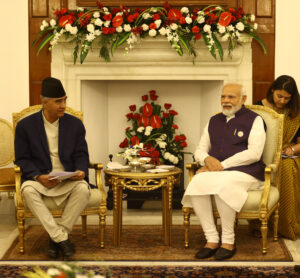
Prime Minister Sher Bahadur Deuba has returned home after concluding his three-day official visit to India. It was his first India visit after assuming office in July last year.
Although PM Deuba held a single meeting as well as a formal bilateral meeting with his Indian counterpart Narendra Modi on Saturday, the two countries did not issue any joint statement at the end of the visit, raising suspicion about whether the visit was successful. It is said that a joint statement was not issued as Nepal raised the Kalapani issue.
Also, PM Deuba held talks with Modi without keeping any aide with him while Modi had one with him. So, there will be no record in Nepal of his talks with Modi.
It was reported that after a special meeting held between the two premiers at the Hyderabad House in New Delhi on Saturday, PM Deuba had proposed a mechanism to resolve the boundary disputes.
“We discussed the boundary issues and I urged PM Modi to resolve them through established mechanisms,” PM Deuba said at the joint press conference organised following the talks.
The two PMs talked about border issues, security concerns, partnership and cooperation in energy development, and enhancement of connectivity networks for economic development. However, it is not known whether the issue of Kalapani was raised in the talks. But when no joint statement was issued at the end of the visit, many have suspected that the Kalapani issue prevent the issuance of the joint statement.
Following the talks, a delegation-level talk was held between the delegates of the two countries. PM Deuba and PM Modi addressed a press conference.
The two PMs jointly flagged off the inaugural passenger service between the Jayanagar-Kurtha rail link, which was constructed under Indian assistance. They also witnessed the exchange of a Memorandum of Understanding on Technical Cooperation in the Railway Sector, inaugurated 90 km long 132 KVDC Solu Corridor Transmission Line Project built under an Indian line of credit, and launched the operation of RuPay cards in Nepal which is expected to promote the flow of Indian tourists to Nepal.
Likewise, they agreed to conclude the revised Transit Treaty which will facilitate the operationalisation of rail, cargo, transhipment, private operators, inland waterways and access to additional ports. They also discussed the early completion of the DPR of the Pancheshwar Multipurpose Project, which could be a milestone in Nepal-India cooperation in hydropower development.
Similarly, there were discussions on cooperation in civil aviation and Nepal requested additional air entry routes to Nepal through Mahendranagar, Nepalgunj and Janakpur, and also for the concurrence of near border flight operations to smoothly operationalise the Gautam Buddha International Airport in Bhairahawa.
PM Deuba also said that the cross-border power trade remained a priority agenda during the discussion. “I am happy with the Nepal-India Joint Vision Statement on Power Sector Cooperation that we have agreed upon today for mutually beneficial cooperation on hydroelectricity generation, transmission and cross-border trade. I welcome PM Modiji’s offer of purchasing electricity from Nepal,” said PM Deuba.
Upon arrival at TIA, Foreign Minister Narayan Khadka briefed the media about the visit by issuing a press note.
According to Minister Khadka, the two countries signed an MoU for Enhancing Technical Cooperation in Railway Sector; Framework Agreement of International Solar Alliance; Agreement between Nepal Oil Corporation and Indian Oil Corporation for Supply of Fuel for 5 Years, and Agreement between NOC and IOC for Sharing Technical Expertise.
Similarly, the Janakpur-Jayanagar Cross Border Rail Link, 132 KVDC Solu Corridor Transmission Line Project, Construction of 132 health facilities and Rupay Card issued by SBI bank in Nepal were launched.
The two countries agreed to further strengthen mutually beneficial bilateral cooperation in the power sector including joint development of power generation projects in Nepal, and the development of cross-border transmission infrastructure.
However, the PM’s India visit could not be free from controversy, mainly for two reasons. One, Prime Minister Deuba visited the office of the BJP, the ruling party of India and he did not meet the leaders of the opposition parties.
The visit of Deuba, however, has helped increase personal relations between Deuba and Modi. Deuba, who is accused of being a pro-western leader in Nepal, had tried to win the confidence of Modi and other leaders of the BJP, and this was all made possible by Arzu Rana, his spouse, who had prepared the base of the visit by reaching New Delhi a few weeks ago.
There is no formal information about whether the two PMs discussed in the EPG report which was prepared jointly by the EPG members constituted by the Nepal and Indian governments under the initiative of the Indian government. The report was prepared three years ago but the Indian PM has denied receiving the report. The report is said to be replacing the unequal 1950 Treaty and regulating Nepal-India borders curbing cross-border crimes and other illegal activities.
PM Deuba, who is advocating for the agenda of secularism in the party, visited Vanarashi as the special guest of influential BJP leader, chief minister of Uttar Pradesh, and Hindu religious Guru Yogi Aadityanath and performed special pooja at the Bishwanath and Kalbhairab temples at the presence of the chief minister.
It is said that Aadityanath is the possible successor of Modi, thus far, Deuba wished to become the special guest of Adityanath. Deuba is trying to lift his wife Arju into Nepali congress politics.
Although the two leaders talked about completing the Pancheshwor project soon, the Nepali diplomats suspect the Indian intention as the project is pending since it was signed 25 years ago.
Diplomatic observers have remarked that whether the visit was successful or not, the upcoming results will show.
Will Pancheswar project be constructed?
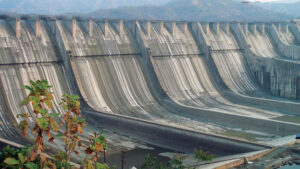 Nepal and India have renewed their commitments to build the Pancheshwor Multipurpose Project.
During Prime Minister Sher Bahadur Deuba’s recent visit to India, the two sides decided to complete the DPR of Pancheshwar Multipurpose Project.
Almost 26 years after the signing of the Mahakali treatment, India and Nepal have decided the complete the dam construction of Pancheshowr Multipurpose project, which is a part of the Mahakali treaty.
The Mahakali Treaty concerning the integrated development of the Mahakali River, which included the Sarada Barrage, Tanakpur barrage and Pancheshwar Dam Project, was signed between the Government of Nepal and the Government of India on February 12, 1996, and was endorsed by the House in September 1996. The treaty became controversial, which culminated in the division of the CPN-UML.
However, completion of the project is still suspected as the Nepali people are still divided over the project. Biplav-led Communist Party of Maoist had already threatened to disturb the project. Again, when no work was done in 26 years, it looks unlikely to complete the project in six months.

Login to add a comment