








By Narayan Prasad Mishra
I have my ancestral property in Bhaktapur, where my forefathers have lived for the last five/six hundred years. I was born, grew up, and did my schooling in that historic city. As my house is the closest residential house to the Taleju Bhawani Temple courtyard, I heard praying, singing, and music of that holy place every morning and evening. I love that prayer music playing and continuing for many centuries. The Big Bell (Thulo Ghanta) and Big Drum (Nagara) were in front of Taleju Bhawani Temple at Bhaktapur Durbar Square. When I was in school, my friends Tuyucha and Chandrika Karmacharya from Sukul Dhoka Tole had a duty to unlock the Big Bell and play. Very often, I accompanied them for that work. They played the Big Bell chanting the mantra, and I stood with them enjoying the bell. That was my pleasant life. I am happy to remember it.
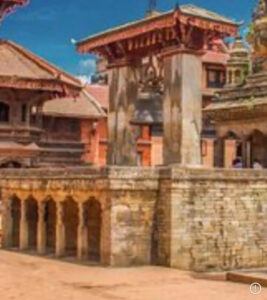
Big Bell (Thulo Ghanta in Nepali and Tagaa in Newari language)
Even now, I vividly remember that. I love my Bhaktapur with no know bounds. The life and culture of that city are mixed with my blood and flesh. When I write articles about the life and culture of Nepal, firstly, I write about the life and culture of that city because I know that more than any other thing. My family had a unique contribution to the education development of that city. My uncle, my father’s elder brother Shiva Prasad Mishra was the founding teacher of Shree Padma High School, Bhaktapur, the oldest school. Later on, my eldest brother Bhawani Prasad Mishra, who was 27 years senior to me, followed in my uncle’s footsteps, being one of its other teachers at the beginning. My brother Bhawani Prasad Mishra was the teacher of English education to almost all the people who became teachers and other professional people in that city being legendary. He was the teacher of teachers of Bhaktapur. That was the part of the history of education in Bhaktapur. They should not be hidden and forgotten.
On 8 Mangsir 2078, I went to Bhaktapur to get the recommendation of Ghar Bato (whether there is a motorable road or walking paths connected to the house and land) from the Ward No 2 of Bhaktapur Municipality regarding the sharing of my ancestral property between the brothers and nephews. To my great surprise, the Chief of that ward office refused to give me the recommendation saying that I cannot own the land or house in the municipality area according to the new law — nobody except the residents of that Municipality could own land or home there. At the same time, they told me I do not seem to be a resident of that place as I have my citizenship paper (Nagarikata Praman Patra) from Kathmandu District Office and live now at Kuleshwor, Balkhu. I did not know about that, and I could not even think I would not be a resident of that area because of the new law and rules. Anyway, that was the serious problem raised by the Municipality, and I was in severe pain in my birthplace. I was shocked to hear it as if I was separated from my mother.
The Ward chief referred me to the Mayor to talk about it.
I went to see Mayor Sunil Prajapati, and he was kind to meet me. I tried my best to convince him that the law, even if it was there, should not be applied to me from the following points.
- On my present Citizenship Certificate, my birthplace is mentioned that I was born in Ward No 10 (present Ward No 2) Bhaktapur.
- On the same paper, it is mentioned that my father, Durga Prasad Mishra was from the same ward.
- Only Kathmandu District Office was mentioned as my Citizenship Certificate issuing office.
- It does not mean that I am not a citizen of Bhaktapur or of that Municipality.
- It does not mean that I am a citizen of Kathmandu.
- So far, we know and understand about a Citizenship Certificate means that it is a document proving the citizen of Nepal.
- On the other hand, any person belonging to any district could get a citizenship paper from Kathmandu at that time. Under that provision, I got the Citizenship paper from Kathmandu. It does not mean I relinquished the citizenship of Bhaktapur.
- Besides, I have my ancestral property – house and the land of my possession in that Municipality, and I have been paying taxes to the Municipality for that where I live according to my necessity.
- More than that, I possessed the historic Citizenship Paper issued to me by Bhaktapur Municipality on 2 Saun 2015 BS which was 63 years ago according to the then law and rules.
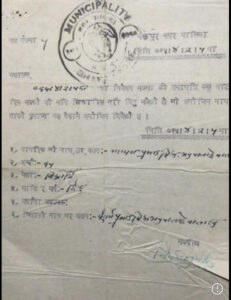 A historic citizenship certificate
Mayor Prajapati listened to me attentively and copied my historic Citizenship Paper with great interest but asked me to wait outside of his office till they discussed that problem in their committee. I had no alternative except to obey him. I stayed there with a heavy heart.
After about an hour, Ward Chief Hari Prasad Basukala returned my file without any decision after the meeting with the Mayor and asked me to wait for a few more days. At the same time, he asked me to talk to their Administrative Officer (Prashasakia Adhikrit), who was also coming out from the Mayor’s Office. His name was Ram Bahadur Shrestha. As an administrative man who is supposed to be fully acquainted with the country’s constitution, laws, rules, and regulations, I thought he could easily grasp my points and remove my problem quickly. So I hurriedly went to catch him and asked for some minutes to talk. But he seemed to be different from my expectations and did not want to listen to me. He ignored me like anything. He said he was busy and had no time to talk very rudely. At the same time, he said he knew my problem well and had my Citizenship Paper from Kathmandu. They needed to think over the matter and make a decision. I was astonished to tolerate his rudeness which I had never experienced in my life, being a high-ranking officer and chief administrator also of the University equivalent to the post of the Secretary to a Ministry once upon a time. I returned from there with despair and sadness.
Suddenly I remembered my district’s present parliamentarian Prem Suwal and my childhood friend, Narayan Man Bijukchhe Rohit, well known political leader and the Chairman of the Nepal Mazdoor Kishan Party. When I called Prem Suwal, he was kind to give me time. I went to see him in his party office. He received me well, and we had a good talk. He even arranged a meeting with Bijukchhe. After many years, I was so pleased to see Bijukchhe. We had several hours of companionship and chatted about childhood life, family relations, politics, education, culture, history, etc. They assured me that I would not have any problem with the present law, which intended to preserve the culture of the city, nothing else, and my family and I were an integral part of that culture for many centuries. I was surprised why the Municipality could not understand what they said to me about the goodwill of the law.
I needed the recommendation from the Ward office very urgently as I was going to the States soon after finishing the property sharing work in the Land Registration Office. I was much worried for my family members regarding that work which would put them in trouble if the job was not done when I was present. So I was very much worried when the procedure took a long time. With the understanding, goodwill, love, and support of Chairman Bijukchhe and Parliamentarian Suwal, I got my recommendation at last on 14 Mangsir 2078 and finished my work at the Land Office on 17 Mangsir 2078. I was happy and thanked them for their goodwill in my heart.
But the worry is always in my mind that our country will be divided if many kinds of citizenship papers exist – 1. Country’s citizenship, 2. State citizenship 3. District citizenship 4. Municipality citizenship? So far, I know Nepali citizens can freely move to any part of the country and own property anywhere without any hindrance and obstacles according to the country’s constitution. That is one of our fundamental rights. Is that provision of the constitution amended or changed? We all should think wisely about whether it is necessary to make the law that any municipality could prevent the residents of other districts from coming and settling in the name of preserving the culture and tradition of the city! Can we not make other conditions of living strictly for maintaining the culture and practice of the municipality instead of preventing our citizens of the country from entering and settling? We must think wisely with a free conscience and holy heart that those laws make the people divided or united? I want all to consider putting the nation first rather than the district or municipality when you do any work.
I want all to think about making the country and nationality stronger than other things. The present Republican leaders must consider these points in creating a new Nepal. Otherwise, I doubt you will have a new Nepal or an old Nepal one day.

Login to add a comment