








Review of World Affairs (RWA)

By Shashi P.B.B. Malla
Nepal’s Parliament Finally Ratifies MCC-Compact
With the ratification of the compact which had been sitting in parliament since July 2019, Prime Minister Sher Bahadur Deuba has virtually achieved the impossible.
- He has been able to meet the February 28 deadline given to the United States.
- Brought his unruly coalition partners, the CPN-Maoist Centre and the CPN-Unified Socialist on board and preserved the coalition government for what it is worth.
- Demonstrated for once leadership qualities not very apparent before.
- Preserved the traditional good relations with the U.S., which was the second country to recognize Nepal’s independent status and was instrumental in pushing Nepal’s admission to the United Nations.
The whole process was dragged into unnecessary controversy in the later stages for no rhyme or reason. Vested interests mainly used social media to make it a hugely divisive issue.
The Communists of all colours and hues have shown themselves to be anti-national and anti-social elements. They have no principles, ideology or genuine patriotism and are not fit for public office.
The government will now be able to finally work towards implementing the five-year programme.
It will mean more jobs for Nepalese, a reliable supply of electricity in east and west, north and south, and lower transportation costs. We may also be able to export electricity to India and Bangladesh. The energy sector will be a reliable one to invest in and the investment of thousands of Nepalese in this sector will now be safe.
The Nepalese Chamber of Commerce and Industry (FNCCI) – the umbrella organization of the Nepalese private sector – has said that the MCC-Nepal Compact will play a pivotal role in economic growth and infrastructure development in Nepal (THT/The Himalayan Times, March 1). So much for it being against the country’s vital national interests!
And yes, US Marines will also be coming in force – but only to take up regular duty at the U.S. Embassy in Maharajgunj!
India Walks Tightrope in Ukraine Conflict
India’s decision to abstain from voting on a U.N. Security Council resolution demanding that Russia cease its invasion of Ukraine does mean indirect support for Moscow, and also reflects New Delhi’s reliance on its Cold War ally, the Soviet Union for energy, weapons and support in intense conflicts with neighbours China and Pakistan.
Last week, India self-righteously regretted ‘countries’ giving up the path of diplomacy but refrained from voting along with the United States on the resolution that would have meant rupturing its ties with Russia spanning seven decades. Russia vetoed the vote, and China and the United Arab Emirates (UAE) also abstained.
This was in spite of the indubitable fact that Russia had flagrantly repudiated the very principles of the Charta of the United Nations [of which both it and Ukraine were founding members] and also the norms of International Law, in particular the sacrosanct principles of the inviolability of the sovereignty and territorial integrity of states.
A retired Indian diplomat G. Parthasarthy had the audacity to claim that India had not supported what Russia had done. “We have abstained. It is the right thing to do in the circumstances.” (AP/Associated Press, Feb. 26). To keep silent, or sit on the fence in such grave circumstances – a turning point in history – may have been the cowardly sign of realpolitik, but definitely not statecraft.
In the past, India depended on Soviet support and its veto power in the UN Security Council (UNSC) in its dispute over Kashmir with its longtime rival Pakistan.
This Himalayan territory is divided de facto between India, Pakistan and China [the Aksai Chin plateau of Ladakh in the northeast].
India accuses Pakistan of supporting armed rebels in Kashmir in a conflict dating back to the independence of both countries in 1947 and that has claimed tens of thousands of lives and propelled the nuclear-armed rivals to fight two wars.
India watched warily as Pakistani Prime Minister Imran Khan landed in Moscow as Russia began its invasion of Ukraine. Putin met with Khan for nearly three hours in the middle of the crisis.
Raja Mohan, a senior fellow with the Asia Society Policy Institute, said the problem was India’s continued reliance on Russian weapons.
“This is not just an abstract question. But the fact is that India is in the middle of a war with China. India is locked in an eyeball-to-eyeball confrontation with China over a disputed frontier,” he said (AP).
India and Russia have set a target of US $ Dollar 30 billion in bilateral trade by the end of 2025. India is also dependent on Russian oil and gas.
Modi and Putin met last year to discuss defence and trade relations, and signed an agreement to extend their military technology cooperation for the next decade.
India’s acquisition of the Russian S-400 missile systems [also acquired by NATO-member Turkey], which it considers to be critical in countering China, has also proved to be an irritant in Indo-U.S. ties. The S-400 is a sophisticated surface-to-air defence system and is expected to give India strategic deterrence against rivals China and Pakistan.
At the same time, New Delhi has not hesitated to seek support from Washington and its allies in confronting China, a common ground in the Indo-Pacific Strategy to forge the security alliance known as the “the Quad” that also includes Australia and Japan.
India is thus trying to have it both ways.
India has been diversifying its weapons purchases with U.S. equipment as well. During the Trump presidency, the US and India concluded defence deals worth over US dollar 3 billion. Bilateral defence trade increased from near zero in 2008 to US dollar 15 billion in 2019.
As Putin’s war against Ukraine deepens, the real problem for India is how it navigates international sanctions against Russia.
India is part and parcel of the US strategy of containment of China in the Asia-Pacific theatre. Without India, there would be a huge gap in the Indian Ocean geo-political region. The Americans have, therefore, turned a blind eye to India’s purchase of Russian military equipment and have not applied any sanctions – yet.
According to the Indian foreign policy pundit, Raja Mohan, “the problem for India has just begun. The urgent need for it is to break out of dependence on the Russian weapons” (AP).
Is there a Russia-China Axis? Not Yet!
China, the world’s second-largest economy, is the only major government – together with India – not to have condemned Putin’s war against Ukraine.
China now appears to be the only friend that might help Russia blunt the impact of Western [and some East Asian] sanctions over Russia’s war against Ukraine [leaving aside such tin-pot dictatorships like Cuba, Nicaragua, Venezuela and North Korea].
However, even if it wanted to, its ability to support Vladimir Putin by importing more Russian gas and other commodities is limited.
China’s relations with Moscow have warmed since Xi jinpin assumed power in 2012, motivated by shared resentment of Washington, but their interests can also collide. While their militaries hold regular joint ‘war games’, Putin is, at the same time, uneasy about the growing Chinese economic presence in Central Asia [ Russia’s traditional sphere of influence] and Russia’s own Far East.
“China-Russia relations are at the highest level in history, but the two countries are not an alliance,” insisted Li Xin, an international relations expert at the Shanghai University of Political Science and Law (AP/Feb. 26).
In response to Putin’s war, the US, Britain, the 27-member European Union and other Western allies have already announced wide-ranging sanctions against Russian banks, officials, business leaders and companies, as well as export controls aimed at starving Russia’s industries and military of high-tech products.
Xi’s government might support Putin within limits, and Chinese companies might use the current situation to pursue better deals, but will be reluctant at openly violating sanctions and being targeted for penalties.
Chinese trade with Russia rose to US dollar 146.9 billion last year, but that is less than one-tenth of China’s total of US dollar 1.6 trillion in trade with the U.S. and EU. Russia is just not that big a market.
“The degree of Chinese support Russia receives is likely to prove a crucial factor in how well it can weather the long-term consequences,’ wrote Kevin Rudd, a former Australian prime minister and currently president of the Asia Society (AP).
Moscow may have undercut Beijing’s willingness to help by launching its invasion after Xi just endorsed Russian complaints about security and the expansion of the NATO military alliance in a lengthy statement with Putin last month.
Xi’s government has also tried to distance itself from the war by urging respect for national sovereignty – which is far more than India is willing to go – which Foreign Minister Wang Yi said includes Ukraine.
The Complete Unraveling of Vladimir Putin
History points to Stalin, Adolf Hitler and Benito Mussolini exerting the kind of absolute power which can lead an autocrat to believe his own propaganda and act on his worst impulses (Ruth Ben-Ghiat in MSNBC, Feb. 26).
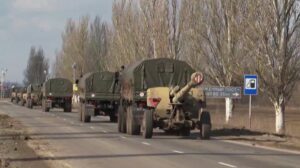
The dramatic events in Eastern Europe, and the possible terrible toll of strongman leadership come to mind as Russian President Vladimir Putin embarks on a risky and calamitous war against puny Ukraine – Goliath against David!
He is probably motivated by an intense desire to secure his place in history as the supreme leader who revived a version of the Russian/Soviet empire. This could go utterly wrong in multiple ways.
“After 22 years in power, Putin’s governance style and structures resemble those that have led past autocrats to make bad decisions” (Ben-Ghiat). The recent photographs of him at an enormous table, absurdly distant from foreign heads of state/government [Macron and Scholz] and the great space between him and members of his own security council [and his behavior toward them], suggest a state of isolation common among leaders who have exercised too much power for too long – compounded by the isolation incumbent on the planetary pandemic.
In 2018, 3 percent of Russians held about 90 percent of the country’s assets, with Putin’s oligarchs owning the lion’s share. Russia is, therefore, a fully realized kleptocracy.
At the same time, Putin suffers from fantasies of grandeur. He obtained a patriotic/nationalist high, and soaring approval ratings, following his 2014 annexation of Crimea.
But Russia is now a different place in 1922, both in terms of foreign preparedness to act against his and his inner circle’s kleptocracy and the degree of domestic disaffection/disapproval with Putin’s corruption and repression that have accelerated over the past few years.
The Russian president’s formal lock on power, secured by his 2020 amendment of the constitution, has been accompanied by increasing violence against those who expose his corruption – like Alexei Navalny, now exiled to Siberia. This is a sign of intense insecurity, not of confidence.
This rogue attack against Ukraine will likely bring more disillusionment and further expose the president’s total lack of regard for his own people.
As the tragedy in Ukraine unfolds, Putin is revealing himself as motivated by personal glory and megalomania. As with other strongmen/autocrats, his downhill journey may have already started.
Putin Plays the Nuclear Card
Putin may already have become unhinged.
He has just put his country’s nuclear forces on “special” alert, complaining of “aggressive statements” over Ukraine by NATO leaders (BBC, Feb.28). Is he now like a cornered wild cat – either slinking away, or attacking ferociously for all it is worth?
Last Thursday, when announcing his “special military operation” in Ukraine [which in reality was a full-scale invasion ], he delivered a chilling warning:
“To anyone who would consider interfering from the outside – if you do, you will face consequences greater than any you have faced in history.”
“Putin’s words sound like a direct threat of nuclear war,” believes Nobel Peace Prize laureate Dmitry Muratov, chief editor of the Novaya Gazeta newspaper.
If Putin is perceived to be failing and suffers heavy casualties, there is legitimate fear that it could prompt the Kremlin to adopt more desperate measures.
The war is also of defence minister Sergey Shoygu’s making. He paved the way for Russia’s Ukraine assault. According to Russian investigative journalists, Andrei Soldatov and Irina Borogan, he may have bitten off more than he could chew: Shoygu has experienced only successes so far, but “who lacks the proper military training to understand that a battlefield victory, no matter how impressive, can sometimes lead to an even larger political defeat” (Foreign Affairs/”The Man Behind Putin’s Military”, Feb. 26).
Given the intense external economic pressure, the unexpected brave resistance by Ukraine and the gathering storm of domestic opposition, and compounded by poor planning of Putin’s invasion and low morale of the invading forces, it is quite possible to visualize that parts of the Russian armed forces may mutiny, for instance in Belarus. This would be the beginning of the end of Putin’s dictatorial regime.
The writer can be reached at: shashipbmalla@hotmail.com

Login to add a comment