








By Narayan Prasad Mishra
Nepal is a tiny country with a population of around 30 million and an area of 147181 sq. km. It will be more in population and area if we add the population and size of the new map brought out by the government with Kalapani-Limpiyadhura-Lipulekh — presently illegally occupied by India. There are many smaller countries in the world than ours. We say Nepal is small because we have two huge countries – China and India, our immediate neighbors. Although a small country, according to the government statistics, we have 125 castes/ethnic groups and 125 spoken languages. A majority of Hindus and Buddhists live in the country, and their life, culture, traditions, rituals are based on it. Though Buddhism is much different from Hinduism or Hinduism from Buddhism in philosophy, most of us take it as one. That is the beauty of our country. We do not see any point in fighting in the name of God when you believe that the supreme power and the creator of this universe are Gods though you may have many different names according to your languages and faiths. Our Gods and Goddesses teach us not to hate anyone but love each other.
Sometimes, when I try to observe and study ourselves, our people, our behavior, attitude, mentality, life, living, activities, and actions, I am astonished about many things. It becomes a mystery for me. The most mysterious for me is the acceptance of changing Nepal from a Hindu state to a secular country by most Hindus. The second mystery for me is that the majority of the people voted for the parties instrumental for the country’s secular status. On the other hand, we take pride in being Hindu and observe all religious rituals and festivals with devotion and dignity. I think these things are contradictory. It shows that they are not honest with their faiths.
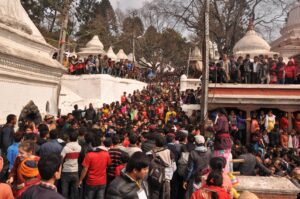
A huge crowd of Hindu devotees at the Pashupatinath Temple
The proverb says only the wearer knows where the shoe pinches. Though the report of our development always shows the country has developed statistically with a high percentage of growth rate, we all know the condition of our country and the suffering of our people. Our country is not in good shape. People have more hardships than 30 years before. Corruption and nepotism are in peak. Since the inception of the multiparty democracy, the country’s government is always for the party in power, not the people. They have been working more for themselves, not for the country and people. The political leaders and their close followers in power are visibly super-rich. Everybody sees it.
Bad governance and corruption in the offices are causing unbearable pain and trouble to the general public. Nepotism, suppression, and injustice are everywhere. I have experienced bitter, agonizing, lifelong pain in my own life. My late beloved wife Shanti Mishra, the first woman professor, the legendary lady, and I were proud of our sincerity, honesty, and integrity to the service of Tribhuvan University. We left no stone unturned to serve that institution actively, efficiently with complete dedication and devotion unparallel to anyone. We gave our blood and flesh to it and took it as part of our life and body. We were not in politics, purely professional and loyal to the nation and the people. Neither we had to do anything for the king nor the then-existing Panchayat system. In 1992, with political power and strength, Kedar Bhakta Mathema, then Vice-Chancellor, and his gang pushed us out of university 14 years before our retirement age by just taking political ill-feeling without any reason. The fire of injustice done to us has always been burning in my heart. Even knowing that kindness and forgiveness are two essential qualities of good people, I often feel that even the punishment stated to the killer would be inadequate to them. Silently, I condemn all the corrupt parties for the various injustices done to Nepali people, including us, in multiple ways.
But the mystery is that when the election comes, the significant parties practicing corruption and mal-governance, nepotism and favoritism, who were in power sometime before, always win the election. People vote for them. They make the corrupt people win the election.
We chose the party that ruins our country. I often hear Balkrishna Neupane, the President of the Nepalko Lagi Nepali Party, saying with anger that you do not win the election with honesty and integrity unless you have a record of crime, killing, kidnapping, extortion, hijacking, bank looting, etc. in our country. When you observe the history of our political parties and the winners — became parliamentarians — Neupane is right. It appears that all condemnable, punishable crimes and wrongdoings are the essential qualities to be eligible and qualified to win the election here. How unfortunate is this?
Our main political parties encourage, attract and urge the gangsters, thieves, looters, dacoits, kidnappers, killers, and criminals to be their party leaders and followers. The known anti-social figures were made party leaders and followers from time to time – Ghaite, Chari, Chakre, Milan, Deepak, Ganesh, Raju, Parshu, Allamkhallam, etc. I vividly remember My Republica published on 17 October 2017. They take pride in it. This is another mystery that people still vote for that party instead of boycotting them.
Another mystery is our rivers. We take rivers as holy God Narayan. When we touch the water in the river, we say, “Oh! Narayan!” with total devotion. We perform our pooja (worship) from birth to the death rituals to the river banks. We take a bath there and think we are holy and pure after a bath there.
On the other hand, people are throwing dead animals and garbage into the rivers. The people, our government agencies, and offices do not feel bad taking their sewage drain to the rivers. That is like you poop and pee in the same place and eat in the same spot. How mysterious is that? Where did your religion, faith, and belief go at this time?
Without a doubt, Nepalese are god-fearing people. It is clearly established from our heritage, temples of gods and goddesses, varieties of birth and death rituals, many, many festivals, a system of our mass worship and visit to the temples of gods and goddesses on the types of special days – Yekadashi (eleventh day of the month), Purnima (full-moon day ) as per the lunar calendar. We have a special day on Tuesday for Ganesh, the God of success. In the same way, we have special days for other gods and goddesses. When we say god-fearing means believing in God as a supreme power, who is everywhere, who knows everything, and one cannot hide your good or bad karma (deeds) from him. He judges you, and you get a reward or punishment accordingly. You always step back from doing anything wrong, remembering God the Supreme Judge. But in practice in our country, you hardly see people of this nature. In the name of god-fearing or being the devotees, you often see them perform varieties of worship rituals offering fruits and sweets and sometimes with a big feast as a prasad, a grace of God, a leftover of the offering to the God.
When you walk around the Kathmandu Valley – Kathmandu, Bhaktapur, and Lalitpur — you often see the people on the roadside sweeping and cleaning their shops and house premises. They usually come to throw their dust and garbage some distance from their area – right or left and to the public road. They hardly think that that should not be done as a good citizen, and the dust and garbage thrown nearby you return to you with air and wind soon. Very few think they should collect the dust and debris in a container and manage it properly, not hampering anyone – your neighbour or the pedestrians. That is also surprising for me.
Youth and young in general love democracy, equality, and justice. But I see the young followers of the political parties accepting, respecting, and becoming the servants of the visibly seen corrupt leaders hoping to get some advantage – monetary, position, or any other things in our country. We know that becoming a party member is much different from becoming a servant of a corrupt leader. I hate to see young people like this.
We call ourselves Nepali; we are proud to be Nepali and happy to have Nepal. Still, we have a government of the five different political parties which deny the valuable role of Prithivi Narayan Shah, the great king, in creating this country and disrespecting him. Most people in the country have no courage to voice and protest against it, not only that the people elect those parties and their leaders in elections.
Such odd things exist in our society. I think ours is a country of mystery. We often say in Nepali – Ajab Gajabko Nepal (country of mystery), Ajab Gajabko Nepali (people of mystery)!

Login to add a comment