







 By Our Reporter
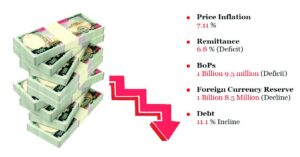
The latest report of the Nepal Rastra Bank showed a bleak picture of the national economy with almost all indicators being negative. Inflation and import have gone up while remittance, the backbone of Nepal’s economy, has fallen significantly.
According to the Nepal Rastra Bank (NRB)’s latest report published on Thursday, remittance inflow decreased by 6.8 per cent to Rs.388.58 billion in the first five months of the current year. In the same period last year, the remittance had increased by 11.0 per cent.
The report maintained that the number of Nepali workers (institutional and individual-new and legalized) taking approval for foreign employment increased significantly to 131,082 in the review period. The number had decreased by 92.7 per cent in the same period of the previous year due to COVID-19 related restrictions at home and abroad.
Meanwhile, the number of Nepali workers (renew entry) taking approval for foreign employment increased by 295.8 per cent to 99,580 in the review period. It had decreased by 77.3 per cent in the same period the previous year.
According to the central bank, the balance at various accounts of the government maintained with the NRB remained Rs. 291.19 billion (including provincial government and local bodies account) as of mid-December 2021 compared to Rs. 194.70 billion in mid-July 2021.
In the review period, BFIs interbank transactions amounted to Rs. 1419.8 billion, including Rs.1235.72 billion inter-bank transactions among commercial banks and Rs.184.08 billion among other financial institutions while such transactions were of Rs. 207.09 billion in the first five months of the previous year.
The current account remained at a deficit of Rs. 300.69 billion by mid-December 2021. The account was at a deficit of Rs. 23 billion in the same period last year.
In the review period, capital transfer decreased by 2.4 per cent to Rs. 4.64 billion while net foreign direct investment (FDI) increased by 57 per cent to Rs. 7.07 billion. In the same period of the previous year, capital transfer and net FDI amounted to Rs. 4.75 billion and Rs. 4.50 billion respectively.
Similarly, Balance of Payments (BOP) remained at a deficit of Rs.195 billion in five months this year against a surplus of Rs. 106.48 billion in the same period last year.
Likewise, gross foreign exchange reserves decreased by 13.2 per cent to Rs. 1214 billion in mid-December 2021 from Rs. 1399 billion in mid-July 2021.
Of the total foreign exchange reserves, reserves held by NRB decreased by 12.9 per cent to Rs. 1084.6 billion in mid-December 2021 from Rs. 1244.6 billion in mid-July 2021.
Reserves held by banks and financial institutions decreased by 16.2 per cent to Rs.129.4 billion in mid-December 2021 from Rs. 154.39 billion in mid-July 2021.
The consumer price inflation has increased significantly during the first five months of the current fiscal year 2021/22.
According to the current macroeconomic and financial report published by the Nepal Rastra Bank (NRB) last week, the year-on-year (y-o-y) consumer price inflation stood at 7.11 per cent in the first five months of the current fiscal year compared to 2.93 per cent a year ago.
Food and beverage inflation stood at 5.67 per cent whereas non-food and service inflation stood at 8.25 per cent in the review month.
The price of ghee and oil, transportation, pulses and legumes, education and tobacco products sub-categories rose by 28.52 per cent, 16.25 per cent, 11.79 per cent, 11.78 per cent and 11.74 per cent respectively on a y-o-y basis.

Login to add a comment