








By Shanker Man Singh
Any fair or exhibition is considered as a place and opportunity for buyers and sellers to meet face to face, to serve the buyer, to understand the real demand of the buyer. The 15th Handicraft Trade Fair and the 13th Handicraft Competition were held at Bhrikuti Mandap in Kathmandu recently. The fair was organized to promote Nepali handicraft items in the international market. Inaugurating the fair, President Vidya Devi Bhandari clarified that Nepali handicraft items have made significant contribution to Nepal’s export trade. She also expressed the belief that handicraft business could create employment opportunities in the country and alleviate poverty. President Bhandari also stressed on the need to pass on the traditional knowledge of Nepali handicrafts to future generations.
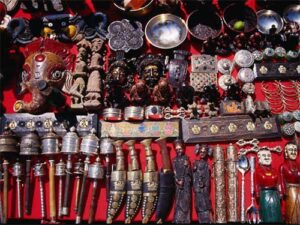 Domestic products produced in different parts of the country were given special emphasis at the fair. The 18th Handicraft Trade Fair and the 16th Handicraft Competition were held. The three-day fair organized by the Nepal Handicrafts Federation in Kathmandu had a turnover of around Rs 80 million. There is no doubt that handicrafts should be given high priority by the government as handicrafts play an important role in export trade, job creation and protection and promotion of art and culture of the country.
On the one hand, it helps in solving the employment problem of the country and on the other hand, the development of handicraft industry has become necessary as even rare foreign currency can be earned. Although the Handicraft Industry Association later transformed to FHAN has been conducting various trainings and seminars for the development and promotion of this sector, it still has ample potential for improvement and development as expected.
The export of handicraft items seems to have played an important role in the countries where rural development is given national priority. The aim is to create a forum in the country to create opportunities for display and sale of handicraft products from different regions, provinces, districts, local handicraft entrepreneurs, businessmen, artists and Kaligarh, and to provide quality and useful utility handicrafts in the nation at affordable and competitive prices.
It is also seen as a good opportunity for foreign business buyers and local handicraft producers, artists, businessmen to have business meetings, trade relations, handicraft entrepreneurs/producers and artists to have existing marketing efforts.
Handicraft exporters need to study the market trends to get such benefits. Also, handicraft fair should be considered as a special sales opportunity and marketing strategy should be prepared carefully. At the same time, it is time for handicraft entrepreneurs and businessmen to think and understand how to promote exports given the changes in the market.
The exploration of new commodities and the search for new markets for the adoption and export of commodities must continue at the same time. Nepali traditional handicrafts have their own important demand. It reflects the glorious culture and traditions of this mountainous country.
Among the handicraft items that can be exported from Nepal in significant quantities are woolen items, artistically carved sculptures and metal items, silver ornaments, inlaid items, woodworking items, home-made items, thankas and other such items. Bringing the reality to Nepali people through handicraft fairs and exhibitions, seminars, workshops, exhibitions etc. organized in Nepal and abroad in the context of the bitter truth that Nepali handicrafts, especially metal handicrafts, are being sold cheaply by neighboring countries all over the world.
The term “handicraft” in general also refers to hand-made items, ranging from jewelry to household furniture. Such goods are made with low capital investment, reflecting or reflecting the local cultural elements, as well as being made easily available in the producing countries. However, sometimes handicraft items are copied and made into machines, which harms handicraft entrepreneurs.
Handicraft exports, which had grown exponentially in the last years of the 1960’s, gradually declined after the 1970s and 1980s. Consumers’ interest in both utility and decorative handicrafts gradually waned. Since such goods were made by hand even before the industrial revolution, the demand for such goods in the developed countries has been gradually declining since the industrial revolution, especially in developed countries. Whether it is as a hobby or as a business, handicraft items require a special kind of skill which is not an exaggeration to say that we in Nepali artisans have enough. In the past, Tibetan carpets made in Nepal were the leading export of Nepal. Although carpets are no longer classified as handicrafts, we should not underestimate the employment status and potential of the weavers involved.
Belief in any religion or God as well as the religion prevalent in Nepal also reflects the antiquity of the handicraft industry. In this way we see different gods being portrayed in centuries old form and form. From this perspective, artistic metal carved pearls, metal wares, inlays, wood carving, stone carved sculptures, handmade woolen carpets, small pottery rented paintings,Thanka ready-made garments, etc. are unique specimens of Nepali craftsmen and craftsmen. Thus, choosing the product of one’s interest and desire from these unfathomable goods seems to be a major challenge for the producers, exporters and even the foreign importers.
Nepali exporters should be able to make the importers realize that the uniqueness and basic quality of Nepal’s handicrafts is more important than quantifying them. According to the Trade and Export Promotion Center, handicrafts worth Rs. 8 billion were exported from Nepal in the last fiscal year 2075/76. Exports of handicrafts increased by Rs 5 billion in 2018/2019 despite the adverse effects of the Covid-19 pandemic.
Another problem seen in the handicraft industry is that Nepali handicrafts, especially metal handicrafts, are being sold cheaply in India by India. More importantly, the sale of such cheap machine-made items in the Nepali market as Nepali handicrafts is not only a disgrace to Nepali handicrafts, but also a big question mark in the future of our handicraft industry.
It is important to study the market for useful handicraft items as Nepali handicraft items are more “decorative than useful” and the market for such items is very limited. Nepal should continue to develop handicrafts, especially wood products, as a gift item, even if the customs duty rate is very low or very low customs duty is imposed on the export of goods in most countries, including the European Community. It is also important to think seriously about what will happen after Nepal’s graduation to developing country. Entrepreneurs involved in the handicraft industry should be given equal importance by the government for the development of this industry. The country’s industrial policy of 1992 has categorized handicraft industry as a small and home-based industry and under the Investment and Foreign Investment Act, only technology can be brought in small and home-based industries and no investment can be made in it.
To protect this industry, the government should increase the tariff rate on imports of foreign handicraft items for development of home industries and especially handicraft industries. Given the country’s policy of liberalization, the extent to which this is possible remains to be seen. The need to arrange skill development training from time to time to produce high quality and good goods has also become more urgent.

Login to add a comment