








By Narayan Prasad Mishra
Human beings are the same wherever we live Asia, Europe, America, or Africa, though there are some colour differences. We know some are white, some are black, and some others are brown. Some are big and larger, some are short and small, but their general nature is similar. We are one, one species. We are human beings. So, we all have human nature of the same kind – eating, sleeping, talking, thinking, desire, anger, greed, love, hate, etc.
Though we all are one in our nature, we are different in our culture. We have many different languages. We have different faiths and religions. Our social habits and cuisine are different. We wear many different kinds of dresses suitable to our geography and climate. So, our customs traditions, manners, etc., are different.
Though it is not big in the area to compare to many countries, Nepal has got the land of many climates. Kathmandu Valley is very much different from other parts of the country as it is neither mountainous nor plane and surfaces like Terai or Hills. In the same way, it is much different from the Himalayan regions of the country. We see snow peaks almost all around the year in the north of the city. But we hardly get snow in the Valley, Maybe once in a lifetime. But we have Himalayan regions where we always have snow and cold.
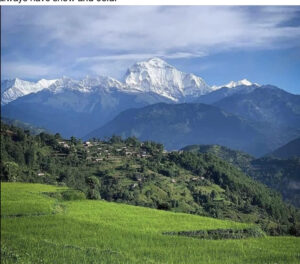 View of Beautiful Snow Peakes. Source – Nepal Tourism Board
Similarly, we have Tarai plains, where we have low surface land with a hot and warm climate. We have mountain and hilly regions where people live on the top of the hills, on high land as if living in the sky. We have our people of many different languages, religions, cultures, traditions, cuisines, and dresses in the country because of all these things.
However, it is a country of many languages and religions living together, taking glory in their motherland, Nepal’s land. Amid many different cultures, ways of life, behaviour, beliefs, and values, Nepalese have some common manners and customs, traditions and beliefs.
Nepali is our national language spoken by the majority and understood by a vast number of people. It is a common communicative language. However, there are many languages – Maithili, Newari, and many others spoken by Gurungs, Tamangs, Magars, Tharus, Sherpas, etc.
Our leading food is rice though there are many other foods considered leading food in Nepal.
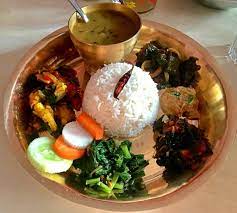
Nepalese cuisine – Dal, Bhat, and Tarkari
Mainly we eat rice with vegetable curry (Tarkari), lintel soup (Dl) which we call the Dal, Bhat, Tarkari in Nepal. In general, we have two meals – Dal, Bhat, Tarkari launch before office hours starts around 9 am and Dal Bhat, Tarkari dinner around 8 pm. Some people take tea and snacks before launch and around 1: 30 pm tea time in the office. We make Dal and Tarkari of many varieties according to our wishes. In the country, some are vegetarian, and some are meat-eaters non-vegetarian. In general, the meat-eaters eat lamb and goat meat. But Buffalo meat, chicken, and pork are not eaten even by some meat-eaters. Mamo (meat dumpling) is a popular snack in Nepal.
Daura, Suruwal, Coat, and Nepali Cap is our formal national dress for men and the Sari, Cholo, or blouse for women. But many different communities have their traditional formal dresses.

Man with Dauro Suruwal and woman with Sari and Blouse
We have many religions – Hindu, Buddhist, Christians, Muslims, Sikhs, Jains, etc. But the vast majority are Hindus, So we see Hindu temples almost everywhere. Hindus believe in many gods though they have Mahadeva (great got or supreme God). It seems God is God for Hindus, whether the God of Muslims or the God of Christians. So, they do not deny other gods but show respect. That is the reason we do not see any fight between the different religious faiths in Nepal. The other exciting part is that Hindus observe Buddhists as one of their gods though Buddhism is much different from Hinduism, mostly in rituals. In the same, Nepalese Buddhist visit Hindu temples in Nepal. That is the beautiful part of our religion in the country. In essence, all the world religions preach love, truth, compassion, kindness, and service to the needy, and no faith teaches hate, not to love
Traditionally, Nepalese have an extended family system living together – grandparents, parents, brothers, sisters-in-law, sisters until marriage, grandchildren though it is gradually disappearing. The siblings get an equal share of property – house, land, ornaments, cash from the parent’s property, not by parent’s wish.
We still have the tradition of arranged marriages in the country, organized by seniors within the same caste and community. But among some educated, mostly city dwellers have some loving marriages.
Seniors are to be respected not only your family members, even the outsiders. People address others with some words of relation – uncle, brother, sister, sister-in-law, etc. Addressing without those words are taken impolite.
We do not have a culture of giving thanks for small or big matters like in Europe or America. More than that, we do not thank our family members in words. Our smile and brightness on the face are our sign of gratefulness and thanks. However, some people use the word “Dhanyabad” (thankyou) these days but not often. Because of that, one should not understand that Nepalese are impolite.
Traditionally we do not eat our launch and dinner on the table. We sit on the floor with some seater for launch and dinner. Foods of pots are not supposed to touch by the hand with which one is eating. If the container or food connected by eating hand without hand wash is considered a jutho (impure) and it would be uneatable for others. After eating, one should wash hands and mouth before doing anything.
Astrological Sign:
In Nepalese life, we still see the role of astrologers. People consult astrologers for matching the couple for marriage, fixing the auspicious day and time for annaprashan (rice feeding ceremony to the baby), bratabandha (secret thread giving) wedding, starting foundation for the new house and house opening, etc., with an exception. From birth to death, people still follow the rituals with the help of priests. There are long rituals to be performed for the deceased though some differences from community to community. With long rituals of puja (worship) up to 13 days in the dead’s memory, most community performs puja once a month till a year complete. After that, the memory puja is performed once a year on the date of death called Barshik Sradha (annual worship).
For doing anything – worship gods and goddesses, offering tika, or giving anything, the right hand should be used necessarily. One should know that the right hand is pure and holy, and the left hand is impure and unauspicious. We move and take round the temple always clockwise. Not only that, we have right-hand driving, right side walking. One should never forget that we should use the correct hand ring finger for putting tika on God, Goddess, or the men. Nepalese use their left hand for washing their butt and anus.
While one’s marriage, sitting, walking, or working together, a wife always sits on the husband’s left side, but while performing other religious rituals, the wife sits on her husband’s right side.
We who had been to Europe or America know that they drink cold milk, they eat raw vegetables called a salad. In Nepal, we drink boiled milk and eat mostly cooked vegetables. We prefer warm and hot food and consider cold food avoidable. But we do eat some raw vegetables – radish, carrot, etc. That is the perfect costume where you hardly get pasteurized milk and hygienic vegetables.
We have a saying in the ancient language Sanskrit, “Atithi Debo Bhawa” (The guests are like gods). This proverb is stamped in the Nepalese mind. People either rich or poor; they try to welcome the newcomer with love and respect whoever comes and visits the house and offers tea in most places.
Most people seem to believe that God is everywhere and he knows everything. You cannot hide your deeds – good or bad from him. They are godfearing and try to be honest and right in the name of God.
In general, the culture of Purbajanma (past life), Prarabdha (fate, fortune), and Punarjanma (rebirth) is attached to Nepalese life, consciously or unconsciously. So, very often, people think they have misfortunes or problems because of the causes of their past life’s misdeeds or evil deeds. They get some solace from it in the days of sorrows and suffering, grief and pain.
I had my operation for prostate in the USA. When I was about to be taken into the procedure, the hospital staff asked me whether I had my last wish. I was astonished to hear that question as we had no that culture in our country. If my family member listened to that question, they certainly would feel unhappy about it. When your father, mother, wife, husband, or any other loved one gets seriously sick with a deadly disease, when the person is in a dying condition with trouble and pain, we not only hide the risk and seriousness, we tell the sick person not to worry about anything. We speak – you will be OK soon thinking to give some peace in mind and keep away from worries. That is our culture doing generation to generation. We never tell you are going to leave me soon. I think I am somewhat different from this culture. I do not want to be ignorant of my problem if I get seriously sick. But when my wife was in dying condition with cancer, I had no courage to tell her that she was disappearing from me soon; neither could she tell me that she would leave me. I am sure she knew about it. She told me she would be living for me. She wanted to live for me. In our system, the doctor or hospital does not need approval from the patient for the treatment and operation; the patient’s legal, authorized relative’s consent is enough. The patient is not to be given a burden for the conscientious. Your near and dear one takes the responsibilities for you and gets the things done what seems to be better. That is very much different from the culture of Europe or America.
The concept of divorce is not encouraged in Nepali society. Like in the European countries, they are not separated with some flimsy matters, whim, or anger unless there is a severe unsolved matter hanging for a long time.
In our culture, the selling of cows and dogs was against our established culture in Kathmandu Valley. Similarly, the sale of fruits in your residential garden was against the tradition. When I was a kid, that system was well-taken care of. We gave our cows, dogs, or fruits to our friends and the neighbours as gifts and never sold them. Now, the system has mostly disappeared.
We know the culture is mixed with your blood and flesh. It is always with your life and thinking. You have your culture in your taste, in your food, in your dress, in your manners – sitting, eating, sleeping, moving, walking., talking, behaviour, greetings. When you lose your culture, you lose your identity. That is why people are different from the people.

Login to add a comment