







 By Our Reporter
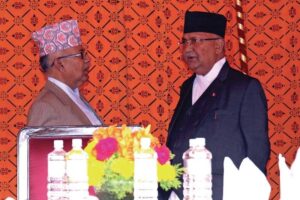
It seems if nothing miracle happens in the speech and acts of party chair and Prime Minister KP Sharma Oli, split in the ruling CPN-UML looks inevitable, because every time the second generation leaders intensify talks to settle disputes in the party, Oli either takes unilateral decisions spoiling the atmosphere or criticises Madhav Kumar Nepal using rude words.
Although Oli had agreed to revive the task force formed in May to find a middle path to resolve the intra-party dispute and the task force held two meetings, nothing has been done to maintain unity.
Oli, who threatened to oust the 23 leaders who submitted their signatures in the writ filed in the Supreme Court demanding that NC chief Sher Bahadur Deuba be appointed Prime Minister if they did not withdraw the signature, had to meet the demand of leader Madhav Kumar Nepal to revive the task force. This showed that Oli is now in a defensive position in the party. He expelled BhimaRawal from the task force but invited him to Baluwatar and asked to work for party unity by reviving the task force on Monday.
Of course, the harsh words used by Oli last week against leader Nepal and the calling of the Standing Committee meeting by the 10th general convention organising Committee, which was invalidated by the Supreme Court, spoiled the environment further. When the Nepal faction did not bow before the threat, Oli is now applying every measure to woo the rival leaders in a bid to prevent Deuba from becoming the next Prime Minister. Moreover, the government decided to push ahead Kaligandaki Diversion project and leader Mahesh Basnet’s proposal to review secularism and federalism are likely to spoil the environment again. UML leaders are not happy with the Kaligandaki Diversion project. Moreover, Basnet’s comment is likely to add fuel to fire because the Nepal-Khanal faction has been accusing Oli of trying to sabotage the constitution, and Basent’s proposal has supported their claim. Leader Bam Dev Gautam who joined the Oli faction looks right to say that unity in UML will be impossible unless Oli and Nepal’s anger gets cooled.
Even if the UML manages to stand united, Oli will become weaker because he has to agree to power-sharing with the rival faction.
NC General Convention, who will become the new party chief?
Election fever has gripped the Nepali Congress leaders as they are preparing to contest for the top post in the party in the upcoming general convention scheduled for September 1-4.
As of Wednesday, at least seven leaders have expressed their desire to contest for the post of party president. They include Sher Bahadur Deuba, Ram Chandra Paudel, Dr. Shekhar Koirala, Bimalendra Nidhi, Prakashman Singh, Dr. Shasanka Koirala and Kiran Gurung. Even Krishna Sitaula has also said he would fight for the top post again.
However, by the time the 14th general convention kicks off from September 1, there may be left only four leaders—two each from each faction– to contest the top post. Deuba, Paudel, Nidhi and Dr. Shekhar Koirala are likely to be the final candidates, and when no leader can obtain 51 per cent votes in the first round of elections, Dr. Koirala and Deuba are likely to contests the second-round elections with both Paudel and Nidhi supporting Koirala.
Of course, a revolt by Nidhi could be costly for Deuba while Paudel is likely to be left behind by Dr. Koirala. As NC became weak in Deuba’s leadership, many NC leaders want to change the leadership bringing it back to the Koirala clan. And Dr. Shekhar has emerged as a potential leader for now. He is likely to be favoured by India as well.
However, the NC that is preparing to organize its 14th general convention in the first week of September has failed to finalise the list of the active membership in the given deadline of July 4. The delay in finalizing the active membership row could result in a further amendment to its convention calendar.
The Nepali Congress Active Membership Probe Committee failed to submit its last report to party president Sher Bahadur Deuba crossing within the deadline of July 4 due to factional interests and personal interests.
The NC had given a deadline to the Committee to submit its report by July 4, but the Committee said it completed active membership row only in half district from among the 77 districts as of July 4.
The party has scheduled to complete its conventions in local bodies by July 31. In the districts that have only one electoral constituency, their conventions will be completed by August 4. In districts that have two or more than two electoral constituencies, the conventions will be completed by August 8.
Provincial conventions in seven provinces will be completed by August 17 and 18.
Hearing on House dissolution concludes, verdict likely on July 12
The constitutional bench of the Supreme Court has completed the final hearing on writ petitions concerning the dissolution of the House of Representatives (HoR).
The hearing continued for 11 days and the law practitioners representing writ petitioners, respondents and four amicus curie pleaded before the five-member constitutional bench.
After the conclusion of the pleadings on Monday, Chief Justice Cholendra Shumsher JB Rana informed that the bench was adjourned till July 12.
Following the counter-arguments presented by law practitioners representing writ petitioners – senior advocates Harihar Dahal, Badri Bahadur Karki, Krishna Prasad Bhandari, and Shambhu Thapa, four amicus curiae presented their impartial opinion before the court on the final day of the hearing.
Senior advocates Komal Prakash Ghimire, Prakash Bahadur KC, Raghavlal Vaidhya, and Usha Malla Pathak presented their opinion as amicus curiae, the friend of the court.
Amicus curiae Pathak and KC claimed that the HoR was dissolved in line with the Constitution and holding an election was the only way out from the current political crisis.
Pathak, who was appointed as amicus curiae from the Nepal Bar Association, said that it was the President’s right to reject the claim if basis to obtain the vote of confidence as per Article 76 (5) seemed inappropriate.
Likewise, senior advocate, KC said that that it was the constitutional duty of the party members to follow the rules and decisions of their party and thus, the party’s whip as applicable in the case.
Meanwhile, senior advocate Vaidhya claimed that appointing KP Sharma Oli as the Prime Minister even after he failed to obtain House’s confidence as per 76 (3) was against the constitutional norms
Amicus Curiae Ghimire said that Deuba’s claim to head the government in line with 76 (5) was appropriate as he had submitted signatures of 149 parliamentarians.
Moreover, presenting the counter-arguments, senior advocates representing writ petitioners claimed that the House could not be dissolved until the possibility to form an alternative government existed.
The SC that has bought a week time is likely to give the final verdict on July 12.

Login to add a comment