







In anticipation for Nepal Springs?

By Bihari Krishna Shrestha
The Janaandolan of 2046
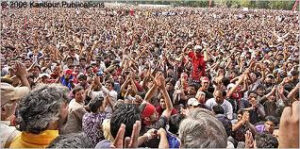
People’s Movement in 1989. Photo: Internet
Come Chaitra 26 every year for the last three decades, it is time for the celebration of the post-Panchayat democratic restoration in 1990 in Nepal. While the event itself was India-engineered and followed its protracted blockade of landlocked Nepal, it was basically inspired by its sinister design to Bhutanize Nepal. Should Nepal acquiesce, India had offered to terminate the agitation against the Panchayat system being launched by Nepali Congress and UML parties with India on the lead. Once King Birendra summarily rejected the idea of surrendering Nepal’s sovereignty to India, what followed was the intensification of the agitation that saw India’s political stalwart, Chandra Shekhar, land in Kathmandu to further it. The Panchayat regime’s capitulation happened on 26th of Chaitra, 2046 (Bikram calendar).
While the day used to be celebrated by all the political parties with gusto during the initial years of the restoration, with the multiparty polity performing increasingly hopelessly the significance of the day too has since taken a nosedive not just for the people but also for the politicians themselves too.
Commitments never met
Senior journalist Harihar Birahi, a longtime NC adherent and BP loyalist, made the right noise in this regard when he wrote the following in a digital Nepali news portal: “Had there been no change over of 2046, the Nepali society would not have been able to arrive at this state. The communist party too wouldn’t have recast its faith and trust in democratic order, and people too would not have understood the significance of democracy”. Lest he could be misunderstood as trying to glorify a failed order, Birahi was quick to admit, “Too many of its commitments remain unaccomplished” even after three full decades of the restoration.
Democratic restoration: Opening the floodgates of political corruption
For the people of Nepal, however, the restoration signifies the opening of the floodgates of political corruption in the country. While Prime Minister K.P. Sharma Oli today stands tainted with mega corruption scandals such as the Wide Body scam or Yeti Holdings deal and so on, they are, however, only the aggravated versions of Girija Koirala”s Dhamija scam, Lauda Air scandal and so on. The political corruptibility problem has become so bad in the country in the meantime that just about every single politician today remains a corrupt man or woman.
Bidhi: The false flag operation for bhagbanda corruption
Today, the factional rivalry in the UML remains the big political news, the faction led by former PMs, Madhav Kumar Nepal and Jhalanath Khanal combine, two rivals in their own right too — staging nationwide tantrum of organizing parallel party committees ostensibly for establishing bidhi or order in the party, a term that PM Oli understands only as of the euphemism for their claim for bhagbanda or their share in the mundane spoils of their party being in power. While Oli has been ignoring these rivals ever since he became PM three years ago, they have been keeping quiet. No bidhi-related question was raised nor Oli’s failure to toe their election manifesto. The reason was that the Constitution did not allow any no-confidence vote against the PM for the first two years of his tenure. Now that PM Oli can be dislodged by the numbers’ game in parliament, these sidelined Nepal-Khanal faction (and other members in their orbit), have since launched what is essentially a false flag operation of bidhi.
Corruption inundates the nation
This swamp of political corruption is not limited to Kathmandu. The whole of the nation is deluged. In a visit to Parbat district last year, Home Minister Ram Bahadur Thapa Badal himself was categorical in his dramatic disclosure that if the action were to be taken against corrupt officials at the local level, then all the 753 local bodies in the country would be left without elected functionaries.
The reason for their reckless corruptibility is not far to seek. During the second constituent assembly days, the Balananda Committee on state restructuring foolishly reduced the number of local bodies to 753 which was only one-fifth of the nearly 3500 VDCs and municipalities that existed then. With this change, the elected officials now became five times more distant from the electors even as the annual budget to be allocated to them by the government soared into crores. This attracted the attention and interest of a category of people who knew how to make money by fair means or foul. The nomination tickets to fight the newly created Palika elections were “bought” from the party bosses mostly by construction contractors who alone had the money to invest in the election big time. As per the media reports then, it cost at least one crore rupees to contest for a Gaupalika chair and 20 lakh rupees for a ward chair. It is therefore little wonder that the local bodies today are houses of corruption as revealed by the home minister.
Civil society and academic community – disparate, opportunistic, partisan, myopic and corrupt
While in academic discourse civil society is generally seen as the conscience keeper of society and a force for change in society, particularly when it comes to such a larger cause as revamping Nepal’s corruption-infested democracy and put it back on track in line with other successful democracies. But Nepal’s civil society-a disparate entity subsuming a wide and diverse array of individuals and non-government organizations–has delivered disappointingly little in redressing this national malaise. While its members share much of its socio-economic traits that go on to make feudal elites–high caste, rich, educated, possibly with a professional background too–many of them have been found to be hypocritical, opportunistic, often corrupt, overtly or covertly politically aligned, and selective in their agenda to ensure at least two (feudalistic) objectives, staying in the limelight and also courting the favour of these corrupt politicians for personal protection, personal advancement such as political appointments or other mundane gains.
“Dirt poor” Nepal
A recent Economist article on Nepal started with the following words: “Dirt poor Nepal….”. While it feels absolutely humiliating, the point is that you cannot have a recklessly corrupt country and still make progress. If you are a corrupt society, you are also condemned to remain impoverished, the association between the two being direct and proportional. This relationship is borne out by our own developmental experience. The forest user groups introduced in 1988 were a major innovation of the Panchayat days and directly derived from the Decentralization Act of 1982. Since the management is universally participatory–every single user, man or woman, high caste or low caste, rich or poor are legally empowered to participate in their decision making–their management is structurally ensured to be transparent and the leadership accountable to the membership. This has been the secret behind the dramatic restoration of Nepal’s forests in about a decade’s time that were near totally denuded during the three decades following their nationalization in 1957. Today, the FUGs count as the richest local institutions and source of funds for many development undertakings including poverty reduction in the rural landscape of Nepal.
The unfortunate fact with today’s academics and professionals in the government and outside is that they continue to remain viscerally partisan in their approach and remain in denial to objectively assess the achievements made under the partyless democratic experiment of three decades between 1960-90. Clearly, it has to do with their bread and butter to adulate the corrupt multiparty politics that has kept Nepal “dirt poor” all these years.
Waiting for “Nepal Springs“?
With widespread disenchantment of the people with these corrupt parties and politicians, the overall situation in Nepal remains potentially explosive, waiting for something like Nepal Springs to happen akin to the Arab Springs of a decade ago that had been highly disruptive across many countries in the Middle East. In Algeria, however, in 2019 the rising spate of demonstrations against the then president Abdelaziz Bouteflika was brought to its end with the Army securing his immediate resignation. Similarly, in Zimbabwe and Sudan too the militaries had intervened to persuade their unpopular presidents to step down and to put their own democracies back on track. In Nepal, this role could have been played by President Bidya Devi Bhandari who, however, seems to have chosen to act more as a factional advocate of her earlier party, the UML. At least in social media, a few twitters have lately wondered if the Nepal Army too would play a catalytic role to reform its democracy before it is too late.

Login to add a comment