







Air pollution at an alarming level
AQI in Kathmandu becoming hazardous
By Our Reporter
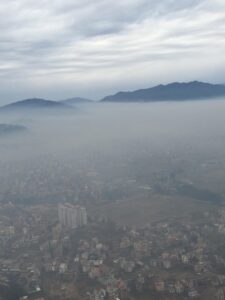
Air pollution has started affecting life again across the country from Sunday, making Kathmandu the worst polluted capital city in the world.
Rainfall of last week in eastern and central Nepal had helped reduce the air pollution level but the situation started worsening again since Sunday.
According to officials at the Department of Environment, Air Quality Index (AQI) as shown from AQI stations of Phora Durbar on Monday, AQI was recorded at 313 near Kantipath, 290 in Maharajgun, and 158 in Ratnapark.
The highest level of air pollution was measured in Dhangadhi on Monday morning. Dhangadhi’s AQI has reached 429 this morning. Bharatpur of Chitwan was in the second position with AQI 398, followed by Bhansepati in Lalitpur at 325.
Air quality is measured in the Air Quality Index (AQI).
An AQI of 50 to consider AQI as healthy, 50 to 100 is considered as moderate. When the AQI reaches 150, this level of air pollution will become unhealthy to certain sensitive age group.
Reaching 200 is unhealthy for everyone. Reaching AQI 300 is considered risky and going above 300 is considered fatal or most hazardous.
Continuous dry winter, extreme forest fire situations across the country, weak westerly winds, and smog have been blamed for the current air pollution.
According to the statistics of the Forecast Division, the Kathmandu Valley receives an average of 45 millimetres of rain from November 3 to March 4. This time only 4 mm of rain had occurred in the same period. In other words, the Kathmandu Valley did not receive even 10 per cent rain this winter. This is a big change in itself, she said.
It is estimated that an average rainfall of 60 mm occurs in Nepal from 16 November to 15 March. This time only 16 mm of rain occurred across the country.
Not only in Nepal but also in the Hindu Kush region from Bhutan to northern India and Pakistan, there has been less rain this winter.
PM instructs officials to take steps to control wildfires
Prime Minister and Minister for Defense KP Sharma Oli has directed the concerned agencies to do their homework on the use of aeroplanes and helicopters to control wildfire, which is currently causing air pollution across the country.
Addressing a meeting of the Ministry of Defense’s quarterly budget review and Ministry-level Development Problem Solving Committee held at PM’s residence in Baluwatar on Tuesday, Prime Minister Oli said the existing fire brigade and manpower would not be sufficient to control the fire on a large scale and in remote forest areas.
“Homework should be done to bring in multi-purpose helicopters or aeroplanes, so that they can be used to control the fire and for other purposes as well,” the Prime Minister said.
He also directed the concerned bodies to start their work for an immediate solution to the problem by installing fire extinguishers in the existing aeroplanes or helicopters in the country. Stating that it was unusual to witness the fire at 700 places at the same time, the Prime Minister also warned that the air pollution caused by the fire would cause serious health problems.

Login to add a comment