







By Shanker Man Singh
In the policy and program presented by President Bidyadevi Bhandari in the first week of June last year, it was said that the industries that were closed and sick in the running fiscal year would be brought into operation. The government had brought policies and programs to bring the industries that were closed down due to various reasons into operation with the help of the private sector.
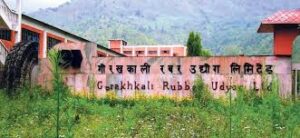
Gorakhkali Rubber Industry remained close for decades
It is seen that the development of the industrial sector has been given top priority and the sick industries are being brought into operation. It remains to be seen whether the sick industries can be transformed into a public-private partnership. Industries including the Hetauda Textile Industry, Butwal Yarn Factory, and Gorakhkali Rubber Industry have been closed for a long time.
The government’s plan to run 10 sick industries owned by the private sector has fallen by the wayside. Even though the Industrial Enterprise Act has paved the way for the re-operation of the industry for almost 25 years, the plan to operate such industries is in doubt due to the delay. As the government has been encouraging re-operation from time to time, the option of liquidating the private sector has been blocked. Billions of rupees are being blocked in the ailing industries of the private sector.
On the one hand, a large amount of capital has sunk and its assets have been pledged, on the other, banks and financial institutions have been shifting their responsibilities as unproductive assets for years.
While reviewing the history, the Industrial Enterprises Act 2049 BS had made provision for the re-operation of the ailing industry. Even after two decades, the necessary regulations have not been formulated to implement it.
According to the Ministry of Industry, these industries have become ill due to poor management, unscientific pricing, incline on project cost, lack of working capital, lack of study and research, instability in policies, acts, rules, strikes, and lockouts. The Ministry is of the view that these industries have become sick due to instability, lack of study and research, instability in policies, acts, and rules, strikes, and lockouts.
Due to the Maoists’ 10-year armed insurgency and the long transitional period that followed, many private sector-run industries in the country were shut down, while the condition of government-invested public enterprises and industries was deplorable. As public companies are collapsing due to political interference and cumbersome policy arrangements, the state has formulated a special policy for the management of such industries.
At present, a high-level committee was formed to study the possibility of its re-operation and to study the modalities of its operation. The policy initiatives of the government regarding ailing industries can be taken positively. The government’s policy and the program also said that the industries that were closed and in a sick condition would be brought into operation in the running fiscal year.
Attempts to involve the private sector in the operation of the government-invested Hetauda Textile Factory, Butwal Yarn Factory, Gorakhkali Rubber Factory, and other industries have not been successful. As dozens of industries are also closed in the private sector, there is enthusiasm for the formation of the committee.
As per the Industrial Enterprises Regulations, there is a provision for exemption in income tax, excise duty, export, and import tax for a certain time for sick industries. The Ministry of Finance should be generous for its implementation. On the other hand, the government should also be vigilant to prevent misuse of loan facilities and concessions on interest and compensation at concessional rates for such industries. The government has an important role to play in managing additional capital for investment by operating industries by determining concessions, facilities, and concessions and the government should work hand in hand with financial institutions.
The government’s delay in identifying sick industries hampered the resumption of sick industries and the government declared sick industries only 22 years after the enactment of the Act. Exercising the authority given by the Act, the government had declared these industries as sick. It has also been made public in the Nepal Gazette on June 10, 2014.
Borders Limited, Birat Leather Industries, Birat Shoe Industries Limited, Basuling Sugar and General Industries Limited, Sumi Pharmaceuticals Pvt., Fleur Himalayan Limited, Rhinoceros Wildlife Camp Pvt. Ltd., The Phulbari Resort Ltd., and Dolphins Manor Hotel Pvt. Ltd. were declared sick industries.
An industry that has been operating at a loss for five consecutive years and producing 20 percent or less of the total production capacity will be declared a sick industry by publishing a notice in the Nepal Gazette if it deems it appropriate. In the second point, it is stated that no tariff, fee, and tax will be levied on the imported machinery to expand and diversify such industries.
Announcement only:
On 23 September 2012, the then Council of Ministers decided to revive the ailing industry by issuing an immediate relief program. The government has started searching for the government and private industries that have been sick.
The guidelines on sick industries need to be changed relative to time. This seems even more relevant in the case of Covid 19. As there is no other option for the industries which are in a state of complete and sick operation and have no other option but to go for easy exit, necessary arrangements have to be made in the regulations.
The complete sick industry means the period in which the capital of the industry has been depleted by more than 70 percent and operating at a capacity of less than 30 percent. The patient’s profit has been declining for the last four years and the capital of the industry has been depleted by more than 60 percent.
As per the Industrial Enterprise Regulations 2020, the government has set the criteria for sick industries. Accordingly, in those industries which have not been able to repay the principal of the loan, the amount of loan in proportion to the capital is unnaturally high, the market value is less than the face value in the case of industries listed in the Securities Board and the industry produced below the break-even point can be included in the list of sick industries
Similarly, according to the criteria, industries that could not operate due to natural calamities or other uncontrollable conditions, changes in international industrial or commercial policy arrangements, and industries whose products cannot compete at the international level are also included in the list of such industries.
Criteria have also been set to identify sick industries. Accordingly, an industry that has been in continuous operation for at least five years from the date of commencement of commercial production or business and is in any of the conditions mentioned in Rule 24 can apply by going through the process if it wants to identify its industry as a sick.
Similarly, it is mentioned that such industries should have submitted a business plan related to additional equity investment for the operation of the industry. There is a provision to form an investigation team based on the application by the high-level body itself or also an expert in the related subject and prepare a report based on the details or documents submitted by the concerned industry and the on-site monitoring.
Based on the report and the business plan submitted by the industry, there is a legal provision that the high-level body should recommend to the Ministry to identify the concerned sick industry. With the consent of the Ministry of Finance, such industries can be recommended to the government to be identified as sick industries.
The government should provide concession and facilities to sick industries such as the proven loan should be converted into a soft loan; giving a discount on interest and damages of previous loans; providing additional credit for the operation of the industry; recommending to banks and financial institutions; facilitating the raw materials required by the industry at concessional rates and exemption from liability for taxes or fees or fines as per prevailing law.
he committee has been tasked with identifying the ailing industries, the causes of the ailing industries, and formulating modalities for rehabilitation plans. The task force consists of three experts in the fields of industry, commerce and banking and economics, the head of the physical infrastructure and environment division under the ministry and the chief joint secretary member secretary of the industrial and investment promotion division.
It is mentioned that necessary exemption should be given to the sick industry — the exemption in income tax, excise duty, export and import tax for a certain period as per the law; loan facility at concessional rate and exemption in interest and damages. The government will provide additional capital for the operation of such industries by determining the discounts, facilities, and concessions available to such industries if such facilities or concessions are likely to come into operation.
Similarly, it is mentioned that arrangements can be made to change the management of the industry or to run the industry by adopting any other measure deemed necessary by the government. The government has a plan to operate the closed and sick industries at maximum capacity through appropriate management methods and procedures of the private sector.
The reason for being sick should be identified and addressed as managerial, financial technical. It is necessary to identify the different reasons why someone gets sick at birth and gets sick later.
As per the provision mentioned in the Monetary Policy 2021/22, the provision of obtaining a loan facility at a 3 percent interest rate on the loans received by small and cottage industries should be implemented effectively.
The guidelines for the sick industry need to be changed relative to time. This seems even more relevant in the context of Covid 19.
As there is no other option for the industries which are in full and sick condition and cannot come into operation, there is no other option but to go out easily.
If the government gives full consideration, the sick industries can revive.
The writer, MBA, PGDIM (Delhi School of Economics), SEC (USA, is the former CEO at NEPSE, SEZ and associated with RBB, CIT, as Board Member.

Login to add a comment