








By Narayan Prasad Mishra
We see many things in our lives, and we experience many events and incidents in this world. We easily believe in the present because we see it and share it. But when we talk about history, we often start to doubt whether that was true or not? We know the time and period of today also, someday in future it will be a part of the history as any time passed that we call history. When you think about history from this angle, it certainly gives you a strong point and clue to believe in history.
The day of 1 Poush 2017 (15 December 1960) is old history for those who were not born because it occurred 60 years ago. Though it has been six decades for the one like me who experienced it is still a part of your present. I was then 17 years old. I remember the political situation of that time. We had the constitution of 1959 with a multiparty system. We had many political parties though not many compare to present-day Nepal. When we had the first general election, Bisheshwor Prasad Koirala, the Nepali Congress Party leader, became the Prime Minister with a two-thirds majority in the Parliament. Mahendra Bir Bikram Shah Dev was the King of the country. He was the head of the nation.
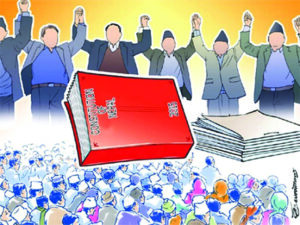 After the election, Dr K. I. Singh, the Samyukta Prajatantra Party leader, filed a case at the Supreme Court against the election result charging a massive rigging. When he lost the case, he said he lost it due to the justices affiliated with the Nepali Congress Party. That was his version. The Supreme Court was at Ratna Park at the location of the present police office there. The old building is no more there.
One year and a few months after the government was formed, King Mahendra dissolved the Parliament and took power in his hand with a speech of his reasons for taking action on 15 December. For which his opponents call it a royal coup and his admirers call it a historic step. Though Prime Minister Koirala was a praiseworthy, learned, knowledgeable politician, the party’s government in power was certainly not free of nepotism and favouritism as of the country’s present-day. For the Nepali Congress party and its leaders and followers, everything was going in the right direction. For others, everything was in a mess. People were not happy with the government. The other parties also were not pleased with the government. There was also a grumbling faction of some leaders within the government party.
It seemed the King thought the multiparty system was the leading cause of the struggle between the parties and between the leaders and followers of the party within the party. He also thought the general people’s rights and welfare would be neglected in the party system as they always would give priority only to their followers. He felt that the system would not be a sound system for its development as the strife and struggles would permanently block the action. The then political picture was somewhat like the present political picture of the country. So the King introduced the Panchayat System, the partyless political system with the elected Parliament, and the elected government. It was an excellent system to develop the country by staying away from party politics and struggles. The King nicely managed his power and prestige in it, which was natural as he made it.
It seemed the revolt Nepali Congress party leaders Dr Tulsi Giri and Bishwabandhu Thapa were the architect and leading supporters of this system. But as the system was introduced after throwing out its government, the Nepali Congress party people did not show any interest in joining it.
On the other hand, the government also seemed to look at them as the system’s enemies. Similarly, the young educated people of then like us did not show their interest in it. They considered themselves wise and progressive to think that the King was the person of the undemocratic institution and the party leaders were the person of the democratic organization. They had the impression that the King introduced that system to be himself more powerful. I, too certainly, felt like that. That was their thinking attached to the age – right or wrong. I vividly remember that the schools and colleges’ failure and dropouts who had no caliber to do any good work joined the panchayats initially and became the members, chairman of village and district panchayats. Similarly, the government showed some soft corner to the communists to have help and participation against Congress. I think it gave the communists an excellent opportunity to organize and expand their organization secretly. It was a truth that the then government had a hard corner to the Congress and the soft corner to the communist. I assume that is also why the rise of the communists in the country is now the party with no significant representation in 1959 with just four seats in the Parliament. D.P. Adhikari, Kamal Raj Regmi, Dr Kesharjung Rayamajhi, and many other communist leaders joined it. Later, Nepali Congress top leaders Rudra Prasad Giri, Parshunarayan Chaudhary, Shreebhadra Sharma Khanal, and many others joined it. But the system became an organization and center of mostly uninterested people who joined and stayed there to fulfill their interests rather than working for the nation and the people. Despite this, it showed remarkable results in the development of the country’s infrastructure – roads, communication, health, education, commerce, industry, culture, etc., under the King’s direct leadership as there was no struggles and fight between the parties and there was no protest what we see these days. If the system was accepted by all the politicians, including the banned Nepali Congress party, and if the system was reformed with the needs of the time, it could have been a suitable system for the country. I feel it now. That time, my thinking was different because of my weakness and experience. I was never in politics — directly or indirectly. I always try to speak my conscience.
We lost the Panchayat System in 1990 following the people’s revolution. After that, we introduced multiparty democracy. Again with the revolution of 2006, we threw our monarch from it. Now we have multiparty democracy with the republic, without the King. We have been experiencing a multiparty system for 30 years. But we are in the state of the same multiparty condition which King Mahendra concluded not to be fruitful for the country and its people 60 years ago with his observation and reasons. Since its inception, we have been experiencing fights between the parties and struggles between the party’s leaders and followers. Due to it, we have experienced many times the dissolve of the Parliament and the midterm election.
We have wasted billions of rupees on it. We hardly share good governance. The party government is always self-centred and worked only for itself and its group and followers. The fundamental rights, civil rights, human rights, and many other beautiful rights mentioned in the constitution and the laws are only in the paper, not in life. Our development is standstill. Corruption is becoming like a way of life. It is an open secret. The work is done nowhere – land office, tax office, municipality office to ministers without giving and taking – immense amount or small amount under the table Running life is becoming hard for the general public. The price of food, education, health is beyond the capacity of ordinary people. At present also we are facing a terrible political problem with the struggle between Prime Minister Oli and the leaders Prachanda and Nepal. Now all the people know the horrible situation of the country. We are in a state of the Mahabharata Yuddha. People are divided into Pandavas and Kauravas. Lakhs and lakhs of people are going after their leaders to protest and show the rally’s strength as the Tibetan sheep’s and goats follow the Tibetan Lama even the time taken them to the sale for sacrifice.
If the God of righteousness exists and King Mahendra had done good deeds for this country and its people, he must be living peacefully in heaven. Even if he is there, he will not come to retake power to rule this country. It is sure. Now we have a republic. So his decedent also is not leading the nation. In this context, no one needs to be scare of confessing any truth and giving some due credit to King Mahendra for his well thought about the political system. From our 60 years of experience, including King Mahendra’s period and the present struggle between the parties and leaders, we must admit that we are not worthy of a multiparty system which is making us like street dogs fighting each other rather than working for the development of the country and the welfare of the people. Why do we not accept it honestly in the name of God? Why do we not adopt the constitution and the system suitable to us?
If we study our constitution’s history, we see we have not only one or two constitutions; we have many constitutions – 1948, 1951, 1959, 1962, 1990, 2007, 2015. We are rich in the constitution than the USA and many other European countries. If we compare our standard of living and life, development with other countries we see we are far behind compared with developing countries. We see our country’s growth in the constitution and the decadence in development. That is true. So, we should not look for a new constitution as we are already rich in it. Instead of doing it if we all agree and select the one constitution among all the constitutions we already have, the Panchayat constitution may be an excellent selection for our standards and needs if we do not disgust it just thinking that King Mahendra introduced it. Of course, you can reform it to your liking with additions and omissions according to our present condition and needs – republic or constitutional monarchy, powerful president system or powerful prime minister system, etc. If we all become Nepalbadi and forget all the isms and foreign political philosophers and determine to establish our political system suitable to us, we can easily do it. Leave dogma of socialism or communism, have courage, and think it over. Establish a system of justice and development. That is enough for the country. It could make the right road for the country’s development not spoiling our cordial relationship in the name of your party and my party.
The writer can be reached at: narayanshanti70@gmail.com

Login to add a comment